







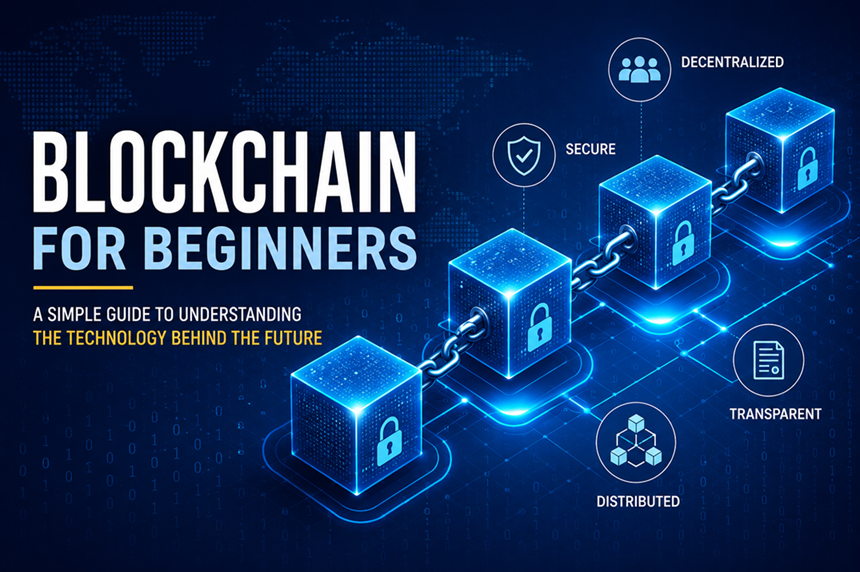
Blockchain has become one of the most discussed technologies in modern computing. It powers cryptocurrencies such as Bitcoin. However, blockchain is much broader than cryptocurrency. It is a method of recording and sharing information across a network. Blockchain for Beginners: A Simple Guide to Understanding Blockchain Technology explains how records are kept resistant to unauthorized changes.
For beginners, Blockchain for Beginners: A Simple Guide to Understanding Blockchain Technology can initially seem complicated. It explains how databases, cryptography, networking, and consensus mechanisms fit together. The basic idea is straightforward: participants share a digital ledger and follow predefined rules.
This guide explains blockchain in simple language, including how it works, its main components, practical applications, benefits, limitations, and how beginners can start learning the technology.
What Is Blockchain?
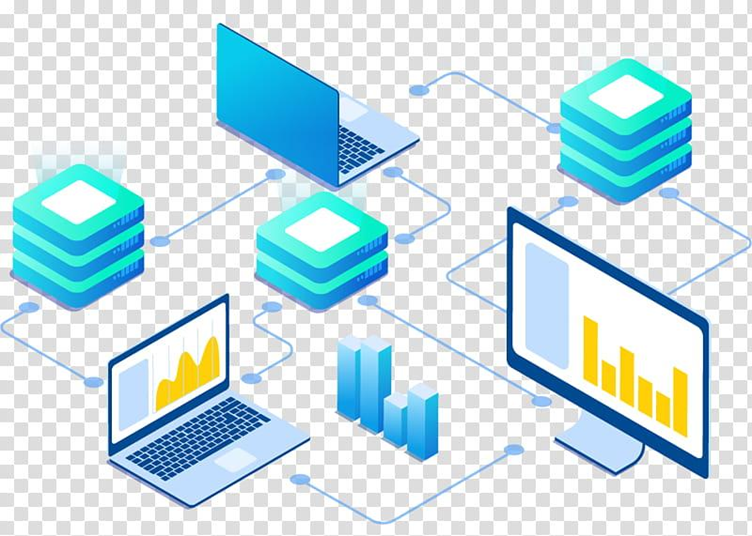
A blockchain is a type of distributed digital ledger. Instead of keeping transaction records in one central database, copies of the ledger can be maintained across multiple computers, known as nodes.
The records are grouped into blocks. Each block is photographically linked to the previous block, creating a chronological chain.
A useful analogy is a shared digital notebook. Imagine that thousands of people have copies of the same notebook. When a new entry is accepted, the network updates its copies according to agreed rules. If someone attempts to secretly change an earlier entry, the inconsistency can be detected.
Importantly, blockchain is not automatically “unshockable” or perfectly immutable. A better technical description is tamper-evident and tamper-resistant. The exact security properties depend on the blockchain’s design, consensus mechanism, implementation, and network participants.
How Does Blockchain Work?
Although individual blockchain networks differ, a simplified transaction process looks like this:
1. A Transaction Is Created
A participant initiates an action, such as transferring a digital asset or submitting information to a blockchain application.
2. The Transaction Is Broadcast
The transaction is distributed to participating nodes on the network.
3. The Network Validates It
Nodes use the blockchain’s rules and consensus mechanism to determine whether the transaction is valid.
Different networks use different approaches. Bitcoin, for example, uses Proof of Work, while other networks use mechanisms such as Proof of Stake.
4. Transactions Are Grouped Into a Block
Valid transactions can be organized into a new block. Depending on the blockchain, the block contains transaction information, timestamps, cryptography information, and other metadata.
5. The Block Is Added to the Chain
Once the network reaches the required consensus, the new block becomes part of the blockchain.
6. The Ledger Is Updated
Participating nodes update their copies according to the network’s protocol.
This combination of cryptography, distributed storage, and consensus is what gives blockchain its distinctive characteristics.

Key Components of Blockchain
Blocks
A block is a container for a group of records. Its structure varies between blockchain systems, but commonly includes transaction data and information linking it to previous records.
Hashes
A cryptography hash is a mathematical representation of data. If the underlying data changes, its hash generally changes as well.
Hashes help connect blocks and make unauthorized modifications easier to detect.
Nodes
Nodes are computers participating in a blockchain network. Depending on the network and node type, they may store blockchain data, validate transactions, relay information, or perform other network functions.
Consensus Mechanisms
Consensus mechanisms provide rules for reaching agreement about which transactions should be accepted and what the current state of the blockchain should be.
Common examples include Proof of Work and Proof of Stake.
Cryptography Keys
Blockchain systems commonly use public-key cryptography. Users may have a public address for receiving assets and a private key used to authorize certain actions.
Protecting private keys is critical because losing or exposing them can result in loss of control over associated assets.
Blockchain vs. Traditional Databases
Blockchain is not automatically better than a traditional database.
A conventional database can be faster, easier to manage, and more efficient when a trusted organization controls the system.
Blockchain becomes more interesting when multiple parties need to coordinate around a shared record and there is a reason to reduce dependence on a single central database or administrator.
For example, several independent organizations participating in a supply chain may benefit from sharing a verifiable record of product movements rather than maintaining completely separate records.
The right question is therefore not “Can blockchain be used?” but rather “Does blockchain solve a specific problem better than available alternatives?”
Types of Blockchain
Public Blockchains
Public blockchains are generally open networks in which participation is not restricted to a single organization.
Bitcoin and Ethereum are well-known examples.
Private or Permissioned Blockchains
Permissioned systems restrict participation or certain activities to approved users or organizations.
They can be useful in business environments where participants need shared records but also require greater control over access and governance.
Consortium Networks
A consortium blockchain can be governed by multiple organizations rather than one central entity. This model can be considered when several businesses need to collaborate around shared information.
Real-World Applications of Blockchain
Cryptocurrency and Digital Payments
Cryptocurrency remains the most recognizable blockchain application. Blockchain provides the distributed ledger on which transactions can be recorded and verified.
However, cryptocurrency and blockchain should not be treated as synonyms. Cryptocurrency is an application of blockchain technology, not blockchain itself.
Supply Chain Management
Blockchain can provide a shared record of events involving products as they move through a supply chain.
For example, manufacturers, distributors, and retailers could use a shared system to record selected events such as production, shipment, and delivery.
The technology does not automatically guarantee that the original information is truthful, however. If inaccurate information is entered into a blockchain, the blockchain can preserve that inaccurate information very effectively.
Smart Contracts
Smart contracts are programs deployed on blockchain networks that can execute predefined logic when specified conditions are satisfied.
They can support applications involving digital assets, decentralized finance, automated agreements, and other programmable transactions.
Digital Identity and Records
Blockchain-based systems can potentially support verifiable credentials, identity-related records, and other forms of digital verification.
The design must carefully consider privacy because putting sensitive personal information directly onto a permanent or widely replicated ledger may create unnecessary risks.
Asset Tracking
Blockchain can be used to represent or track certain digital or physical assets, depending on how the system is designed.
This can be useful when multiple organizations need a common record of ownership, transfers, or status.
Advantages of Blockchain
Blockchain can offer several potential benefits:
- Shared records: Multiple participants can work from a common ledger.
- Tamper evidence: Cryptography linking makes unauthorized changes detectable.
- Auditability: Blockchain records can provide a traceable history of transactions.
- Reduced reconciliation: Organizations may spend less effort comparing separate databases.
- Programmability: Smart contracts can automate predefined processes.
- Resilience: Distributed architectures can reduce dependence on a single database location.
The actual benefits depend heavily on implementation. Blockchain should not be treated as a universal solution for security, transparency, or efficiency.
Limitations and Challenges
Blockchain also has important limitations.
Scalability
Some blockchain networks have limited transaction throughput compared with centralized database systems. Scaling while maintaining security and decentralization can be technically challenging.
Energy Consumption
Energy requirements vary significantly between blockchain designs. Proof-of-Work systems can require substantial computational resources, while other consensus mechanisms can have very different energy profiles.
Complexity
Blockchain introduces new concepts such as wallets, private keys, consensus mechanisms, smart contracts, and network fees. Poorly designed systems can be difficult for users to understand and operate safely.
Privacy
Transparency can be valuable, but it can also create privacy concerns. Blockchain designers must carefully determine what information belongs on-chain and what should remain off-chain.
Governance
Blockchain networks still require rules, software development, maintenance, upgrades, and governance. Decentralization does not mean that governance disappears.
Blockchain Security: What Beginners Should Know
One common misconception is that blockchain makes everything secure automatically.
Blockchain can provide strong cryptography and distributed mechanisms, but applications built around blockchain can still contain vulnerabilities. Smart-contract bugs, compromised private keys, fraudulent websites, insecure wallets, and poorly designed applications can create serious risks.
A practical beginner rule is simple: understand the technology before transferring valuable assets or interacting with unfamiliar blockchain applications.

How to Start Learning Blockchain
Beginners do not need to become cryptography experts immediately.
Start by learning these concepts in order:
- Understand distributed ledgers and databases.
- Learn blocks, hashes, transactions, and nodes.
- Understand public and private keys.
- Study Proof of Work and Proof of Stake.
- Learn how Bitcoin uses blockchain.
- Explore Ethereum and smart contracts.
- Experiment with blockchain development tools using test networks rather than valuable assets.
- Read technical documentation and security research from reputable sources.
A useful learning strategy is to build a small conceptual project—for example, a simple ledger that links records using hashes. This demonstrates the basic blockchain structure without requiring cryptocurrency.
Conclusion
Blockchain is best understood not as a synonym for cryptocurrency, but as a technology for maintaining shared, photographically linked records across a network.
Its value comes from combining distributed data, cryptography, consensus, and programmable logic. These characteristics can be useful in financial systems, supply chains, digital assets, identity solutions, and other applications where participants need reliable coordination around shared records.
At the same time, blockchain is not a universal replacement for traditional databases. Scalability, privacy, governance, energy consumption, usability, and security remain important considerations. For beginners, the best starting point is to understand the underlying technology rather than focusing only on cryptocurrency prices or hype. Once the fundamentals are clear, concepts such as smart contracts, decentralized applications, tokens, and Web3 become much easier to understand.


