







Procrastination is something almost everyone experiences at some point. A task may be important, yet we still find ourselves checking social media, organizing our desk, watching another video, or telling ourselves that we will “start tomorrow.” The problem is not always a lack of time or ability. Psychological research increasingly shows that procrastination can involve how we respond to uncomfortable emotions such as boredom, anxiety, frustration, or self-doubt.
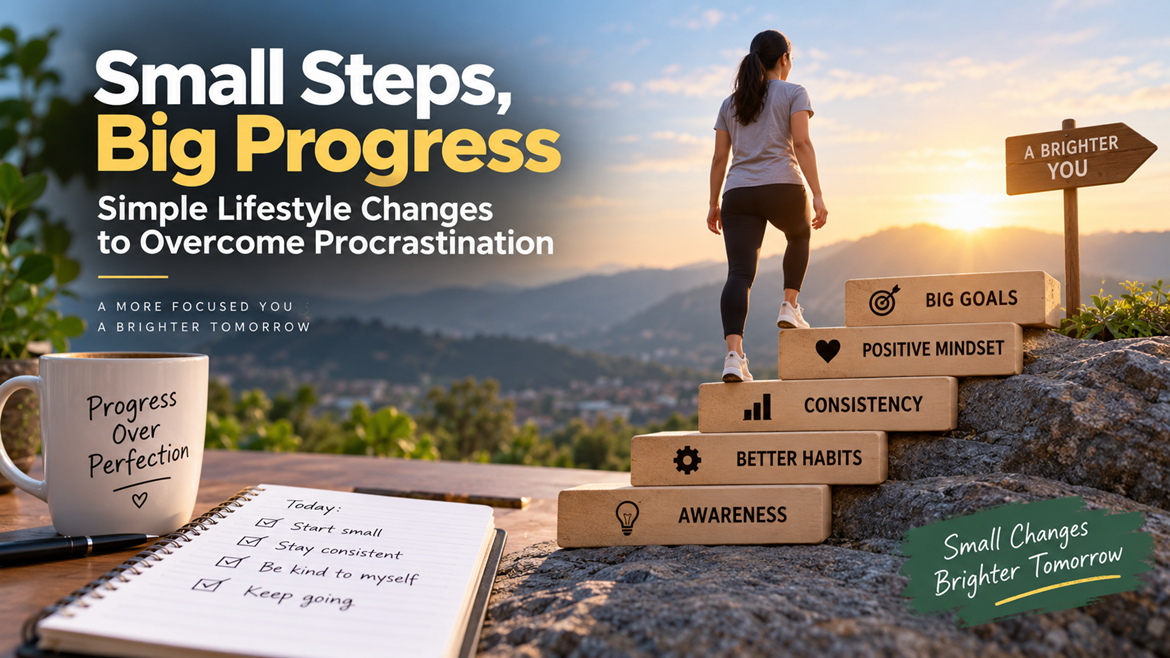
The good news is that overcoming procrastination does not necessarily require a dramatic transformation. Small, practical changes to daily routines can make important tasks easier to begin and easier to continue.
Instead of waiting for perfect motivation, the goal is to create an environment and routine in which taking the next step becomes simple.
What Is Procrastination?
Procrastination is the unnecessary and voluntary delay of an intended task despite knowing that the delay may have negative consequences.
This distinction matters because procrastination is not the same as taking a deliberate break, changing priorities, or deciding that a task is no longer important.
For example, postponing a meeting because of an emergency is not procrastination. Spending two hours scrolling through social media while repeatedly thinking about an important report you intended to write is much closer to it.
Research discussed by the American Psychological Association suggests that emotional regulation plays an important role. People may postpone a task partly because avoiding it provides temporary relief from unpleasant feelings.
That temporary relief, however, can create a cycle:
Uncomfortable task → avoidance → temporary relief → increased pressure → more discomfort → further avoidance
Breaking this cycle often starts with making the first action smaller.
Why Small Steps Work Better Than Huge Resolutions
A common mistake is trying to eliminate procrastination through ambitious plans.
Someone who has been avoiding exercise might suddenly decide to exercise for an hour every morning. A person behind on work may plan to complete an entire project in one weekend.
Such plans can look motivating on paper but may create another psychological barrier: the task feels too large to begin.
A more practical approach is to reduce the starting requirement.
Instead of:
“I need to finish this entire report.”
Try:
“I will open the document and write the first three sentences.”
Instead of:
“I need to completely reorganize my life.”
Try:
“I will spend 10 minutes planning tomorrow.”
Breaking a task into manageable actions is consistent with practical strategies recommended by psychologists and productivity experts. The APA has also highlighted the usefulness of starting with relatively short periods of focused work and gradually building consistency.
1. Use the Five-Minute Starting Rule
When a task feels overwhelming, commit to doing it for just five minutes.
The objective is not necessarily to finish the task. It is to overcome the resistance to starting.
For example:
- Open the book and read one page.
- Write the first paragraph of an article.
- Wash five dishes.
- Walk for five minutes.
- Reply to one important email.
- Organize one small section of your workspace.
After five minutes, you can decide whether to continue.
Often, beginning changes how difficult the task feels. Forbes has similarly highlighted short, measurable actions as a practical way to reduce the psychological barrier to getting started.
Why This Helps
The phrase “finish the project” creates a much larger mental demand than “work on the project for five minutes.”
The smaller commitment reduces the pressure surrounding the starting point.
2. Turn Large Goals Into Micro-Tasks
Large goals are useful for direction, but they are often poor instructions for daily action.
“Start a blog” is a goal.
“Choose three possible article topics” is an action.
“Get fit” is a goal.
“Put on my walking shoes and walk for 10 minutes” is an action.
“Learn a new skill” is a goal.
“Watch one introductory lesson” is an action.
A useful question is:
What is the smallest useful action I can take right now?
Once you identify that action, focus on completing it rather than thinking about the entire project.
3. Replace Vague Intentions With Specific Plans
“I’ll do it later” is not a plan.
A more effective approach is to decide what you will do, when you will do it, and where it will happen.
For example:
- “At 7:00 p.m., I will spend 15 minutes reviewing my notes at my desk.”
- “After breakfast, I will answer the most important email.”
- “At 9:30 a.m., I will work on my report for 20 minutes.”
Psychology research on implementation intentions supports the use of specific “if-then” plans. The basic structure is:
If situation X happens, then I will do Y.
For example:
“If I finish breakfast, then I will spend 15 minutes working on my priority task.”
This converts a general intention into a concrete behavioral cue.
4. Create a Procrastination-Friendly Morning Routine
Your daily environment can either make action easier or make distraction easier.
A simple morning routine might include:
- Write down the three most important tasks.
- Choose one priority task.
- Decide the first physical action required.
- Remove obvious distractions.
- Start with a short focused work period.
Avoid creating a massive morning checklist. The purpose is to establish direction, not to create another source of pressure.
For example, instead of writing “work on business,” write:
“Draft the introduction for the business proposal.”
Specificity makes the next action clearer.


5. Reduce Digital Distractions
Phones, notifications, social media, and constantly changing online content can make it harder to stay with an uncomfortable task.
You do not necessarily need to eliminate technology. Instead, create boundaries around it.
Try:
- Turning off nonessential notifications.
- Keeping your phone away during focused work.
- Closing unnecessary browser tabs.
- Using website or app limits when appropriate.
- Checking messages at predetermined times.
- Keeping entertainment apps away from your primary work environment.
The objective is not perfect concentration. It is reducing unnecessary opportunities to escape from the task.
6. Design Your Environment for Action
Motivation is unreliable. Your environment can provide more consistent cues.
If you want to read regularly, keep a book somewhere visible.
If you want to exercise in the morning, prepare your clothes the night before.
If you need to study, prepare your desk before your planned study session.
If you need to write, keep the document ready instead of spending the first 10 minutes deciding what software or materials to use.
Think of this as reducing friction.
The easier it is to begin, the less opportunity there is for procrastination to take over.
7. Stop Waiting for Perfect Motivation
One of the most common procrastination traps is:
“I’ll start when I feel motivated.”
Motivation can certainly help, but action does not always have to wait for motivation.
A better approach is:
Start small → experience progress → build momentum → continue.
For example, someone who does not feel like exercising can commit to putting on their shoes and walking for five minutes.
Someone who does not feel like studying can read one page.
Someone who feels intimidated by writing can create a rough outline.
The goal is to separate starting from feeling ready.
8. Use Short, Protected Work Sessions
Instead of scheduling several hours of vague productivity, create a short period during which one task receives your full attention.
Start with 15–25 minutes if that feels manageable.
During that period:
- Choose one task.
- Remove obvious distractions.
- Set a timer.
- Work only on that task.
- Take a short break afterward.
The APA has recommended beginning with manageable periods of work and protecting that time from interruptions when building consistent work habits.
Over time, you can adjust the length according to your responsibilities, energy, and the nature of the task.
9. Make “Good Enough” Your Starting Standard
Perfectionism can fuel procrastination.
If you believe the first attempt must be excellent, starting becomes threatening. You may spend more time thinking about how to do something perfectly than actually doing it.
A healthier strategy is to separate creating from improving.
For example:
First session: Write a rough draft.
Second session: Improve the structure.
Third session: Edit language and details.
This approach gives you something concrete to improve.
The first version does not need to be the final version.
10. Practice Self-Compassion Instead of Self-Criticism
After procrastinating, people sometimes respond with harsh self-judgment:
“I am lazy.”
“I never finish anything.”
“I have wasted the whole day.”
Such thoughts rarely provide a useful action plan.
Research discussed by psychologist Fuschia Sirois emphasizes the relationship between procrastination, difficult emotions, and self-compassion.
Instead of attacking yourself, ask:
“What made this task difficult to start, and what can I change next time?”
Perhaps the task was unclear. Maybe it was too large. Maybe your environment contained too many distractions. Perhaps you were worried about making a mistake.
Understanding the obstacle gives you something you can actually change.
11. Build a Simple Evening Reset
A five-minute evening review can make the following day easier.
Write down:
- What did I complete today?
- What remains unfinished?
- What is tomorrow’s most important task?
- What is the first action required?
- When will I do it?
For example:
Tomorrow’s priority: Finish article introduction.
First action: Open the document and write the headline.
Start time: 9:00 a.m.
This removes some decision-making from tomorrow morning.
12. Measure Progress, Not Perfection
Progress does not mean completing every task every day.
A more useful measure is whether you are becoming better at returning to important tasks.
If you previously avoided a task for a week and now begin it within a day, that is progress.
If you previously needed three hours to start and now begin within 15 minutes, that is progress.
If you previously abandoned a task after one interruption and now return to it, that is progress.
The objective is not to become a person who never procrastinates. Occasional delay is normal. The objective is to make unnecessary delay less frequent and less disruptive.
A Simple 7-Day Anti-Procrastination Challenge
Try this practical experiment for one week.
Day 1: Identify One Delayed Task
Choose one task you have been avoiding.
Day 2: Shrink It
Break it into the smallest useful action.
Day 3: Schedule It
Choose a specific time and place.
Day 4: Remove One Distraction
Turn off one source of interruption.
Day 5: Use a 15-Minute Session
Work on the task without expecting to finish it.
Day 6: Review the Barrier
Ask what made starting difficult and adjust your environment or plan.
Day 7: Repeat What Worked
Keep the strategy that made starting easier.
The purpose of the challenge is not to create another demanding productivity system. It is to discover which small changes work best for your circumstances.
When Procrastination May Need More Attention
Occasional procrastination is common. However, persistent difficulty initiating or completing important tasks can sometimes occur alongside broader problems involving mood, anxiety, attention, sleep, stress, or other aspects of wellbeing.
If procrastination is seriously interfering with education, employment, relationships, or everyday responsibilities, consider speaking with a qualified mental-health or healthcare professional rather than relying solely on productivity techniques.
Conclusion: Small Actions Create Sustainable Progress
Overcoming procrastination is rarely about discovering one magical productivity trick. It is about repeatedly making useful action easier than avoidance.
Start with five minutes.
Break large projects into smaller actions.
Create specific plans.
Reduce distractions.
Prepare your environment.
Permit yourself to produce imperfect first attempts.
And when you fall back into old patterns, examine what happened instead of treating the setback as proof that you cannot change.
Big progress is often the accumulated result of small decisions made consistently.
You do not need to finish everything today.
You simply need to make the next useful step easier to take.


