







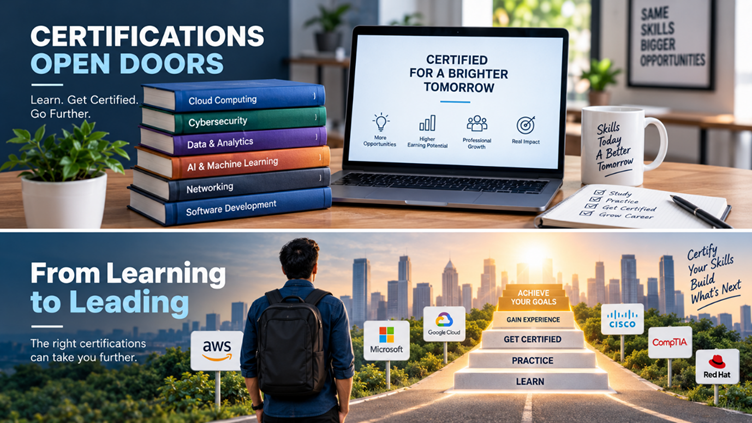
Technology changes quickly, but one thing remains valuable: demonstrable skills. Tech certifications can help professionals validate their knowledge, stand out during hiring, transition into new technology roles, and keep their skills aligned with industry platforms.
However, not every certification carries the same value for every professional. The best choice depends on your career goal, existing experience, target technology, and the type of organization you want to work for.
This guide explores the tech certifications that matter most, from cloud computing and security to networking, data, AI, and software development.
Why Tech Certifications Still Matter
A certification shouldn’t be viewed as a substitute for real-world experience. Instead, it should complement practical skills.
A strong certification can demonstrate that you have studied a defined body of knowledge and successfully passed an assessment. Many major technology providers now organize certifications around specific job roles and skill levels.
For example, Microsoft offers credentials ranging from Fundamentals through Associate, Expert, and Specialty levels, while AWS organizes certifications into Foundational, Associate, Professional, and Specialty categories.
For employers, this makes certifications particularly useful as an initial signal when evaluating candidates.
How to Choose a Tech Certification
Before paying for an exam, ask five questions:
- What job do I want?
- What technologies does that job use?
- Is the certification recognized by employers in my target market?
- Does the exam test practical, job-relevant knowledge?
- Can I combine the certification with a portfolio or real project?
The last point is particularly important. A candidate with a certification plus evidence of actually building, deploying, securing, or analyzing something is generally in a stronger position than someone who simply lists multiple certificates.
1. Cloud Computing Certifications
Cloud computing remains one of the most important certification areas because organizations use platforms such as AWS, Microsoft Azure, and Google Cloud for infrastructure, applications, data, and AI workloads.
AWS Certifications
AWS offers certifications across several levels. For beginners, AWS Certified Cloud Practitioner provides foundational knowledge of AWS and cloud computing. More technical professionals can consider certifications such as AWS Certified Solutions Architect – Associate, AWS Certified Developer – Associate, AWS Certified CloudOps Engineer – Associate, or specialized credentials.
Best suited for:
- Cloud engineers
- Solutions architects
- Developers
- DevOps professionals
- IT administrators
- Cloud security specialists
A useful progression could be:
Cloud fundamentals → Associate certification → hands-on AWS projects → Professional/Specialty certification
AWS also requires certifications to be maintained or re certified, helping credentials remain aligned with evolving cloud technologies.
Explore AWS Certification paths
Microsoft Azure Certifications
Microsoft’s certification portfolio is particularly relevant for professionals working in Microsoft-heavy environments.
Azure Fundamentals (AZ-900) is designed as a beginner-level introduction to cloud concepts and Azure services. More experienced professionals can pursue role-based credentials such as Azure Administrator Associate or Azure Solutions Architect Expert.
For example, an IT administrator managing virtual machines, networking, identity, storage, and monitoring could build toward the Azure Administrator Associate credential.
Google Cloud Certifications
Google Cloud offers Foundational, Associate, and Professional certifications. Professional-level credentials are aimed at advanced technical roles involving design, implementation, and management of Google Cloud technologies.
They can be particularly relevant to professionals working in:
- Cloud engineering
- Data engineering
- Machine learning
- Cloud architecture
- DevOps

2. Security Certifications
Security is another major certification category, but the right credential depends heavily on experience.
CompTIA Security
CompTIA Security is commonly used as a foundational security credential. It covers areas such as security concepts, threats, vulnerabilities, risk management, and security operations.
It can be a sensible starting point for someone moving from general IT toward security.
CRISP
For experienced security professionals, CRISP (Certified Information Systems Security Professional) is a more advanced credential associated with broad information-security knowledge and professional experience.
It is better suited to professionals progressing toward positions involving security architecture, management, governance, and risk rather than someone just entering IT.
Specialized Security Certifications
Experienced security professionals may also consider credentials focused on areas such as:
- Cloud security
- Security management
- Auditing
- Penetration testing
- Incident response
- Identity and access management
The key lesson is simple: don’t choose an advanced security certification simply because it sounds prestigious. Choose one that matches your actual responsibilities and experience.
3. Networking Certifications
Networking remains fundamental even as infrastructure moves into the cloud.
Cisco Certifications
Cisco certifications can be particularly useful for networking professionals working with enterprise networking environments.
The Cisco Certified Network Associate (CCNA) is widely associated with foundational networking knowledge, including network fundamentals, IP connectivity, security fundamentals, and automation concepts.
For experienced network engineers, advanced Cisco certifications can support progression into more specialized roles.
Networking knowledge is also valuable beyond traditional network-engineering jobs. Cloud engineers, security professionals, DevOps engineers, and systems administrators all benefit from understanding networking fundamentals.
4. IT Infrastructure and Systems Certifications
Infrastructure certifications remain useful for professionals responsible for servers, operating systems, enterprise environments, and IT operations.
Certifications from organizations such as CompTIA and Red Hat can help validate knowledge across areas including:
- Linux administration
- IT infrastructure
- Troubleshooting
- Enterprise systems
- System administration
For example, someone working toward a Linux administration career could combine a Linux-focused certification with practical experience managing virtual machines, users, permissions, networking, storage, and automation.
The practical component matters. Build a home lab, use virtual machines, or work with cloud-based Linux instances while preparing for the certification.
5. Data and Analytics Certifications
Data has become central to business decision-making, making data-related credentials increasingly relevant.
Depending on your career path, consider certifications or credentials covering:
- Data analytics
- Database administration
- Data engineering
- Business intelligence
- Cloud data platforms
- Machine learning
Microsoft, AWS, and Google Cloud all offer credentials connected to data and analytics roles. AWS, for example, currently offers the AWS Certified Data Engineer – Associate, which validates skills related to data models, data life cycles, and data quality.
For an aspiring data professional, certification should ideally be accompanied by projects involving SQL, dashboards, data cleaning, visualization, or data pipelines.
6. AI and Machine Learning Certifications
Artificial intelligence is rapidly changing technology roles, but AI certification should be approached strategically.
Rather than collecting generic AI certificates, focus on credentials that support a specific career objective.
Potential paths include:
AI fundamentals → Python/data foundations → machine learning → cloud AI/ML → specialized projects
AWS currently offers AWS Certified AI Practitioner at the foundational level and AWS Certified Machine Learning Engineer – Associate for professionals implementing and maintaining AI/ML solutions.
Microsoft and Google Cloud also offer AI-related credentials and learning pathways.
For AI careers, a GitHub portfolio containing working projects can be particularly valuable alongside certification.
7. Software Development Certifications
Certifications are somewhat less central to software development than they are to cloud, networking, or security.
For developers, employers often place significant emphasis on:
- Programming ability
- Problem-solving
- Git and version control
- Software architecture
- Testing
- Apish
- Databases
- Deployment
- Portfolio projects
Nevertheless, platform-specific certifications can be valuable for developers working extensively with cloud ecosystems.
For example, AWS’s Developer – Associate certification validates skills involving developing, testing, deploying, and debugging AWS-based applications.
The best approach is to pair a certification with demonstrable software.
Certification vs. Experience: Which Matters More?
The answer is both, but for different reasons.
A certification can help demonstrate structured knowledge. Experience demonstrates that you can apply that knowledge when requirements are unclear, systems fail, deadlines change, or business priorities conflict.
Consider two candidates:
Candidate A
- Five unrelated certifications
- No portfolio
- Limited practical experience
Candidate B
- One relevant certification
- Two years of hands-on experience
- Three documented projects
- Strong understanding of the target technology
For many technical positions, Candidate B may present the stronger overall profile.
This is why certifications should be treated as career accelerators rather than career replacements.
How to Make a Certification More Valuable
Build a Real Project
After learning a technology, build something with it.
For cloud computing, deploy a small application. For security, create a controlled lab environment. For data analytics, analyze a public dataset. For networking, build a virtual network.
Document What You Built
Create a short project write-up explaining:
- The problem
- Technologies used
- Architecture
- Your decisions
- Challenges
- Results
- What you would improve
This gives employers evidence beyond the certification badge.
Keep Certifications Relevant
Technology changes rapidly. Microsoft notes that eligible certifications can require annual renewal, while AWS certifications generally require periodic re certification.
Instead of collecting certificates indefinitely, periodically review whether your credentials still support your career direction.
A Practical Certification Road map
If You’re New to IT
Start with:
IT fundamentals → networking fundamentals → cloud fundamentals → entry-level specialization
If You Want a Cloud Career
Consider:
Cloud fundamentals → Associate-level cloud certification → hands-on cloud projects → advanced specialization
If You Want Security
Consider:
IT/networking fundamentals → Security or equivalent foundation → security projects → advanced security specialization
If You Want Data or AI
Consider:
Python/SQL → statistics and data fundamentals → data/AI certification → portfolio projects → specialization
If You’re Already Experienced
Don’t automatically start at the beginner level. Review the certification’s official exam objectives and determine whether your current knowledge matches the intended role and difficulty.
Final Thoughts
The tech certifications that matter most are not necessarily the ones with the biggest names or the longest lists of acronyms. Their value comes from relevance, credibility, current knowledge, and your ability to apply what you’ve learned.
Cloud certifications from AWS, Microsoft Azure, and Google Cloud can be valuable for cloud-focused careers. Security credentials can help demonstrate security knowledge, while networking, infrastructure, data, AI, and software-development certifications can strengthen specialized career paths.
The most effective strategy is to choose one certification aligned with a specific career goal, prepare using authoritative exam objectives, gain hands-on experience, and document real projects.
In a technology industry where tools constantly evolve, the strongest credential is ultimately not just a certificate—it is evidence that you can use your knowledge to solve real problems.


2 Comments
Pingback: Run DeepSeek & Llama 3 Locally with Ollama
Pingback: Open-Source AI vs GitHub Copilot: Full Comparison