







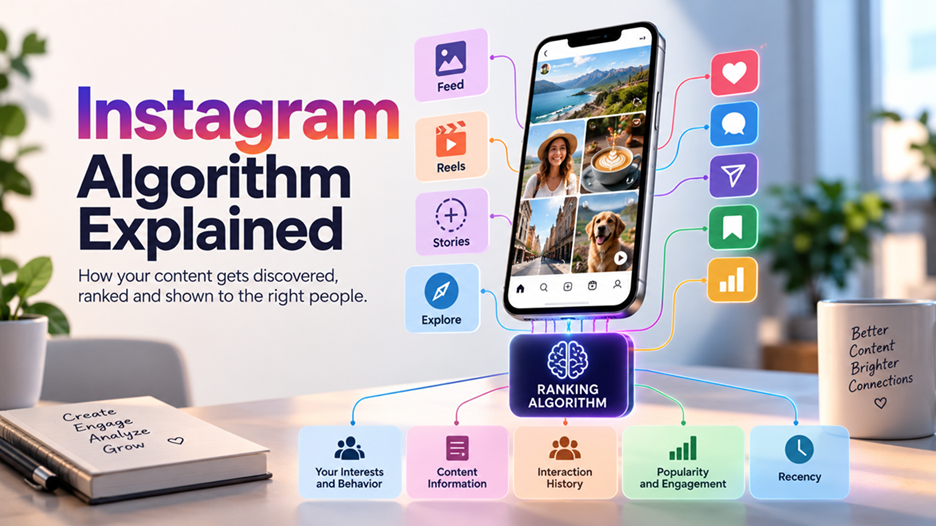
Instagram can feel unpredictable: one post reaches thousands of people while another, seemingly similar post barely gets noticed. The reason is not a single mysterious “Instagram algorithm.” Instagram uses multiple ranking systems that evaluate content, viewer behavior, relationships, and predicted interest to determine what appears in Feed, Reels, Stories, Explore, and Search.
Understanding these systems is more useful than chasing so-called “algorithm hacks.” Instagram’s ranking systems are designed to predict what each user is most likely to find valuable or interesting. Current guidance and industry analysis consistently point toward signals such as watch time, likes, sends/shares, interaction history, content relevance, and decency.
The practical lesson is simple: create content people genuinely want to watch, save, share, discuss, or revisit—and make it relevant to a clearly defined audience.
What Is the Instagram Algorithm?
The phrase “Instagram algorithm” is slightly misleading. Instagram uses multiple algorithms, classifiers, and ranking processes, with different systems responsible for different areas of the platform.
Feed, Stories, Reels, Explore, and Search don’t necessarily evaluate content in the same way. For example, Feed emphasizes relationships and interactions, while Reels and Explore are particularly important for discovering content from accounts a user doesn’t already follow.
At a high level, Instagram’s ranking process can be understood as:
- Collect eligible content
- Analyze content and user signals
- Predict what the user may find valuable
- Rank the available content
- Display the highest-ranked content
This happens extremely quickly and is personalized for each user.
The Main Signals That Influence Instagram Ranking
Instagram does not publish a simple formula such as “likes × 2 + comments × 3.” Instead, its systems consider many signals and use machine-learning models to predict likely user behavior.
1. Watch Time
For video content, especially Reels, watch behavior is extremely important.
If viewers consistently watch a Reel for a substantial portion of its duration, Instagram receives evidence that the content is holding attention. Rematches can provide another useful indication that the content is valuable or entertaining.
For creators, this means the first few seconds matter, but the rest of the video has to deliver on the opening promise.
Example:
Instead of beginning a cooking Reel with a long logo animation, a creator might immediately show the finished dish and say, “Here’s how to make this in 15 minutes.”
2. Likes
Likes remain an important ranking signal, particularly for content reaching people who already follow or interact with an account. Instagram’s Adam Mossier has identified watch time, likes, and sends as key signals for understanding content performance.
However, chasing likes alone can be misleading. A post can receive many likes without generating meaningful business results.
For example, a humorous meme might generate thousands of likes but produce fewer website visits than a highly practical carousel with fewer likes but many saves and shares.
3. Sends and Shares
Sharing is particularly valuable because it indicates that someone found the content worth passing to another person.
A useful post might be:
- Sent to a friend
- Shared to Stories
- Shared in a group conversation
- Saved for later reference
This is why content that solves a specific problem can outperform content designed simply to collect likes.
4. Comments and Conversations
Comments can indicate meaningful interaction, particularly when they lead to genuine discussion.
A post asking a relevant question can encourage conversation:
“Which productivity method has actually worked for you?”
But creators should avoid engagement bait that feels artificial or manipulative. The goal should be to start a useful conversation, not manufacture meaningless comments.
5. Interaction History
Instagram learns from what users do.
If someone regularly watches, likes, comments on, or messages an account, Instagram has stronger evidence that the account’s content may be relevant to that person.
This explains why two people can open Instagram at the same moment and see completely different feeds.
How Different Parts of Instagram Rank Content
Instagram Feed
The Feed is strongly influenced by relationships, previous interactions, content information, and decency.
Instagram considers signals such as:
- Whether you follow the creator
- How frequently you interact with that account
- The type of content you normally engage with
- How recently the post was published
- How other users are responding to the post
The objective is not simply to show the newest post first. It is to show the posts Instagram predicts you will find most relevant.
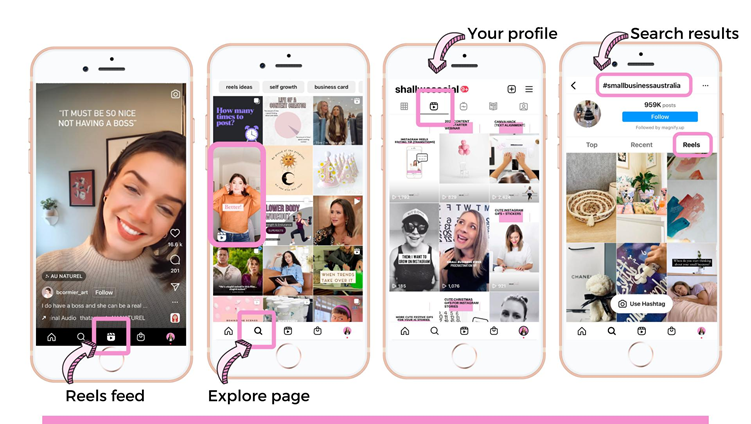
Instagram Reels
Reels are a major discovery mechanism.
Because users frequently encounter Reels from accounts they don’t follow, Instagram needs to predict whether an unfamiliar video will interest them.
Important signals include:
- Watch time
- Rematches
- Likes
- Sends
- Viewer interaction patterns
- Relevance to the user’s interests
A strong Reel therefore needs more than a trending audio track. It needs a clear concept and enough value or entertainment to hold attention.
Instagram Stories
Stories work differently from discovery-oriented surfaces.
They are particularly useful for maintaining relationships with an existing audience. Instagram considers signals such as how frequently someone watches your Stories, responds to them, or interacts with your account.
For businesses, this makes Stories useful for:
- Polls
- QA sessions
- Product demonstrations
- Behind-the-scenes content
- Announcements
- Community conversations
Instagram Explore
Explore is designed primarily for discovery.
It helps users find posts and accounts they don’t already follow, based on their interests and previous activity. Instagram’s Explore system uses multiple stages of machine learning to identify potentially relevant content and rank it according to predicted engagement.
For creators, Explore can provide substantial additional reach because the audience isn’t limited to existing followers.
Instagram Search
Search introduces another important concept: Instagram SEOUL.
Instagram considers the search text entered by the user alongside information such as usernames, bios, captions, hashtags, and locations. User activity and popularity signals can also influence results.
This means creators should naturally include relevant keywords in:
- Profile names
- Bios
- Captions
- On-screen text
- Alt text where appropriate
- Relevant hashtags
For example, a photographer specializing in wedding photography could naturally describe their profile and content around terms such as “wedding photographer,” “wedding photography,” and the locations they serve.
What the Instagram Algorithm Does Not Mean
There are several persistent myths about Instagram ranking.
“There is one secret algorithm.”
Not really. Instagram uses different ranking systems across different surfaces.
“More followers automatically means more reach.”
Follower count can provide a larger potential audience, but it doesn’t guarantee that every follower will see every post.
Relevance and predicted interest remain important.
“You need to post constantly.”
Posting more frequently is not automatically better. A high-volume strategy can actually become counterproductive if it causes content quality to decline.
A better approach is to establish a sustainable publishing schedule that allows enough time for research, production, testing, and community interaction.
“Hashtags are the secret to going viral.”
Hashtags can help categorize and discover content, but they aren’t a substitute for useful or compelling content. Instagram’s search system considers numerous signals beyond hashtags.
“The algorithm hates small accounts.”
There is no sound basis for treating follower count as a simple ranking switch. Discovery surfaces such as Reels and Explore can expose content beyond an account’s existing followers.
How to Create Content That Works With Instagram’s Ranking Systems
1. Start With the Audience’s Problem
Instead of asking:
“What should I post today?”
Ask:
“What does my audience need, want, or find entertaining today?”
A fitness creator could produce:
- “3 exercises for beginners”
- “Common squat mistakes”
- “A 15-minute home workout”
These topics provide a clear reason for someone to watch or save the content.
2. Make the Opening Count
For video, the opening should quickly communicate why the viewer should continue watching.
Weak opening:
“Hey everyone, welcome back to my channel…”
Stronger opening:
“If your Instagram Reels aren’t getting reach, check these three things first.”
The second immediately establishes relevance.
3. Create Savable Content
Think beyond entertainment.
Checklists, tutorials, templates, comparisons, recipes, educational carousels, and step-by-step guides can naturally encourage saves.
4. Give People a Reason to Share
Ask yourself:
“Who would someone send this to?”
If the answer is obvious, the content has stronger sharing potential.
For example, a post titled “5 Instagram mistakes small businesses should stop making” is naturally shareable among business owners and marketing teams.
5. Use Insights to Improve Decisions
Instagram analytics can help creators identify patterns.
Instead of focusing only on follower growth, examine metrics such as:
- Average watch time
- Reach
- Likes per reach
- Sends/shares
- Saves
- Profile visits
- Follows generated
- Website actions
A Reel with fewer total views but unusually strong saves or profile visits may reveal a valuable topic worth developing further.

A Practical Instagram Content Experiment
Suppose a skincare brand wants to determine what its audience prefers.
It could test three Reel concepts:
A: Product showcase
B: “3 skincare mistakes” educational video
C: Before-and-after routine explanation
Rather than declaring the winner based solely on views, the brand could compare watch time, likes per reach, sends, saves, profile visits, and conversions.
If Reel B produces fewer views than Reel A but significantly more saves and website visits, the brand has learned something valuable about audience intent.
This is a more reliable approach than searching for a universal “best time” or supposed algorithm trick.
SEOUL Best Practices for Instagram Content
Instagram increasingly functions like a visual search engine, so content should be understandable to both humans and the platform.
Use specific, descriptive language.
Instead of:
“Amazing tips you need to know!”
Try:
“5 Instagram SEOUL tips for small businesses”
The second communicates the topic immediately.
Also maintain consistency between your:
- Profile positioning
- Caption
- Visual content
- Keywords
- Hashtags
- Audience
This helps establish a clear topical identity.
The Best Strategy: Stop Trying to “Beat” the Algorithm
The most sustainable Instagram strategy isn’t about tricking the ranking system.
It is about understanding what the system is designed to accomplish: connect users with content they are likely to find valuable.
That changes the creator’s mindset.
Instead of asking:
“How do I make Instagram push my post?”
Ask:
“How can I make this post so useful, interesting, entertaining, or relevant that people naturally want to watch, interact with, save, or share it?”
That approach is more durable because individual ranking signals and platform features can change over time.
Conclusion
The Instagram algorithm is not a single switch that determines whether a post succeeds or fails. Instagram uses multiple ranking systems that evaluate content and user behavior differently across Feed, Reels, Stories, Explore, and Search.
The strongest fundamentals remain straightforward: understand your audience, create original and relevant content, earn attention quickly, encourage meaningful interaction, and use analytics to learn what works.
Creators who treat Instagram as a continuous learning process—rather than a game of secret hacks—are better positioned to build sustainable reach.
The algorithm will continue to evolve. Audience value is the part of the strategy that shouldn’t.


