







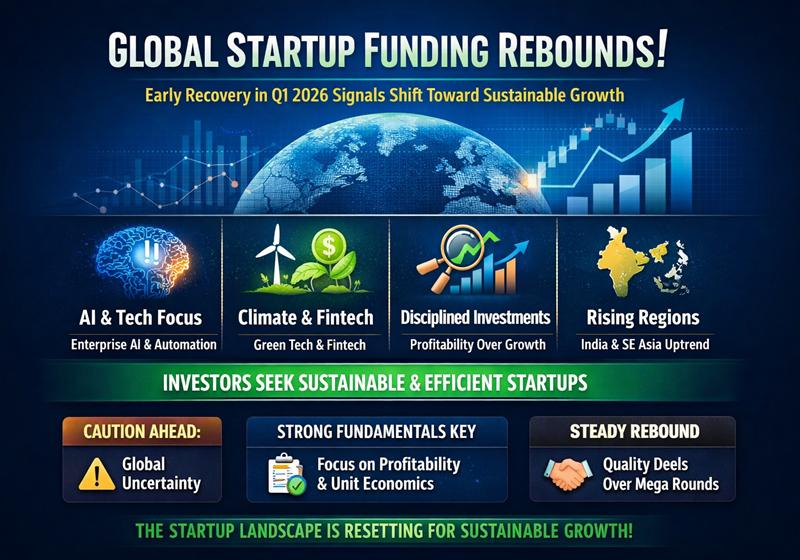
The startup funding landscape in 2026 is showing a striking combination of record capital deployment and greater investor selectivity. Venture capital has not disappeared; instead, it is becoming increasingly concentrated around companies with strong technology, measurable growth, defensible business models, and clear paths to scale.
Globally, startup investment reached a record $510 billion in the first half of 2026, according to Crunchbase—more than the $440 billion invested in 2025. However, this headline figure masks a major shift: a relatively small number of very large funding rounds account for a substantial share of total investment.
For founders, investors, and entrepreneurs, the key question is therefore no longer simply “Is venture capital available?” It is “Which startups are attracting capital, why are investors backing them, and what does this mean for the next generation of companies?”
Crunchbase’s H1 2026 Global Startup Funding Report
Global Startup Funding Reaches Record Levels
AI Is Driving a Large Share of Investment
Artificial intelligence remains the dominant theme in global venture capital. Crunchbase reported that OpenAI and Anthropic alone accounted for $217 billion, or approximately 43% of global startup funding in H1 2026. The concentration demonstrates how frontier AI companies are attracting exceptionally large rounds compared with traditional early-stage startups.
The trend did not emerge suddenly in 2026. OECD research found that AI companies accounted for 61% of global VC investment in 2025, worth approximately $258.7 billion.
This creates an important distinction between total funding growth and broad-based funding growth. The global market may be expanding, while many startups outside the hottest investment categories still face a competitive fundraising environment.
Large Rounds Are Reshaping the Market
Several recent transactions illustrate the scale of capital now available to established technology companies.
For example, AI code-review company CodeRabbit raised $143 million in August 2026, reaching a reported valuation of $1.5 billion. Reuters reported that the company serves more than 17,000 customers and conducts more than two million code reviews weekly.
AI software-development company Lovable also raised $400 million, reportedly doubling its valuation to $13.3 billion. Its strong recurring revenue growth demonstrates why investors are increasingly looking for evidence of commercial adoption alongside technological potential.
These deals do not mean every AI startup can command similar valuations. Rather, they show how investors are rewarding companies that combine technology with significant usage, revenue growth, and scalable markets.
India Startup Funding: More Money, Fewer Deals
India provides an especially interesting example of how the funding environment is changing.
Technology startups in India raised approximately $7.2 billion during H1 2026, representing a 12% year-over-year increase. At the same time, the number of funding rounds fell sharply to 652, down 43% from 1,149 rounds in H1 2025, according to Tracxn data reported by Business Standard.
This means India’s startup ecosystem is experiencing a form of funding concentration: aggregate investment is rising, but fewer companies are receiving capital.
What This Means for Founders
For startup founders, the numbers suggest that simply having a promising idea is unlikely to be sufficient.
Investors are increasingly examining:
- Revenue growth and quality
- Customer retention
- Gross margins
- Cash burn and runway
- Product-market fit
- Unit economics
- Competitive advantages
- Founder-market fit
- Scalability
- The potential path to an IPO or acquisition
In practical terms, a startup generating $1 million in recurring revenue with strong retention may attract more serious attention than a company with a much larger user base but weak monetization.
AI Funding Is Growing in India
AI is also becoming a major funding category within India’s startup ecosystem.
Indian AI startups attracted approximately $1.067 billion in H1 2026, compared with $802 million during the same period in 2025, according to Venture Intelligence data reported by The Economic Times.
Inc42 separately reported that the number of AI funding deals increased substantially during the first half of 2026, highlighting stronger investor interest in frontier technology and AI-focused businesses.
The opportunity extends beyond consumer chatbots. Investors are examining businesses working on:
- Enterprise AI
- AI agents
- Robotics
- Semiconductor technology
- AI infrastructure
- Cybersecurity
- Healthcare AI
- Industrial automation
- Financial technology
This is important because India’s AI opportunity is increasingly connected to real business applications, rather than AI being treated solely as a software feature.

Recent Indian Funding Examples
The latest Indian funding activity also demonstrates that investors are interested in businesses outside pure software.
In August 2026, electric mobility company Yulu raised $93 million through a combination of equity and debt. Reuters reported that the company plans to use the capital to expand its fleet from 50,000 to 200,000 two-wheelers and increase its presence from 12 to 20 cities.
The deal illustrates another important funding trend: investors can support companies with tangible operational expansion when the business demonstrates a credible path toward scale.
Why Investors Are Becoming More Selective
From Growth at All Costs to Efficient Growth
The startup market has increasingly moved away from the previous emphasis on rapid expansion regardless of profitability.
Investors now frequently ask:
How much does it cost to acquire a customer?
How long does that customer stay?
How much revenue does each customer generate?
Can the company grow without continuously increasing its cash burn?
These questions make unit economics increasingly important.
Bigger Checks Do Not Mean Easier Fundraising
The record global funding numbers can create the impression that fundraising has become easier. The data tells a more nuanced story.
When billions of dollars are concentrated into a small number of companies, thousands of other startups may still compete for limited investor attention.
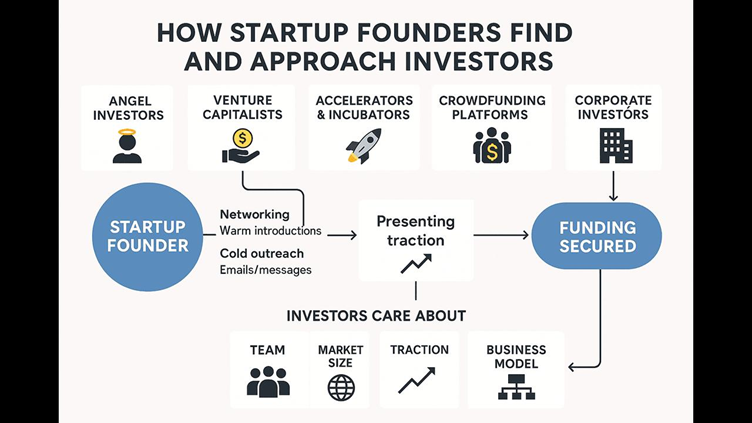
For early-stage founders, this makes preparation critical. A strong fundraising process should clearly communicate:
- The problem being solved.
- The size and characteristics of the market.
- Why customers choose the product.
- Evidence of traction.
- Revenue and growth metrics.
- Competitive differentiation.
- How much capital is required.
- How the capital will be deployed.
- What milestones the funding will achieve.
- The potential next financing or exit pathway.
What Startups Should Do in the Current Funding Environment
Build Before You Fundraise
One of the most practical lessons from the current market is that fundraising should support a business—not substitute for one.
Founders can strengthen their position by developing measurable traction before approaching institutional investors.
For example, a SaaS startup might demonstrate:
- 150 paying customers
- 10% monthly revenue growth
- 90%+ customer retention
- Positive contribution margins
- A repeatable sales process
These metrics give investors evidence that additional capital can accelerate an already-functioning business.
Maintain a Longer Runway
A startup that raises capital should avoid assuming that another round will automatically arrive.
Maintaining sufficient runway provides flexibility if market conditions change, fundraising takes longer than expected, or the company needs to revise its strategy.
A disciplined approach is to establish multiple financial scenarios:
Base case: expected revenue and expenses.
Downside case: slower growth and delayed fundraising.
Upside case: faster growth requiring additional hiring and infrastructure.
This approach helps management make better decisions before cash becomes a constraint.
Where Funding Opportunities Are Emerging
While AI currently dominates venture headlines, opportunities exist across several sectors.
Fintech
Crunchbase reported that global fintech funding reached $28.6 billion in H1 2026, up 22.7% year over year, even as deal volume declined by more than 25%. Investors are concentrating on areas such as financial infrastructure, wealth management, and enterprise automation.
Climate and Mobility
Electric mobility, energy infrastructure, battery technology, and climate-focused businesses continue to attract capital when they demonstrate commercial scalability.
Yulu’s recent financing is one example of investors backing mobility infrastructure with a clearly defined expansion plan.
Enterprise Software
AI-enhanced enterprise software is another major opportunity. Investors are increasingly interested in products that demonstrate measurable productivity improvements rather than simply adding an AI label to an existing application.
What the Latest Funding Data Really Tells Us
The most important takeaway from recent startup funding updates is that venture capital is abundant at the top but competitive elsewhere.
The global $510 billion H1 funding figure is historically significant, but the concentration of capital means founders should avoid interpreting headline numbers as evidence that funding is universally easy to obtain.
India presents a similar pattern. Funding value increased while the number of funding rounds fell substantially, indicating that investors are becoming more selective about where they deploy capital.
For entrepreneurs, this environment rewards discipline: strong customer demand, efficient operations, credible technology, defensible advantages, and transparent financial metrics.
Conclusion
Recent startup funding updates show a venture capital market that is growing in size while becoming more concentrated and selective.
AI is unquestionably the strongest investment theme of 2026, but the broader lesson extends beyond artificial intelligence. Investors are looking for companies capable of converting capital into sustainable growth, meaningful revenue, customer value, and eventually attractive exits.
For founders, the best response is not to chase whatever sector currently receives the largest checks. Instead, startups should focus on solving genuine problems, proving demand, controlling burn, developing strong unit economics, and building businesses that can remain viable even when fundraising conditions change.
In short, 2026 is not simply a year of record startup funding—it is a year of more disciplined capital allocation. The startups most likely to benefit are those that can demonstrate not only an ambitious vision, but also the evidence and execution required to turn that vision into a durable business.


