







Starting a business in a small town does not always mean renting a shop, buying expensive inventory, or competing with established retailers. A service business can be much simpler because customers are paying for your time, skill, convenience, or expertise rather than a physical product. That makes service businesses especially attractive when your starting budget is limited. You can often begin from home, use tools you already own, serve customers within a small area, and grow through word of mouth. In India, the current MSME system also makes the small-business environment worth understanding: the official Udyam portal reported more than 5.13 crore Udyam registrations as of July 22, 2026, with the vast majority classified as micro enterprises.
Why Service Businesses Work Well in Small Towns
A service business is essentially a business built around solving a problem. Think about what happens in an ordinary small town. Families need their homes cleaned, students need academic help, businesses need posters and social media content, vehicles need washing and maintenance, elderly people may need assistance with errands, and households need repairs when something breaks. None of these needs disappear simply because a town has fewer residents. In fact, limited availability of professional services can sometimes create an opportunity for a new entrepreneur. If only one or two people provide a particular service and customers have to wait several days, travel to another town, or depend on informal help, a reliable alternative can stand out quickly.
Lower Startup Costs and Local Demand
The biggest advantage of many service businesses is that you can start with skills instead of stock. A small retail store may require shelves, inventory, rent, electricity, packaging, and working capital before the first sale. A tutor may only need knowledge, a phone, a suitable room, and a way to reach parents. A social media manager can begin with a smartphone or laptop and internet access. A home cleaning operator needs basic equipment and cleaning supplies rather than thousands of rupees worth of merchandise sitting on shelves. This does not mean every service business is practically free to start, but the financial risk can be much lower when you avoid unnecessary fixed costs.
The current Udyam system is another useful part of the Indian small-business landscape. The official government portal says Udyam registration is free, paperless, and based on self-declaration, and it provides a permanent registration number rather than requiring periodic renewal. The current classification rules also allow a micro enterprise to have investment of up to ₹2.5 crore and turnover of up to ₹10 crore, although a new entrepreneur should check the official rules and their specific tax and registration obligations before making business decisions. The important lesson is not that every tiny service business needs formal registration immediately, but that entrepreneurs should understand the formalization options available as their operation grows.
Why Convenience Can Beat Price
Small-town customers do not always choose the cheapest provider. Often, they choose the person who answers the phone, arrives when promised, communicates clearly, and does the job without creating additional problems. Imagine two people offering home appliance repair. One charges slightly less but arrives whenever convenient, does not explain the issue, and sometimes leaves customers waiting. The other charges a little more, gives a clear appointment time, explains the repair, and follows up afterward. Which person would you recommend to your family?
This is where trust becomes a competitive advantage. A new service business should not try to win every customer by offering the lowest possible price. Extremely low pricing can make it difficult to pay for transportation, equipment, labor, and future growth. Instead, build a reputation around reliability, cleanliness, speed, communication, and professional behavior. In a small town, one satisfied customer can introduce you to several more households, which means excellent service can function like a low-cost advertising campaign.
How to Choose the Right Small-Town Service Business
Choosing an idea should begin with your circumstances rather than with a list of trendy businesses. Ask yourself three questions: What can I do well? What problem exists locally? And what can I afford to start? A person who enjoys teaching may have a natural advantage in tutoring. Someone comfortable with tools may be better suited to repair work. A person who understands Instagram, Google Business Profile, photography, and basic design could help local shops improve their online presence. The best opportunity usually sits at the intersection of your existing ability and a problem customers are willing to pay to solve.
Skills, Demand, and Available Budget
Your first goal should be to identify services where you can start small and increase capacity later. Consider whether customers need the service repeatedly or only once. Recurring services such as cleaning, tutoring, bookkeeping, gardening, social media management, and maintenance can create more predictable revenue than occasional jobs. Also consider travel distance. A service that requires you to drive 30 kilometres for a small ₹300 job may look profitable on paper but become unattractive after fuel and time are counted.
Before investing heavily, speak with potential customers. Ask shop owners what tasks they struggle with. Talk to parents about tutoring needs. Ask households which repairs or maintenance services are difficult to find. Visit nearby businesses and observe what appears outdated or poorly managed. You are not looking for people to compliment your idea. You are looking for evidence that someone has a problem and would actually pay for a solution.
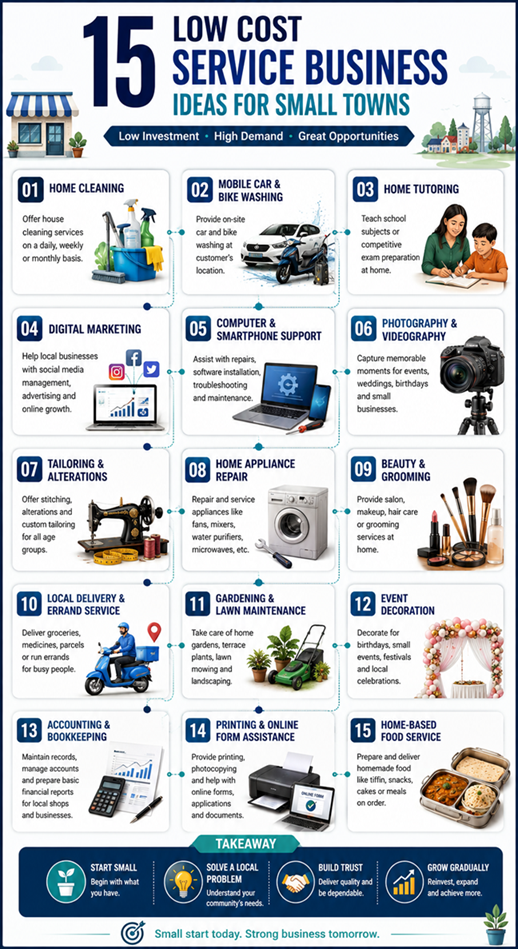
15 Low Cost Service Business Ideas
1. Home Cleaning Service
A home cleaning service can be one of the simplest service businesses to test in a small town. Many families can clean their homes themselves, but deep cleaning before festivals, weddings, moving into a new home, or after renovation can become exhausting. You can offer specialized packages rather than simply saying that you clean houses. For example, you might provide kitchen deep cleaning, bathroom cleaning, move-in cleaning, post-event cleaning, or complete home cleaning.
Startup expenses can include basic cleaning equipment, gloves, brushes, microfiber cloths, buckets, suitable cleaning products, transportation, and simple marketing materials. You can begin alone and eventually train helpers. The important part is to create a consistent process so customers know exactly what they are paying for. Take before-and-after photographs with permission, arrive on time, protect furniture and surfaces, and communicate clearly about what is included in the package.
2. Mobile Car and Bike Washing
A mobile vehicle cleaning service can work particularly well when customers value convenience. Instead of asking customers to drive their vehicles to a washing centre, you travel to their homes, offices, or other agreed locations. You can start with basic equipment and offer different levels of service, such as exterior washing, interior cleaning, polishing, or scheduled maintenance cleaning.
The recurring nature of the business is its strongest feature. A customer who likes your work may book weekly, fortnightly, or monthly cleaning. You can also approach offices, apartment communities, small fleets, taxis, and local businesses. Rather than focusing only on individual customers, look for groups of vehicles located in the same area because several jobs in one place can reduce travel time and improve your daily earnings.
3. Home Tutoring
Home tutoring remains a practical low-cost business for anyone with strong knowledge in a school subject or skill. You do not need a commercial classroom to begin. You can teach students at home, travel to their homes, or conduct sessions online when suitable. Subjects can include mathematics, science, English, computer basics, spoken English, exam preparation, or specialized skills.
Parents usually care about trust and results, so reputation matters greatly. Start with a manageable number of students and focus on delivering genuine improvement. Create simple progress reports and communicate with parents professionally. Once you have several successful students, referrals can become your main source of new customers, allowing you to spend less on advertising.
4. Digital Marketing for Local Businesses
Many small-town businesses have social media accounts but do not use them consistently. A local restaurant may post occasionally, a clothing store may have poor photographs, or a salon may not respond quickly to online enquiries. This creates an opportunity for someone who understands digital marketing for local businesses.
You can offer services such as social media posting, basic graphic design, short-form video editing, Google Business Profile support, product photography, promotional campaigns, and content calendars. The advantage is that your potential customers are other businesses, which means one client can become a recurring monthly account. Start with a few simple packages rather than trying to become a full-service marketing agency immediately. Show prospective clients examples of what you can improve, and focus your sales pitch on outcomes such as better visibility, more enquiries, or a more professional online presence.
5. Computer and Smartphone Support
Technology problems can be frustrating for people who do not feel comfortable troubleshooting devices. A computer and smartphone support service can help with software installation, basic troubleshooting, printer setup, data organization, device configuration, backups, email setup, and general digital assistance.
You can offer home visits or operate from a small workspace. Be careful with customer privacy, especially when handling personal files, photographs, documents, or accounts. Never ask customers to share passwords unnecessarily, and clearly explain what you are doing before making changes. Trust is the product here. If customers know you will treat their devices and information responsibly, they have a reason to return and recommend you.
6. Photography and Videography
A photography and videography service can start surprisingly small if you already own a capable smartphone or camera. Small towns have weddings, birthdays, school functions, shop openings, religious or cultural events, family gatherings, and business promotions. You can begin with simple packages and improve your equipment as revenue grows.
You do not have to compete with expensive professional studios on every type of project. Instead, specialize in a narrow service. You could focus on short promotional videos for local businesses, birthday photography, social media reels, product photographs, or small events. Editing skills can become just as valuable as the camera itself, because customers increasingly want finished digital content rather than hundreds of unedited photographs.
7. Tailoring and Clothing Alteration
If you have sewing skills, tailoring and clothing alteration can be a strong home-based service. Customers may need trousers shortened, dresses altered, blouses adjusted, uniforms repaired, zippers replaced, or garments resized. These jobs require relatively little inventory because the customer generally provides the clothing.
The business can become even more valuable when you specialize. For example, you might offer quick alterations, school uniform services, traditional clothing adjustments, or custom stitching. Reliability matters because customers often need alterations before a specific event. A clean workspace, accurate measurements, clear pricing, and promised delivery times can separate your service from informal competitors.
8. Home Appliance Repair
Repair services can command good value because customers are paying to solve an urgent problem. Fan, mixer, washing machine, refrigerator, cooler, or small appliance repair can therefore be attractive for people who have technical skills. However, this business should be approached responsibly because electrical and appliance work can involve genuine safety risks.
If you already have appropriate training, start with services you understand well. Build relationships with parts suppliers and maintain a transparent approach to estimates. Tell customers what failed, what needs replacement, and what the expected cost will be before beginning significant work. A repair business earns trust when customers feel that the technician is solving the actual problem rather than inventing additional repairs.
9. Beauty and Grooming at Home
A home beauty and grooming service can appeal to customers who value privacy and convenience. Depending on your training and local requirements, services could include basic haircuts, hairstyling, makeup, grooming, or beauty treatments. Home appointments can reduce the cost of renting a commercial salon during the early stage.
The most important investment is skill and hygiene. Keep tools clean, use appropriate disposable items where required, maintain professional standards, and understand any applicable local rules for the services you offer. Special occasions can also provide higher-value opportunities, including weddings, parties, festivals, and family events.
10. Local Delivery and Errand Service
A small town may not need a huge logistics company to solve everyday delivery problems. A local delivery and errand service can handle documents, groceries, medicines where legally appropriate, small packages, shop-to-customer deliveries, or other permitted errands. The business becomes especially useful for elderly customers, busy professionals, small retailers, and people who cannot easily travel.
The model can be built around a small service radius. Instead of promising delivery everywhere, define the areas you serve and charge according to distance or service type. Keep records of orders, payments, addresses, and delivery status. If you eventually work with several shops, you can create scheduled delivery routes that make the operation more efficient.
11. Gardening and Lawn Maintenance
Gardening is another service that can begin with basic tools and practical knowledge. Homes, schools, offices, clinics, hotels, and small commercial properties may need garden maintenance, trimming, planting, cleaning, and routine upkeep. Customers who are busy or physically unable to maintain outdoor spaces may prefer a recurring arrangement.
Recurring contracts are particularly useful. Instead of selling one gardening visit, offer weekly or monthly maintenance plans. You can start with basic work and gradually add specialized services as your knowledge improves. Seasonal demand can also create additional opportunities for planting, pruning, soil preparation, and garden cleanup.
12. Event Decoration Service
Small-town events can create regular demand for event decoration. Birthday parties, engagements, weddings, school functions, shop openings, anniversaries, and community events may require backdrops, balloons, flowers, lighting arrangements, tables, or themed decorations. You do not need a massive inventory on day one.
Begin with a small collection of reusable decoration materials and focus on a few popular packages. Photograph every completed setup with permission. Those images become your portfolio and can be shared through WhatsApp and social media. Over time, you can reinvest profits into reusable structures, lighting, fabrics, artificial flowers, signage, and other equipment.
13. Accounting and Bookkeeping Service
If you have accounting knowledge, bookkeeping and basic business record services can provide recurring income. Small retailers, freelancers, contractors, and service providers often need help organizing invoices, expenses, records, and routine financial information. The exact services you provide should match your qualifications and any professional or regulatory requirements that apply.
The biggest advantage is that bookkeeping can be recurring rather than transactional. Instead of constantly searching for new customers, you can serve a manageable group of businesses each month. Accuracy, confidentiality, organization, and deadlines are critical. A bookkeeping service that helps a business owner understand where money is going can become difficult to replace.
14. Printing, Scanning, and Online Form Assistance
A small digital documentation and online assistance service can solve a surprisingly common local problem. Customers may need printing, scanning, photocopying, document formatting, online applications, résumé preparation, basic typing, or help navigating digital services. The exact services will depend on local demand and the rules governing particular applications.
You do not necessarily need a large cyber café. A computer, printer, scanner, reliable internet connection, and organized workspace may be enough to begin with a narrow service range. Protect customer documents and personal information carefully. Never retain unnecessary copies of identity documents or sensitive files, and make sure customers understand what information is being submitted.
15. Home-Based Food Preparation Service
A home-based food service can work when you identify a specific local demand rather than attempting to sell everything. Possibilities include lunch boxes, snacks, baked goods, breakfast items, traditional foods, or small event orders. A focused menu can keep ingredient waste under control and make production easier.
Before starting, check applicable food-safety, licensing, packaging, and local regulatory requirements. Pricing should include ingredients, packaging, fuel or electricity, delivery, labor, wastage, and your profit. The strongest advantage of a small food service is repeat business. If customers enjoy consistent taste and reliable delivery, weekly meal plans or recurring orders can provide a more predictable base of revenue.

How to Start a Service Business With Little Money
The smartest approach is to validate before you invest. Do not spend your entire budget on equipment, branding, uniforms, a website, and advertising before you know whether people want your service. Start with the smallest version of the business that can deliver a useful result.
Your first investment should make it possible to deliver the service, not simply make the business look impressive. A professional logo is useful, but customer satisfaction is more valuable. A website can help later, but a phone number and clear WhatsApp communication may be enough to get your first local customers. Expensive equipment should be purchased only when it improves quality, increases capacity, or allows you to offer a service customers are actually requesting.
Digital payments can also make collection easier for a small service business. India has a broad digital payment ecosystem, and NPCI’s published statistics show substantial ongoing transaction activity across its payment systems. Offering a convenient digital payment option can reduce friction, although you should keep proper records and understand your tax and accounting responsibilities.
Finding Your First Customers
Your first customers are usually closer than you think. Start with people who already know you, but do not stop there. Ask satisfied customers for referrals, approach nearby businesses, create a simple Google Business Profile where appropriate, and use local WhatsApp groups responsibly. You can also distribute a small number of well-designed flyers in areas where your target customers live or work.
A useful technique is to create a starter offer rather than a permanent discount. For example, a new cleaning service might offer a first-time package, while a digital marketer could offer an initial business profile audit. The goal is to remove the customer’s hesitation without teaching them to expect extremely low prices forever.
Track every enquiry. Write down where customers came from, what they requested, what they paid, how long the job took, and whether they returned. After 20 or 30 jobs, this information can reveal which service is actually profitable. You may discover that one service produces much better returns than the others, giving you a clear path for specialization.
Common Mistakes to Avoid
One of the biggest mistakes new entrepreneurs make is trying to offer everything. A business that says it provides cleaning, delivery, photography, repairs, tutoring, marketing, and decoration can confuse customers. Specialization makes your offer easier to understand. Start narrow, become known for one thing, and expand only when there is a clear reason.
Another mistake is competing entirely on price. Low prices can attract customers quickly, but they can also attract customers who are constantly looking for the cheapest provider. Instead, compete on reliability, communication, quality, convenience, and professionalism. Calculate your real cost before setting prices, including travel, materials, equipment maintenance, time, taxes where applicable, and unexpected expenses.
Cash-flow problems are another common issue. A service business can look profitable while still struggling because customers delay payments or the owner spends revenue immediately. Keep business and personal money organized as much as practical. Record income and expenses from the first day. As the business grows, consider speaking with a qualified accountant or business adviser about the appropriate structure, taxes, registrations, and records.
Finally, do not ignore customer feedback. If three customers complain about the same problem, treat it as business information rather than personal criticism. Maybe your appointment system is unclear. Perhaps your service takes longer than promised. Maybe customers do not understand what is included in the package. Small improvements repeated every week can turn a basic local service into a trusted brand.
Conclusion
The best low cost service business ideas for small towns are not necessarily the most fashionable ones. They are the businesses that solve real local problems with limited startup investment. Cleaning, tutoring, vehicle washing, digital marketing, repair work, bookkeeping, gardening, tailoring, delivery, event decoration, and technology support can all work when matched with genuine local demand and the right skills.
You do not need to build a large company on day one. Start with one service, a small customer area, simple equipment, and a clear promise. Deliver excellent work, collect genuine reviews, ask for referrals, and reinvest part of the revenue into better tools and marketing. As your customer base becomes more stable, you can add employees, expand your service area, introduce packages, and formalize the business as appropriate. The official Udyam portal confirms that registration is free and paperless for eligible enterprises, making it useful for entrepreneurs to understand as they move toward formal business operations.
The real opportunity in a small town is often hiding in plain sight. Look at the tasks people complain about, the services they have difficulty finding, and the jobs they regularly postpone because they are inconvenient. Then ask one simple question: Can I solve that problem better, faster, or more conveniently? If the answer is yes, you may already have the foundation for a profitable service business.
FAQs
1. What is the cheapest service business to start in a small town?
The cheapest option depends on your existing skills and equipment. Tutoring, digital marketing, bookkeeping, online assistance, and some consulting services can have particularly low startup costs because they rely mainly on knowledge and a computer or smartphone. Cleaning, gardening, delivery, and repair services may require more equipment but can still be started on a small scale.
2. Which small-town service business has the most repeat customers?
Businesses based on recurring needs can produce strong repeat demand. Cleaning, tutoring, gardening, bookkeeping, social media management, vehicle cleaning, and maintenance services are examples. The key is not simply choosing a recurring service but delivering consistent quality so customers have a reason to keep using you.
3. Can I start a service business from home?
Yes, many service businesses can begin from home. Tutoring, tailoring, bookkeeping, digital marketing, online assistance, photography editing, and some food-related businesses can operate from a home base, subject to applicable local rules. Mobile services such as cleaning, gardening, vehicle washing, and beauty services can also use your home as an administrative base while you travel to customers.
4. Do I need Udyam registration for a small service business?
Whether you need a particular registration depends on your business structure, activity, turnover, and applicable laws. Udyam registration is the Government of India’s MSME registration system, and the official portal states that registration is free, paperless, and based on self-declaration. It is best to check the current official requirements and seek professional advice when your business reaches a point where tax, licensing, employment, or other regulatory obligations apply.
5. How can I get customers without spending much on advertising?
Start with local referrals, WhatsApp communication, community networks, Google Business Profile where appropriate, simple flyers, partnerships with complementary businesses, and customer reviews. Your first objective should be to create a small group of satisfied customers. In a small town, a strong reputation can become one of your most valuable marketing assets because customers often ask friends and family for recommendations before choosing a service provider.


