

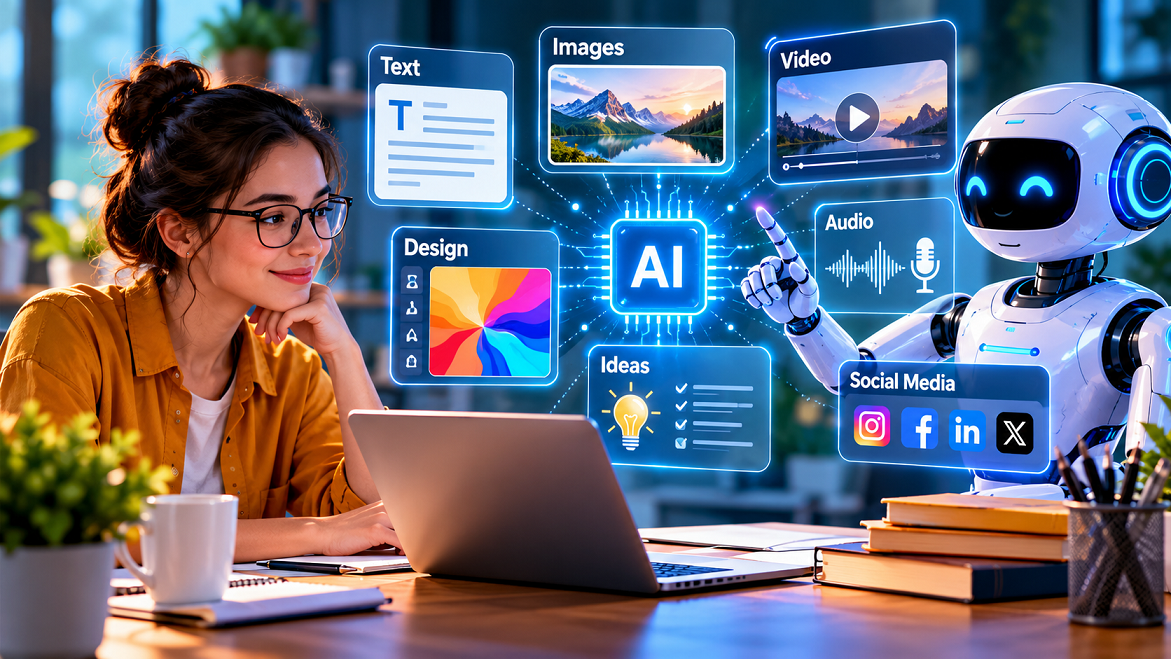
Generative artificial intelligence (AI) is changing how people research, write, design, edit, and distribute digital content. Instead of relying entirely on manual production, creators can now use AI systems to brainstorm ideas, create drafts, generate images, summarize information, develop video concepts, and adapt content for different audiences and platforms.
The change is not simply about producing content faster. Generative AI is also reshaping the content creation workflow itself. Tasks that once required separate tools, specialized skills, or significant amounts of repetitive work can increasingly be combined into a single AI-assisted process.
At the same time, AI-generated content introduces important challenges. Generated information can be inaccurate, repetitive, biased, or misleading, while excessive automation can reduce originality and human perspective. Google’s guidance emphasizes that content should primarily serve people and provide useful, original value rather than being produced mainly to manipulate search rankings.
The most effective approach is therefore not simply “AI versus humans.” It is increasingly AI-assisted content creation, where technology handles suitable production tasks while people provide expertise, judgment, fact-checking, creativity, and accountability.
What Is Generative AI?
Generative AI refers to AI systems capable of producing new content from instructions or other inputs. Depending on the system, that content can include text, images, audio, video, software code, and other digital assets.
Modern generative AI models learn patterns from large datasets and use those learned patterns to produce outputs in response to prompts. This makes them useful for both creative exploration and repetitive production tasks.
For example, a content marketer might use generative AI to:
- Brainstorm article topics
- Create an initial content outline
- Draft social media posts
- Rewrite content for different audiences
- Generate image concepts
- Create video scripts
- Produce advertising variations
- Summarize long documents
- Convert an article into an email newsletter
- Translate or localize content
The technology therefore affects almost every stage of the modern content life cycle.
How Generative AI Is Transforming the Content Creation Process
1. Faster Idea Generation
One of the earliest stages of content creation is deciding what to create. Writers and marketers often spend significant time researching topics, identifying audience questions, and developing content angles.
Generative AI can act as a brainstorming assistant. A creator can provide a subject, audience, business objective, or collection of keywords and ask the system to propose potential ideas.
For example, a technology website covering cybersecurity could ask AI to generate:
- Beginner-friendly article topics
- Advanced technical subjects
- Frequently asked questions
- Social media content ideas
- Video concepts
- Newsletter themes
The important distinction is that AI-generated ideas are starting points rather than automatically validated editorial plans. Human creators still need to determine whether an idea is accurate, useful, original, and relevant to their audience.
2. AI-Assisted Writing
Writing is one of the most visible applications of generative AI.
AI can help create outlines, introductions, summaries, product descriptions, email drafts, social media captions, and other forms of copy. It can also help writers reorganize complex information into clearer language.
For experienced writers, the greatest benefit may not be replacing writing entirely. Instead, AI can reduce repetitive work and provide a first draft that a human can substantially improve.
A practical workflow might look like this:
Research → Outline → AI-assisted draft → Expert review → Fact-checking → Editing → Publication
This approach allows the writer to spend more time on research, interpretation, storytelling, and editorial judgment.
3. Image and Visual Content Creation
Generative AI has also changed visual production.
Modern creative platforms can generate or modify images from natural-language descriptions. Some tools can also help create video clips, graphics, variations, layouts, and other visual assets. Adobe, for example, describes Firefly as a generative AI creative environment capable of generating and editing images, video, audio, and vector graphics.
This can be particularly useful for:
- Blog illustrations
- Social media graphics
- Advertising concepts
- Product mock ups
- Presentation visuals
- Storyboards
- Thumbnail concepts
- Creative experimentation
For small businesses, this can make visual experimentation more accessible. However, generated images still require human review for accuracy, branding, composition, licensing considerations, and misleading visual details.
4. Video and Audio Production
Generative AI is increasingly becoming part of video workflows as well.
Creators can use AI to help develop scripts, generate storyboards, create visual concepts, produce voice overs, translate content, create subtitles, and assist with editing.
A single long-form video can potentially become multiple pieces of content:
One video → Short clips → Social posts → Blog article → Newsletter → Audio gram → Captioned versions
This repurposing capability is especially valuable for creators who already have high-quality original material but lack the time to adapt it manually for every channel.
Research examining YouTube content creation has found generative AI being used across planning, scripting, visual and audio generation, editing, titles, subtitles, and other production activities.
5. Content Personalization at Scale
Traditional content production often involves creating one general message for a broad audience.
Generative AI makes it easier to adapt the same underlying information for different groups.
For example, an online software company could transform one product announcement into:
- A technical explanation for developers
- A short LinkedIn post for professionals
- A beginner-friendly blog article
- An email for existing customers
- A short video script
- A sales presentation
The underlying information can remain consistent while the format, language, length, and emphasis change according to the audience.
Human review remains important because personalization should not introduce factual inconsistencies or inappropriate assumptions about individual users.
6. Content Repurposing Becomes More Efficient
Content repurposing is another area where generative AI can provide practical value.
Consider a 2,000-word expert article. An AI-assisted workflow could help transform it into:
- A 150-word summary
- Five social media posts
- A newsletter
- A short video script
- Frequently asked questions
- A podcast outline
- Presentation talking points
This does not necessarily mean creating seven completely different pieces of information. Instead, AI helps package existing information into formats suitable for different channels.
The creator’s original expertise remains the foundation.
How Generative AI Is Affecting SEO
Generative AI is also changing search-focused content production.
AI can help with keyword research organization, content outlines, search-intent analysis, title variations, FAQs, internal-link suggestions, and content optimization.
However, AI should not be treated as a shortcut to automatically produce hundreds or thousands of low-value pages.
Google explicitly states that scaled content abuse can include generating large amounts of content with generative AI when the primary purpose is manipulating search rankings rather than helping users.
Google’s people-first guidance also emphasizes first-hand experience, expertise, originality, usefulness, and trust. E-E-A-T stands for Experience, Expertise, Authoritativeness, and Trustworthiness, with Google noting that trust is the most important aspect of the concept.
For SEO professionals, this creates an important distinction:
AI can accelerate production, but it cannot replace the need for genuinely valuable information.
The Biggest Benefits of Generative AI for Creators
Increased Productivity
AI can reduce the time required for repetitive tasks such as summarization, formatting, rewriting, brainstorming, and content adaptation.
Lower Barriers to Creation
People without advanced graphic-design, video-editing, or copy writing skills can experiment with different forms of digital content.
Faster Experimentation
Creators can test multiple headlines, concepts, structures, and visual directions before selecting a final version.
Greater Content Accessibility
AI can help transform information into different formats and languages, potentially making content easier for wider audiences to consume.
Better Workflow Integration
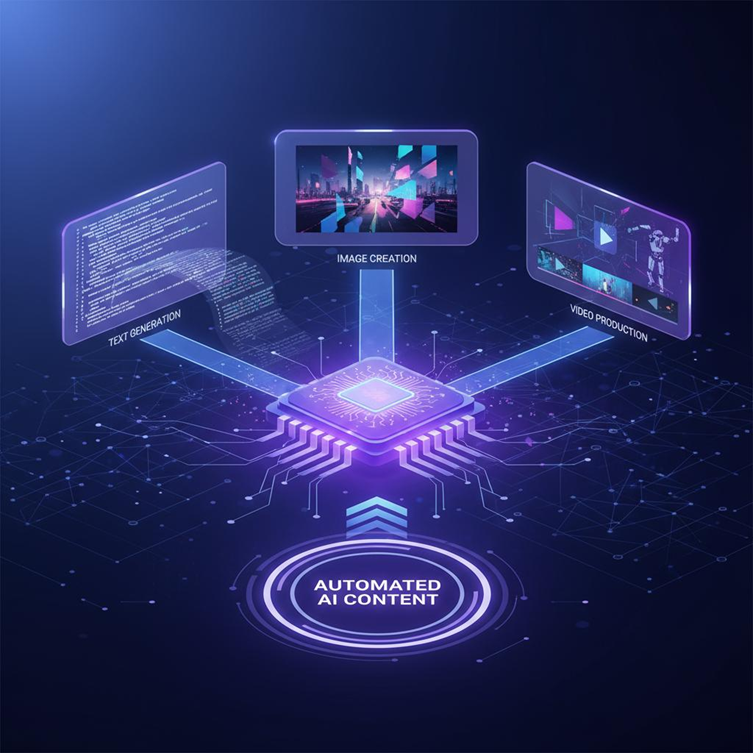
Modern AI systems increasingly operate across multiple content types, allowing creators to move from text to visuals, audio, and video with fewer disconnected steps.
The Limitations and Risks
Generative AI is powerful, but it is not a substitute for verification.
AI Can Produce Incorrect Information
AI systems can generate confident-sounding statements that are inaccurate. NIST identifies “confabulation” as a significant generative AI risk because users may believe incorrect generated information, including fabricated reasoning or citations.
This is particularly important for medical, legal, financial, scientific, and other high-stakes subjects.
Generic Content Can Become More Common
When thousands of creators use similar prompts and models, content can begin to sound repetitive.
Human experience, original research, interviews, examples, observations, and expert interpretation therefore become increasingly valuable differentiators.
Copyright and Ownership Questions
Creators also need to consider the rights associated with source material, generated assets, trademarks, likenesses, and third-party intellectual property.
Policies and legal interpretations can vary by jurisdiction and continue to develop, so businesses should review applicable rules before using AI-generated material commercially.
Privacy and Confidentiality
Sensitive business information should not automatically be entered into public AI systems.
Organizations should establish clear rules for confidential documents, customer information, proprietary data, and other sensitive material.
UNESCO’s guidance on generative AI emphasizes a human-centered approach and highlights issues including privacy, validation, bias, equity, and responsible use.
A Practical Human + AI Content Workflow
A reliable AI-assisted content workflow can be organized into seven stages:
Step 1: Define the Objective
Identify the audience, purpose, topic, format, and desired outcome.
Step 2: Conduct Research
Collect reliable primary and authoritative sources before asking AI to assist with the content.
Step 3: Build the Structure
Use AI for brainstorming and outlining while maintaining control over the editorial direction.
Step 4: Generate a Working Draft
Let AI handle appropriate drafting or transformation tasks.
Step 5: Add Human Expertise
Insert original examples, professional experience, analysis, opinions where appropriate, and unique insights.
Step 6: Verify Everything Important
Fact-check statistics, quotations, dates, names, citations, technical claims, and other important details.
Step 7: Edit and Publish
Improve readability, accuracy, originality, accessibility, visuals, SEO, and overall user experience before publication.
This workflow keeps AI in the role of an assistant rather than treating it as an unquestioned source of truth.
What the Future of Content Creation Looks Like
The most significant change may be the movement from individual AI tools toward integrated creative workflows.
Instead of using separate systems for research, writing, design, video, translation, and editing, creators increasingly have access to platforms that combine several of these capabilities.
That does not mean human creators become irrelevant. In many cases, the value of human work shifts toward areas that AI cannot reliably determine on its own: deciding what matters, understanding audiences, establishing credibility, conducting original research, exercising judgment, and taking responsibility for the final result.
For publishers and businesses, the competitive advantage may therefore come less from simply having access to AI and more from how intelligently the technology is integrated into an existing content strategy.
Conclusion
Generative AI is changing content creation by making ideation, drafting, design, video production, personalization, and content repurposing faster and more accessible.
Its greatest value comes when it removes repetitive work while allowing people to concentrate on strategy, expertise, creativity, verification, and meaningful communication.
The strongest content strategy is not simply to publish more content because AI makes production easier. It is to use AI to create better workflows and more useful experiences for audiences.
For content creators, marketers, publishers, and businesses, the practical lesson is straightforward: use generative AI as a capable production assistant, but keep human expertise and accountability at the center of the process. That combination can help organizations increase efficiency without sacrificing accuracy, originality, or trust.
