

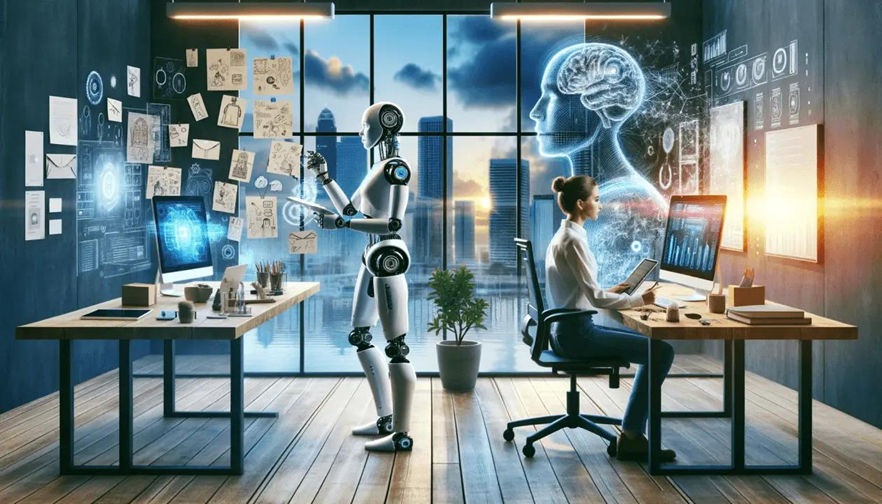
Artificial intelligence has moved from being a behind-the-scenes technology to an everyday creative tool. Today, AI can generate articles, images, music, video concepts, marketing ideas, code, product names, and even business strategies within seconds. This naturally raises an important question: AI vs human creativity—which one wins?
The answer is more nuanced than choosing one side. AI can produce ideas at remarkable speed and scale, identify patterns across enormous amounts of information, and help creators explore possibilities they might not consider immediately. Human creativity, however, is shaped by lived experience, emotion, cultural understanding, personal values, intention, and the ability to decide why an idea matters.
Recent research increasingly examines AI not simply as a replacement for creative professionals, but as a collaborator that can extend human creative processes.
The most useful question, therefore, may not be “Who wins?” but “How can humans and AI create better work together?”
What Is Human Creativity?
Human creativity is the ability to develop ideas, connections, solutions, or expressions that are both meaningful and useful within a particular context.
It is influenced by:
- Personal experiences
- Emotions and intuition
- Cultural background
- Knowledge and observation
- Curiosity and experimentation
- Purpose and personal values
- Understanding of other people’s needs
For example, a novelist may write about grief because of experiences that changed their understanding of relationships. A brand strategist may develop a campaign after observing how customers respond emotionally to a social issue. A designer may reject a technically perfect concept because it does not feel authentic to the audience.
These decisions involve more than generating possibilities. They involve judgment, meaning, context, and intention.
What Does AI Bring to Creativity?
Generative AI works differently. Modern AI systems learn patterns from large datasets and can generate new outputs based on instructions, context, and learned relationships.
AI is particularly useful for:
Speed and Scale
A creator can ask an AI system for dozens of headlines, product concepts, story openings, design directions, or advertising variations in a short period.
Pattern Recognition
AI can process large quantities of information and identify recurring themes, structures, or relationships that may be difficult to notice manually.
Rapid Experimentation
Instead of spending hours developing one initial concept, creators can generate multiple directions and then select, combine, or improve the strongest ones.
Removing Repetitive Work
AI can help with tasks such as first drafts, formatting, summarization, variations, brainstorming, transcription, and basic production work.
Research on human-AI collaboration has found that the way AI is integrated into the creative process matters considerably. Human involvement earlier in the process can help preserve quality and creative diversity rather than simply having people approve AI-generated outputs at the end.
AI vs Human Creativity: A Practical Comparison
| Creative Strength | AI | Humans |
| Generating many ideas quickly | Excellent | Moderate |
| Processing large datasets | Excellent | Limited |
| Repetitive creative tasks | Excellent | Less efficient |
| Personal experience | No lived experience | Strong |
| Emotional understanding | Can model patterns | Deeply experienced |
| Cultural context | Depends on training and context | Stronger contextual awareness |
| Purpose and values | No personal purpose | Central to human creativity |
| Creative judgment | Useful but imperfect | Strong contextual judgment |
| Original personal perspective | Limited by learned patterns | Highly individual |
| Rapid experimentation | Excellent | Moderate |
| Final responsibility | Requires human oversight | Human decision-maker |
This comparison shows why treating creativity as a simple competition can be misleading.
Where AI Can Outperform Humans
AI can have a significant advantage when the creative task involves volume, speed, structured variation, or information processing.
Imagine a digital marketing team developing a campaign. A human strategist might establish the audience, positioning, message, and brand personality. AI could then generate 50 headline variations, 20 social-media concepts, several email openings, and multiple visual directions.
The human does not need to accept every suggestion. Instead, AI becomes a rapid brainstorming partner.
AI can also help creators escape the first-idea trap. When a writer develops one concept, they may unconsciously become attached to it. Generating alternative approaches can encourage broader exploration.
Some experimental research has even found AI systems performing strongly on certain creativity assessments. However, these findings should not be interpreted as proof that AI possesses creativity identical to human creativity. Results depend heavily on the task, evaluation method, prompting strategy, and definition of creativity.
Where Human Creativity Still Has the Advantage
1. Meaning and Intent
Humans create because they want to communicate something.
A filmmaker may make a documentary to challenge social assumptions. A designer may create a campaign to represent a community more accurately. A writer may tell a story to help people understand an experience.
AI can generate content around these objectives, but the underlying purpose comes from people.
2. Emotional and Cultural Context
Creative work often succeeds because audiences recognize something emotionally meaningful.
A human creator can draw upon personal relationships, memories, cultural traditions, social experiences, and observations of real people.
AI can reproduce patterns associated with emotional expression, but that is different from personally experiencing an emotion.
3. Creative Judgment
Generating an idea is only one stage of creativity.
The harder question is often:
“Is this actually a good idea?”
A professional designer may reject an impressive-looking concept because it conflicts with a company’s identity. An editor may remove a technically strong paragraph because it sounds insensitive. A filmmaker may change a scene because the emotional timing feels wrong.
That type of contextual judgment remains essential.
4. Responsibility
Creative decisions can have consequences.
A human professional must consider copyright, accuracy, fairness, cultural sensitivity, privacy, reputation, and potential harm. UNESCO’s guidance on generative AI emphasizes the importance of human-centred and responsible approaches to AI use.
Real-World Example: AI and Content Creation
Consider an SEO content team preparing an article.
A weak workflow would be:
AI → Generate article → Publish
A stronger workflow is:
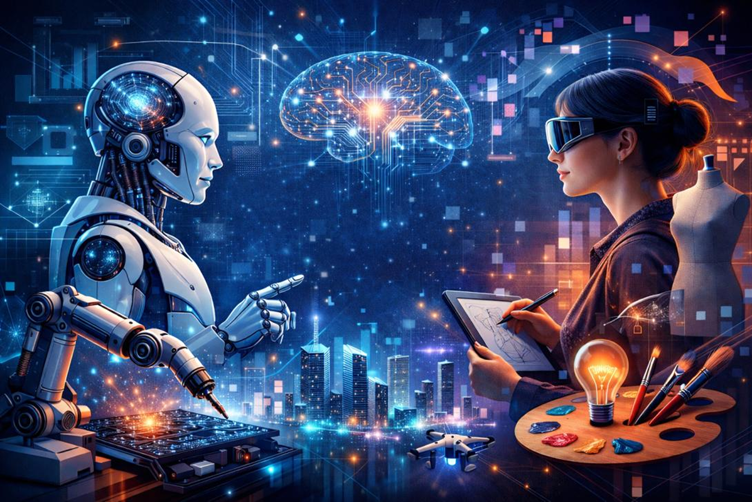
Human research → AI brainstorming → Human fact-checking → AI-assisted drafting → Human editing → Expert review → Publication
In the second workflow, AI contributes speed and variation while people remain responsible for accuracy, originality, tone, expertise, and editorial judgment.
This approach is particularly valuable for educational content, healthcare information, finance, technology, and other subjects where unsupported claims can damage trust.
Real-World Example: AI and Graphic Design
A designer working on a new campaign might use AI to explore different compositions, color directions, visual metaphors, or image concepts.
Instead of replacing the designer, AI can shorten the experimentation phase.
The designer still determines:
- What the brand should communicate
- Which concept fits the target audience
- Whether the design is culturally appropriate
- Which visual hierarchy works
- Whether the final result feels authentic
- What should ultimately be published
Stanford researchers are currently exploring ways to improve communication between visual artists and generative AI so creators can steer AI systems with greater precision.
The Biggest Risk: Creative Homogenization
One important concern is that widespread use of similar AI systems could encourage people to produce similar-looking or similar-sounding work.
If thousands of creators use comparable models, prompts, templates, and stylistic instructions, creative output can become more predictable.
This is why human originality remains important.
Creators should use AI to expand exploration, not simply reproduce the first acceptable result.
A practical approach is to add original research, personal observations, distinctive examples, unusual perspectives, and human editing to AI-assisted work.
How to Use AI Without Losing Your Creativity
Start With Your Own Ideas
Before asking AI for solutions, spend time defining the problem yourself.
Use AI for Divergent Thinking
Ask for alternatives, opposing perspectives, unusual approaches, or potential weaknesses.
Challenge the Output
Do not automatically assume an AI-generated answer is correct, original, or appropriate.
Add Human Experience
Bring your own stories, observations, expertise, taste, and judgment into the final result.
Fact-Check Important Claims
AI can produce confident-sounding information that requires verification. For professional or high-stakes content, reliable primary and authoritative sources should remain part of the workflow.
Keep the Human Decision at the Center
AI can suggest. Humans should decide what deserves to survive.
So, Who Wins: AI or Humans?
If the competition is about speed, scale, rapid variation, and information processing, AI can win in many creative tasks.
If the competition is about lived experience, meaning, emotional context, personal perspective, responsibility, and creative judgment, humans retain major advantages.
But the most productive answer is not necessarily a winner.
The strongest creative model is often human-led AI collaboration.
Research published in the Journal of Creativity describes approaches for designing AI systems that support human creators rather than simply replacing them.
AI can become the engine that helps explore possibilities. Humans remain the people who decide which possibilities are valuable, meaningful, ethical, and worth pursuing.
Conclusion
The debate over AI vs human creativity is often presented as a battle between technology and people. In practice, creativity is more complicated.
AI is exceptionally useful for generating possibilities, accelerating workflows, identifying patterns, and reducing repetitive work. Humans contribute experience, intention, emotional understanding, cultural awareness, judgment, and responsibility.
The future of creativity is therefore unlikely to be defined simply by AI replacing humans or humans rejecting AI.
Instead, the creators who learn how to combine human originality with AI’s capabilities may have the strongest creative workflows.
AI can generate possibilities. Humans give those possibilities purpose.

1 Comment
Pingback: How Artificial Intelligence Is Changing Everyday Life - Blackbud