

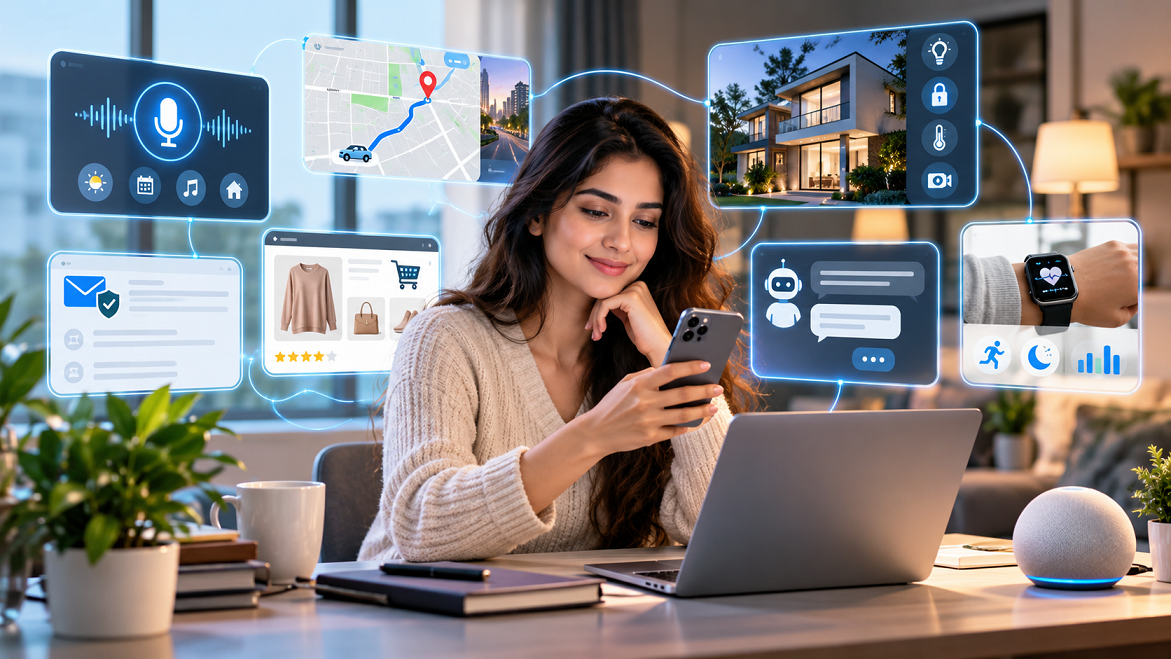
Artificial intelligence (AI) is no longer limited to research laboratories, large technology companies, or science-fiction stories. It has quietly become part of everyday routines—from the moment a smartphone predicts the next word in a message to the moment a navigation app recommends a faster route home.
AI systems can recognize patterns, understand language, make predictions, personalize recommendations, and automate certain tasks. Many of these capabilities operate behind the scenes, meaning people may use AI-powered services every day without realizing how much artificial intelligence is involved. IBM, for example, identifies recommendation engines, fraud detection, customer service, and other practical applications as established real-world uses of machine learning and AI.
AI Is Becoming Part of Everyday Technology
One reason AI is becoming so influential is that it is increasingly embedded into products people already use. Instead of requiring a separate “AI device,” many AI capabilities are built into smartphones, search engines, email services, streaming platforms, online stores, vehicles, and smart-home products.
Natural language processing, for example, allows computers to work with human language and supports technologies such as voice assistants, chat bots, search tools, and voice-operated navigation.
This means AI’s impact is often subtle. A person may simply see a better search result, receive a useful recommendation, or get a warning about suspicious activity without seeing the technology working behind the scenes.
How AI Is Changing Smartphones
Smarter Voice Assistants
Voice assistants use AI and language-processing technologies to interpret spoken requests. People can use them to set reminders, check information, control compatible devices, or perform simple tasks without manually navigating menus.
The technology is particularly useful when hands-free interaction is important—for example, while driving, cooking, or managing household tasks.
Better Photos and Videos
Modern smartphones use AI and machine-learning techniques for features such as scene recognition, image enhancement, portrait effects, noise reduction, and automatic organization.
Rather than simply recording whatever the camera sensor captures, computational photography can analyze an image and make adjustments designed to produce a more useful final result.
Predictive Text and Writing Assistance
When a phone suggests the next word in a sentence or automatically corrects a spelling mistake, machine-learning technology may be involved. These systems analyze patterns in language to predict what a user is likely to type next.
AI Is Transforming Search and Information Discovery
Search engines increasingly use AI to understand the meaning and context behind queries rather than relying exclusively on exact keyword matches.
For users, this can make it easier to find information using conversational questions. AI-powered tools can also summarize information, organize complex topics, and help people explore unfamiliar subjects.
However, convenience does not eliminate the need for judgment. AI systems can produce incorrect or incomplete information, so important claims should still be checked against reliable sources.
Personalized Entertainment and Recommendations
Streaming Services
When a streaming platform recommends a movie, series, song, or playlist, algorithms can analyze signals such as previous viewing or listening behavior and interactions with content.
Machine learning is widely used for recommendation systems. IBM notes that services such as Amazon and Netflix use recommendation engines to personalize suggestions based on factors including browsing behavior and previous interactions.
Social Media Feeds
Social platforms also use algorithms to determine which posts, videos, advertisements, and other content are displayed to individual users.
This personalization can make large amounts of information easier to navigate, but it also means that users may see different content based on their previous interactions.
AI Is Making Shopping More Personalized
Online shopping is another area where AI has become increasingly visible.
AI can help retailers analyze product searches, browsing behavior, purchase histories, and other signals to provide personalized recommendations. It can also support intelligent search, automated customer service, product discovery, and inventory-related processes.
For shoppers, the practical benefit is often convenience. Instead of searching through thousands of products manually, an AI-assisted system can narrow choices according to stated preferences.
Forbes has documented the growing role of AI in shopping and consumer behavior, including personalized product recommendations and AI-assisted search experiences.
AI Is Changing Transportation and Navigation
Navigation apps are among the most practical examples of AI-assisted technology.
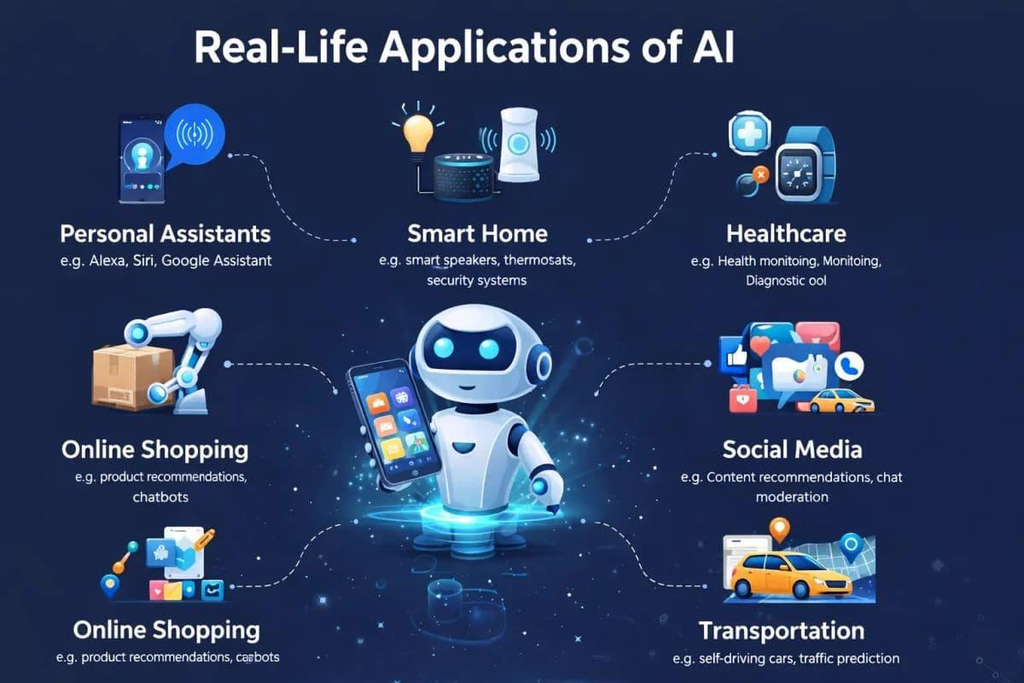
Modern mapping and transportation systems can process large amounts of information to estimate travel times, identify traffic patterns, suggest routes, and provide location-based assistance.
AI can also contribute to driver-assistance systems by helping vehicles interpret information from cameras, sensors, and other systems.
The World Economic Forum identifies enhanced GPS and mapping applications among everyday examples of AI in use.
For an ordinary commuter, the result may be as simple as receiving a notification that another route could save several minutes.
AI in Smart Homes
Smart-home technology is another area where AI can reduce repetitive tasks.
Depending on the devices and services involved, AI-powered systems can help users:
- Control lights and thermostats
- Manage smart appliances
- Recognize unusual activity
- Use voice commands
- Automate household routines
- Monitor energy consumption
- Personalize home settings
The key change is that smart devices can increasingly respond to patterns and context rather than simply following one fixed command.
For example, a connected thermostat may use historical patterns and environmental information to help manage heating or cooling more efficiently.
AI Is Supporting Healthcare and Wellness
AI is also being used in healthcare, although its role should not be confused with replacing professional medical judgment.
Healthcare organizations use AI and machine learning for applications such as analyzing medical images, supporting documentation, identifying patterns in data, and assisting research.
Wearable devices can also use algorithms to interpret information such as activity, sleep patterns, or heart-related measurements.
These technologies can provide useful information, but consumers should treat AI-generated health information as assistance rather than a substitute for qualified medical advice.
AI Is Improving Everyday Communication
AI-powered language technologies have made communication easier across many situations.
Translation systems can help people communicate across languages, while speech recognition can convert spoken words into text. Generative AI tools can also assist with drafting emails, summarizing documents, brainstorming ideas, and improving writing.
These applications are particularly useful for people who communicate frequently across languages or need to process large quantities of written information.
At the same time, users should review AI-generated messages before sending them, particularly when communication involves business, legal, financial, or sensitive personal information.
AI Is Helping Protect Digital Transactions
AI is not only about convenience. It also plays an important role in digital security.
Banks and financial institutions can use machine-learning systems to identify unusual transaction patterns that could indicate fraud. IBM describes anomaly detection as a practical application in which algorithms analyze transaction behavior and flag potentially suspicious activity.
For consumers, this may appear as a simple notification asking them to verify a transaction or temporarily blocking an unusual payment.
Similarly, email services use automated systems to identify spam and potentially harmful messages. The World Economic Forum lists spam filtering among everyday services that rely on AI.
AI Is Changing How People Work and Learn
Generative AI has introduced another important dimension to everyday life.
Students, professionals, entrepreneurs, and creators can use AI tools to:
- Brainstorm ideas
- Summarize lengthy material
- Create outlines
- Analyze information
- Practice languages
- Generate drafts
- Explain complicated concepts
- Automate repetitive digital tasks
The most effective approach is generally to treat AI as an assistant rather than an unquestionable authority.
For example, a professional might use AI to create an initial report structure but personally verify statistics, sources, calculations, and important conclusions.
The Benefits of AI Come With Responsibilities
AI offers significant convenience, but its growing role also creates practical concerns.
Privacy
AI-powered services often depend on data. Users should understand what information an application collects, why it collects it, and how that information may be used.
Accuracy
AI systems can make mistakes. A fluent and confident answer is not necessarily a correct one.
Bias and Fairness
AI systems can reflect limitations in the data and processes used to develop them. Organizations therefore need appropriate testing, oversight, and governance.
Human Oversight
For high-stakes decisions—particularly those involving health, finances, employment, law, or safety—human review remains important.
The World Economic Forum has highlighted both the growing presence of AI in daily life and the importance of addressing issues such as privacy and responsible use.
How Consumers Can Use AI Responsibly
Getting value from AI does not require becoming an AI expert. A few simple habits can make everyday use more effective:
- Verify important information before acting on it.
- Avoid sharing unnecessary sensitive information with AI services.
- Review AI-generated content for errors and misleading statements.
- Use trusted sources when researching important subjects.
- Keep human judgment involved in significant decisions.
- Understand the settings and permissions of AI-powered applications.
- Use AI to assist your thinking, rather than automatically accepting its conclusions.
These habits are especially important as AI becomes more integrated into search, communication, shopping, work, and personal technology.
What the Everyday AI Experience Looks Like
The most significant change may not be a single revolutionary application. Instead, AI is becoming a layer across many ordinary digital experiences.
A typical day might involve an AI-assisted alarm or wearable device in the morning, predictive text while messaging, navigation during a commute, personalized recommendations during lunch, automated spam filtering throughout the day, an AI writing assistant at work, and a smart-home system in the evening.
Each individual application may seem relatively small. Together, however, they demonstrate how deeply AI has entered everyday digital life.
Forbes has also explored the emergence of AI agents that can move beyond responding to individual prompts and potentially carry out more complex tasks on a user’s behalf.
Conclusion
Artificial intelligence is changing everyday life not simply through futuristic robots or advanced research, but through familiar technologies people already use. Smartphones, search engines, streaming services, online shopping, navigation apps, banking systems, smart homes, communication tools, and workplace software increasingly rely on AI to recognize patterns, make predictions, personalize experiences, and automate repetitive tasks.
The most useful way to understand this transformation is to see AI as a powerful technology that augments human capabilities while still requiring human judgment. Its benefits can include greater convenience, personalization, accessibility, and efficiency, but responsible use requires attention to privacy, accuracy, security, and transparency.
As AI becomes increasingly embedded in everyday technology, understanding how it works—and knowing when to trust, verify, or question its output—will become an important digital skill for consumers, professionals, students, and businesses alike.
