






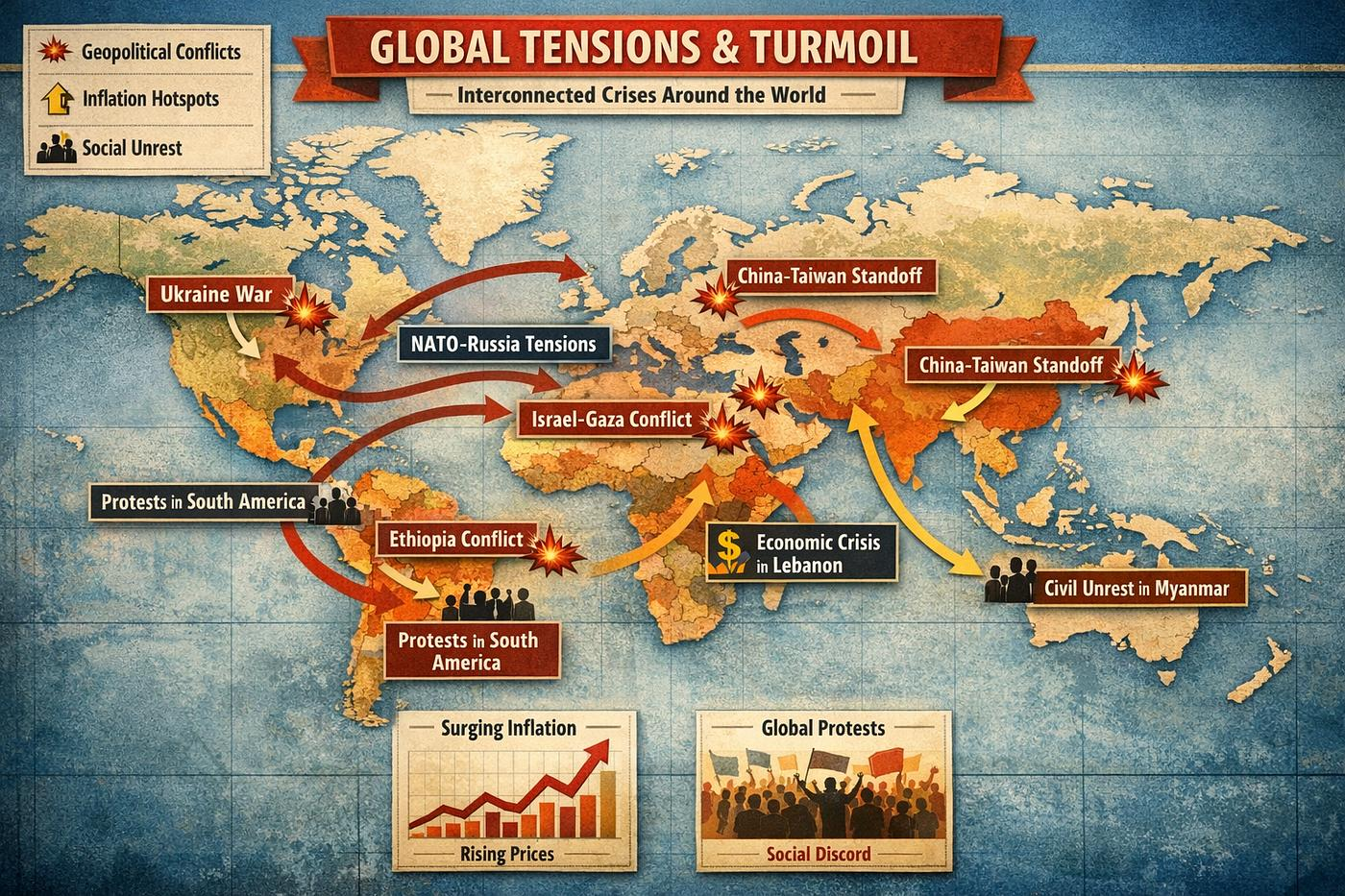
Geopolitical tensions have become one of the defining features of the global environment in 2026. Conflicts and strategic rivalries are increasingly connected through trade, energy markets, technology, military alliances, shipping routes, and supply chains. Rather than being limited to individual regions, today’s crises can quickly create consequences far beyond their borders.
The United Nations has warned that conflicts are becoming more complex and interconnected, while geopolitical divisions are making international consensus harder to achieve. At the same time, global military expenditure reached approximately $2.9 trillion in 2025, the highest level recorded by the Stockholm International Peace Research Institute (SIPRI).
Understanding these developments does not require predicting the next major war. Instead, it requires examining the major pressure points, the economic consequences, and the diplomatic mechanisms that can prevent escalation.
What Is Driving Geopolitical Tensions in 2026?
Several forces are contributing to today’s increasingly complicated security environment.
1. Strategic Competition Between Major Powers
Competition among major powers increasingly involves military capabilities, technology, trade, investment, and influence over strategic regions.
The relationship between the United States and China remains particularly important. Competition extends beyond traditional military power into semiconductors, artificial intelligence, critical minerals, telecommunications, advanced manufacturing, and maritime security.
This creates a broader form of geopolitical competition in which economic policy can become a national-security instrument. The IMF notes that strategic rivals are increasingly using trade policies to pursue national-security objectives, including restrictions involving technology and critical products.
2. Continuing Conflict in Europe
The Russia-Ukraine war remains a central security issue for Europe and the wider international system.
The conflict has influenced European defense planning, energy security, sanctions policy, weapons production, and relations between Russia and Western countries. SIPRI reported that European military expenditure increased 14% in 2025 to $864 billion, reflecting the region’s heightened security concerns.
For businesses, the consequences extend beyond defense. Energy prices, transportation costs, insurance premiums, agricultural exports, and supply-chain planning can all be affected by prolonged instability.
The Middle East Remains a Major Flashpoint
The Middle East continues to demonstrate how quickly regional tensions can affect the global economy.
The United Nations has highlighted the wider consequences of escalating Middle Eastern tensions, including disruption to trade routes, higher food and fuel costs, displacement, and increased insecurity.
Energy and Shipping Risks
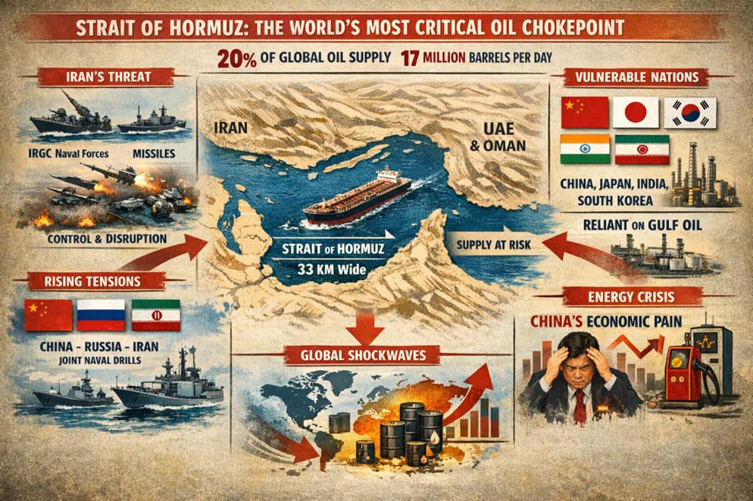
The region contains critical energy infrastructure and some of the world’s most strategically important maritime routes.
Any significant disruption affecting major shipping corridors can increase transportation costs and create delays for companies dependent on international supply chains. The IMF’s July 2026 assessment similarly identifies renewed Middle East escalation as an important downside risk because it can increase commodity prices, inflation, supply shortages, and exchange-rate pressures.
This demonstrates an important principle: geopolitical risk is also economic risk.
China, Taiwan, and the Indo-Pacific
The Indo-Pacific is another important area to watch because of the combination of military competition, maritime disputes, trade relationships, and advanced technology.
Tensions around Taiwan have received particular international attention. In August 2026, Taiwan conducted an anti-blockade naval exercise during a period of increased Chinese maritime pressure. The exercise involved coordination between Taiwan’s navy and coast guard and reflected concerns about the potential economic and security consequences of maritime disruption.
The significance extends well beyond Taiwan itself. The region is deeply integrated into global manufacturing and technology supply chains, meaning serious disruption could affect electronics, semiconductors, shipping, and international trade.
At the same time, it is important to distinguish military exercises, political pressure, and strategic competition from an actual armed conflict. Responsible geopolitical analysis should avoid treating every escalation as evidence that a larger war is inevitable.
The Rise of Economic and Technological Geopolitics
Modern geopolitical competition is increasingly fought through economic and technological measures.
Trade Fragmentation
Governments are increasingly examining supply chains through the lens of national security.
Companies that once optimized primarily for low costs may now consider:
- Supplier diversification
- Geographic concentration risk
- Critical-material availability
- Export controls
- Sanctions exposure
- Shipping-route reliability
- Political stability
The IMF has warned that prolonged geopolitical fragmentation can affect trade and investment flows, while targeted restrictions on critical inputs can create supply bottlenecks and increase production costs.
Technology as Strategic Infrastructure
Artificial intelligence, semiconductors, telecommunications, satellites, drones, and cybersecurity have become increasingly important to national security.
Technology therefore has a dual role. It can improve economic productivity and civilian services while simultaneously becoming part of military competition.
This makes technological independence and supply-chain resilience strategic priorities for many governments.
Global Military Spending Is Rising
One of the clearest measurable indicators of heightened security concerns is military expenditure.
According to SIPRI, global military spending reached $2.887 trillion in 2025, rising for the 11th consecutive year. Spending increased particularly strongly in Europe and Asia and Oceania.
The world’s five largest military spenders in 2025 were the United States, China, Russia, Germany, and India. Together, they represented about 58% of global military expenditure.
Higher defense spending does not automatically mean that major war is imminent. Governments can increase military capabilities for deterrence, alliance commitments, modernization, or perceived defensive requirements.
However, sustained increases in military spending can also create security dilemmas: one country’s attempt to strengthen its security may be interpreted by another as preparation for confrontation.
How Geopolitical Tensions Affect Ordinary People
Geopolitical tensions may appear distant, but their effects can reach households and businesses quickly.

Food and Energy Prices
Conflicts involving major energy producers, transport corridors, or agricultural exporters can influence global commodity prices.
Higher energy costs can increase transportation and manufacturing expenses, while disruptions to agricultural supply chains can affect food prices.
Business and Supply Chains
A company importing components from a single country may face significant disruption if sanctions, export restrictions, conflict, or shipping interruptions occur.
A practical response is supply-chain diversification. Businesses can identify critical suppliers, develop alternatives in different regions, maintain appropriate inventories, and regularly assess geopolitical exposure.
Financial Markets
Geopolitical shocks can increase market volatility. Investors may respond to uncertainty by shifting toward perceived safe-haven assets, while companies may delay investment decisions when political and economic conditions become less predictable.
The IMF’s 2026 outlook emphasizes that prolonged conflict and geopolitical fragmentation can weaken growth and create inflationary pressures.
Why Diplomacy Still Matters
Rising tensions do not mean diplomacy has become irrelevant. In fact, diplomacy becomes more important when the costs of escalation are high.
The United Nations identifies preventive diplomacy, mediation, negotiation, and early-warning mechanisms as important tools for preventing disputes from escalating.
Diplomatic channels can provide governments with opportunities to clarify intentions, establish communication mechanisms, negotiate temporary arrangements, and prevent misunderstandings from turning into larger crises.
International organizations, regional institutions, bilateral negotiations, and informal diplomatic channels can all contribute to de-escalation.
What Businesses and Individuals Can Learn From 2026
Geopolitical awareness is increasingly relevant outside government and defense circles.
Businesses can:
- Diversify suppliers and markets to reduce dependence on one country.
- Monitor sanctions and export-control rules relevant to their industry.
- Assess shipping and logistics vulnerabilities regularly.
- Build contingency plans for energy, technology, and raw-material disruptions.
- Avoid relying on a single geopolitical assumption when making long-term investments.
- Use credible sources rather than social-media rumors when assessing international developments.
For individuals, the most useful approach is similar: understand how geopolitical developments can influence inflation, employment, travel, energy prices, investments, and consumer goods without reacting to sensational predictions.
A More Fragmented but Interconnected World
The central paradox of 2026 is that countries are becoming more strategically divided while remaining economically interconnected.
A conflict in one region can affect oil prices elsewhere. A technology restriction can alter manufacturing decisions thousands of kilometers away. A shipping disruption can affect consumers on another continent.
This interconnectedness means geopolitical risk cannot be evaluated purely through military developments. Economic, technological, environmental, diplomatic, and social factors increasingly overlap.
The United Nations has described the current environment as one in which conflicts, geopolitical divisions, technology, inequality, and climate-related pressures interact with one another.
Conclusion
Rising geopolitical tensions in 2026 reflect a broader transformation of the international system rather than a single crisis. The Russia-Ukraine war, instability in the Middle East, tensions involving Taiwan and the Indo-Pacific, strategic competition between major powers, trade fragmentation, and technological rivalry are all contributing to a more complicated global environment.
Yet heightened tension does not make large-scale conflict inevitable. Deterrence, diplomacy, international law, economic cooperation, crisis communication, and conflict-prevention mechanisms remain essential tools for reducing risks.
For governments, businesses, investors, and ordinary citizens, the most practical response is neither complacency nor alarmism. It is preparedness based on reliable information, diversified risk management, and a clear understanding of how geopolitical events can affect the interconnected global economy.

