


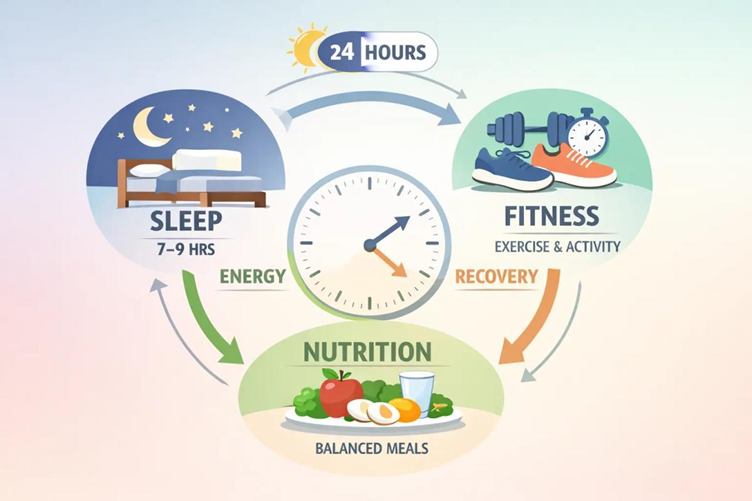
A healthy daily routine does not have to be complicated, expensive, or highly restrictive. In fact, the most sustainable routines are usually built around a few simple habits that can be repeated consistently: getting adequate sleep, eating balanced meals, staying physically active, managing stress, and creating time for work, relationships, and relaxation.
The goal is not to create a “perfect” schedule. It is to build a routine that supports your physical and mental well-being while fitting realistically into your lifestyle. Research-based recommendations from organizations such as the World Health Organization (WHO) and Centers for Disease Control and Prevention (CDC) provide useful foundations, while individual routines can be adapted around work, family responsibilities, culture, and personal preferences.
What Is a Healthy Daily Routine?
A healthy daily routine is a predictable pattern of activities that helps you consistently meet important health needs.
A balanced routine generally includes:
- Adequate and consistent sleep
- Regular physical activity
- Nutritious meals and sufficient hydration
- Time for focused work or responsibilities
- Breaks and relaxation
- Social connection
- Personal hygiene and self-care
- A reasonable bedtime and morning schedule
A useful routine should make healthy choices easier rather than turning every part of your day into another obligation.
1. Start With Your Sleep Schedule
Sleep is one of the most important foundations of a healthy routine. The CDC states that adults aged 18–60 generally need at least seven hours of sleep per night, while recommended sleep duration varies by age. Good sleep is also about quality and consistency, not simply the number of hours spent in bed.
Create a Consistent Sleep-Wake Time
Try going to bed and waking up at approximately the same time each day, including weekends.
For example:
10:30 PM: Begin winding down
11:00 PM: Go to bed
7:00 AM: Wake up
Your exact schedule can be different. What matters is that it provides enough sleep and works with your responsibilities.
Develop a Bedtime Routine
About 30–60 minutes before bed, reduce stimulating activities. You could:
- Dim the lights
- Read a book
- Take a warm shower
- Prepare your clothes for the next day
- Practice gentle stretching
- Put electronic devices aside
The CDC specifically recommends maintaining a regular sleep schedule and turning off electronic devices at least 30 minutes before bedtime.
2. Build Movement Into Your Day
Exercise doesn’t necessarily mean spending an hour at the gym every day. Walking, cycling, household activities, recreational sports, and structured workouts can all contribute to physical activity.
WHO recommends that adults aged 18–64 get 150–300 minutes of moderate-intensity aerobic activity per week, or an equivalent amount of vigorous activity. Muscle-strengthening activities are recommended on at least two days per week.
Make Exercise Easier to Maintain
Instead of depending entirely on motivation, connect physical activity to existing parts of your schedule.
For example:
- Take a 15-minute walk after lunch.
- Use stairs when practical.
- Walk while taking a phone call.
- Do strength training two or three times per week.
- Stretch after long periods of sitting.
- Take a short evening walk with family members.
If you’re currently inactive, beginning with manageable amounts and gradually increasing activity can make the routine easier to maintain. WHO notes that some physical activity is better than none.
3. Make Nutrition Part of Your Routine
A healthy routine should make nutritious food convenient.
Rather than concentrating on a single “perfect” diet, focus on creating balanced meals that provide a variety of nutrients.
Plan Simple Meals
A practical approach is to regularly include:
- Vegetables and fruits
- Whole grains and other high-fiber foods
- Protein-rich foods
- Healthy sources of fats
- Adequate fluids
Meal planning can reduce the temptation to rely on highly processed convenience foods when you’re busy.
For example, you might prepare vegetables, a protein source, and a whole-grain option in advance so that assembling lunch takes only a few minutes.
Don’t Make the Routine Too Restrictive
A healthy eating pattern should be realistic. Extremely restrictive rules can make a routine difficult to maintain.
Instead, concentrate on consistency, variety, appropriate portions, and overall dietary quality.
4. Create a Productive Morning Routine
Your morning routine doesn’t need to contain ten different activities.
A simple structure might look like:
7:00 AM — Wake up
7:10 AM — Personal hygiene and water
7:20 AM — Light movement or walking
7:45 AM — Breakfast
8:15 AM — Plan the day’s priorities
The objective is to begin the day intentionally rather than immediately reacting to notifications, messages, and social media.
Choose Three Morning Priorities
Try identifying three things that matter most for the day.
For example:
- Complete an important work project.
- Exercise for 30 minutes.
- Spend time with family.
This gives your day direction without requiring an unrealistic schedule.
5. Take Regular Breaks During Work
A healthy routine isn’t about working continuously.
If your job involves sitting at a computer for several hours, build movement breaks into your schedule. You might stand, walk around the room, stretch, refill your water, or briefly step outside.
For example:
9:00–10:30: Focused work
10:30–10:40: Short break
10:40–12:00: Focused work
12:00–1:00: Lunch and movement
1:00–3:00: Work
3:00–3:10: Short break
3:10–5:30: Work
The exact timing is less important than avoiding a pattern where work consumes the entire day without meaningful breaks.
6. Make Time for Mental Well-Being
Mental well-being deserves a place in a daily routine just like exercise and nutrition.
Simple activities can include:
- Reading
- Meditation or breathing exercises
- Journalism
- Listening to music
- Spending time outdoors
- Talking with friends or family
- Pursuing hobbies
- Taking short periods away from screens
You don’t necessarily need a long meditation session or elaborate wellness practice. Even a few minutes of intentional downtime can create a useful transition between demanding activities.
7. Build an Evening Reset
A good evening routine prepares you for both rest and the following day.
Spend 10–20 minutes reviewing tomorrow’s responsibilities. Prepare clothing, organize your workspace, plan meals, or write down important tasks.
This can reduce the number of decisions you have to make the next morning.
A simple evening sequence could be:
7:00 PM: Dinner
8:00 PM: Relaxation or family time
9:30 PM: Prepare for tomorrow
10:00 PM: Reduce screen stimulation
10:30 PM: Reading or quiet activity
11:00 PM: Sleep
Again, this is an example—not a universal prescription.
8. Use Habit Stacking
One effective way to make new habits easier is to connect them with habits you already perform.
For example:
- After brushing your teeth → stretch for five minutes.
- After lunch → walk for 10 minutes.
- After finishing work → prepare tomorrow’s task list.
- After dinner → take a short family walk.
- Before getting into bed → read for 10 minutes.
This approach reduces the need to remember completely new behaviors because they become connected to established parts of your day.
9. Avoid the “Perfect Routine” Trap
One of the biggest practical mistakes is creating a schedule that is too ambitious.
Suppose your planned routine includes:
- 60-minute workout
- 30-minute meditation
- Perfect meal preparation
- Two hours of reading
- Eight hours of work
- Extensive skincare
- Multiple productivity sessions
It may look impressive on paper but become difficult to maintain.
Instead, create a minimum viable routine.
For example:
- Sleep sufficiently.
- Eat balanced meals.
- Walk or exercise.
- Complete your most important work.
- Spend some time with people you care about.
- Have a reasonable wind-down period.
On busy days, maintaining these fundamentals may be more useful than trying to complete an elaborate schedule.
Example of a Simple Healthy Daily Routine
| Time | Activity |
| 7:00 AM | Wake up and get ready |
| 7:15 AM | Light movement/walk |
| 7:45 AM | Breakfast |
| 8:30 AM | Begin work/study |
| 10:30 AM | Short movement break |
| 1:00 PM | Balanced lunch |
| 1:15 PM | Short walk |
| 1:30 PM | Return to work |
| 4:00 PM | Break and hydration |
| 6:00 PM | Exercise or outdoor activity |
| 7:30 PM | Dinner |
| 8:30 PM | Relaxation/social time |
| 9:30 PM | Prepare for tomorrow |
| 10:00 PM | Quiet activity |
| 11:00 PM | Sleep |
This example can be adjusted according to work schedules, family responsibilities, cultural practices, exercise preferences, and individual sleep requirements.
How to Make Your Routine Sustainable
The best routine is one you can realistically repeat.
Start Small
Don’t change everything at once. Begin with one or two habits—for example, establishing a consistent bedtime and taking a daily walk.
Track Progress
A simple checklist can help you identify patterns without turning health into a competition.
Expect Imperfect Days
Travel, deadlines, social events, illness, and unexpected responsibilities can disrupt even well-designed routines. Missing one activity doesn’t mean the entire routine has failed.
Simply return to your normal schedule when possible.
Review Your Routine Regularly
Every few weeks, ask:
- Am I getting enough sleep?
- Am I moving regularly?
- Are my meals reasonably balanced?
- Do I have enough time to relax?
- Is my schedule realistic?
- Which habit is easiest to maintain?
- Which part consistently creates problems?
Then make small adjustments.
Final Thoughts
Building a healthy daily routine is less about following a rigid timetable and more about creating an environment where healthy behaviors become easier to repeat.
Start with the fundamentals: adequate sleep, regular physical activity, nutritious food, meaningful breaks, mental well-being, and realistic planning. Then adapt those foundations to your actual life.
A routine that is simple enough to follow on an ordinary Tuesday is often more useful than an impressive schedule that only works on your best days.
The key is consistency—not perfection. Build gradually, evaluate what works, and allow your routine to evolve as your circumstances change.
