


Getting fit does not require a gym membership, expensive equipment, or hours of free time. With a well-planned home workout routine, you can improve strength, cardiovascular fitness, mobility, and overall physical activity using bodyweight exercises and a small amount of equipment.
The key is not to make every workout extremely difficult. A sustainable routine combines strength training, aerobic movement, mobility, adequate recovery, and gradual progression. For most adults, the World Health Organization recommends 150–300 minutes of moderate-intensity aerobic activity per week, or 75–150 minutes of vigorous activity, along with muscle-strengthening activities involving the major muscle groups on at least two days each week.
This guide explains how to build a practical home workout routine, whether you’re a complete beginner or simply looking for a more consistent way to exercise.
Why Choose a Home Workout Routine?
Working out at home offers several practical advantages.
Convenience and flexibility
You can exercise early in the morning, during a lunch break, or after work without commuting to a gym. Even a 20–30 minute session can contribute to your weekly activity.
Minimal equipment
Many effective exercises use your own body weight. Squats, lunges, push-ups, glute bridges, planks, and step-ups can form the foundation of a complete workout.
If you want additional resistance, relatively inexpensive equipment such as resistance bands, dumbbells, or a kettlebell can expand your options.
Easier consistency
In practice, the best workout routine is usually one you can repeat consistently. Removing barriers such as travel time and complicated equipment can make regular exercise easier to maintain.
What Should a Good Home Workout Include?
A balanced routine should train more than one part of fitness.
1. Strength training
Strength exercises challenge major muscle groups and help improve muscular fitness. Examples include:
- Squats
- Reverse lunges
- Push-ups
- Glute bridges
- Resistance-band rows
- Overhead presses
- Planks
The CDC recommends that adults perform muscle-strengthening activities on at least two days each week and work all major muscle groups.
2. Aerobic exercise
Aerobic movement raises your heart rate and can include brisk walking, stair climbing, dancing, jogging in place, cycling, or low-impact cardio workouts.
You do not need to perform all your weekly activity in one session. The CDC notes that activity can be distributed throughout the week and broken into manageable periods.
3. Mobility and flexibility
Gentle mobility exercises can help you move comfortably through your workouts. Include movements such as:
- Arm circles
- Hip rotations
- Cat-cow movements
- Gentle torso rotations
- Ankle mobility
- Controlled leg swings
Mobility work can be especially useful before or after training, depending on the movement and your individual needs.
A Simple 30-Minute Beginner Home Workout
If you’re starting from scratch, keep the routine simple.
Warm-up: 5 minutes
Begin with easy movements to gradually increase body temperature and prepare for exercise.
Try:
- Marching in place — 60 seconds
- Arm circles — 30 seconds
- Bodyweight good mornings — 10 repetitions
- Easy bodyweight squats — 10 repetitions
- Alternating reverse lunges — 5 per side
The goal is preparation rather than exhaustion.
Main workout: 20 minutes
Perform the following exercises for 8–12 repetitions each, using a controlled pace. For planks, begin with approximately 15–30 seconds.
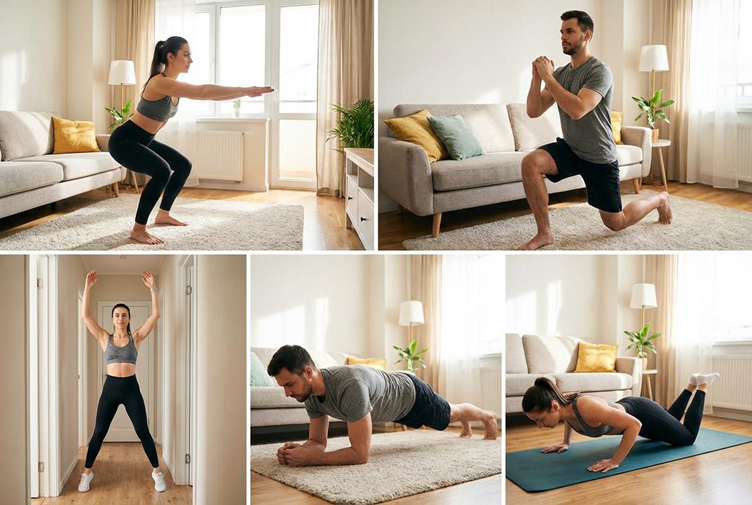
1. Bodyweight squats
Stand with your feet approximately shoulder-width apart. Push your hips backward, bend your knees, and lower yourself as far as comfortable while keeping control. Return to standing.
Beginner modification: Use a sturdy chair for support and practice sitting down and standing up with control.
2. Incline push-ups
Place your hands on a stable elevated surface such as a sturdy countertop. Keep your body aligned and lower your chest toward the surface before pushing away.
Beginner modification: Choose a higher surface to reduce the difficulty.
3. Reverse lunges
Step one foot backward and lower your body under control. Push through the front foot to return to the starting position, then switch sides.
Beginner modification: Hold onto a stable surface if balance is challenging.
4. Glute bridges
Lie on your back with your knees bent and feet planted. Lift your hips while keeping your torso controlled, pause briefly, and lower back down.
5. Forearm plank
Place your forearms on the floor and extend your legs behind you. Keep your torso stable rather than allowing your lower back to sag.
Beginner modification: Perform the plank with your knees on the floor.
Rest for approximately 30–60 seconds between exercises when needed. Complete two or three rounds depending on your fitness level.
Cool-down: 5 minutes
Finish with slower movement and comfortable stretching. Focus on relaxed breathing rather than forcing a stretch.
A Practical Weekly Home Workout Schedule
You do not have to train hard every day. A balanced weekly schedule might look like this:
| Day | Activity |
| Monday | Full-body strength workout |
| Tuesday | 20–30 minutes of brisk walking or cardio |
| Wednesday | Full-body strength workout |
| Thursday | Mobility, walking, or active recovery |
| Friday | Full-body strength workout |
| Saturday | Longer walk, cycling, dancing, or recreational activity |
| Sunday | Rest or gentle movement |
This is only an example. Your schedule should reflect your fitness level, available time, preferences, and recovery needs.
The important principle is to gradually build activity rather than attempting to reach a high training volume immediately. WHO specifically advises inactive people to start with smaller amounts and progressively increase frequency, intensity, and duration.
How to Make Home Workouts More Effective
Simply repeating the same workout forever may eventually limit progress. Instead, gradually increase the challenge.
Increase repetitions
For example, you might progress from 8 squats to 10 and eventually 12 repetitions while maintaining good technique.
Add resistance
When bodyweight exercises become easy, resistance bands, dumbbells, or other suitable equipment can increase the challenge.
Increase exercise difficulty
A progression could look like:
Wall push-up → incline push-up → knee push-up → standard push-up
Similarly:
Chair squat → bodyweight squat → split squat → loaded squat
Progression should be gradual. Quality movement is more important than rushing toward advanced variations.
Improve consistency
A realistic 25-minute workout performed regularly is generally more useful than an ambitious two-hour program that you cannot maintain.
Common Home Workout Mistakes to Avoid
Doing too much too soon
Starting with an extremely demanding workout can leave you excessively sore and make it harder to continue.
Instead, begin at a manageable level and increase the challenge gradually.
Ignoring technique
More repetitions do not compensate for poor movement quality. Perform exercises slowly enough to maintain control.
If you are unsure about technique, consider working with a qualified fitness professional who can assess your movement and provide personalized instruction.
Training only one body part
Doing hundreds of abdominal exercises, for example, does not create a balanced fitness program. Include exercises for your legs, hips, back, chest, shoulders, arms, and core.
Forgetting everyday movement
Your workout is only one part of your overall activity. Walking, taking stairs, household chores, recreational activities, and other movement also contribute to physical activity. WHO recognizes physical activity across daily life, not only formal exercise sessions.
Do You Need Equipment for Home Workouts?
No. You can begin with bodyweight exercises.
However, a few pieces of equipment can provide useful progression:
- Exercise mat
- Resistance bands
- Pair of adjustable dumbbells
- Kettlebell
- Stable step or platform
- Pull-up bar, if appropriate for your space and ability
Equipment should complement your routine rather than become a barrier to starting.
For nutrition habits that support an active lifestyle, see this practical guide to balanced nutrition and healthy eating.
How to Stay Consistent With Your Routine
Motivation naturally changes from day to day, so build a routine around practical habits.
Set a specific workout time
Instead of saying, “I’ll exercise sometime tomorrow,” choose a realistic time.
Keep your equipment visible
Leaving your exercise mat or resistance bands somewhere accessible can reduce the friction of starting.
Track progress
Record simple measures such as:
- Number of workouts completed
- Repetitions performed
- Exercise variations
- Walking or cardio time
- How the workout felt
Progress is not limited to changes in appearance. Being able to perform more repetitions with good form, recover more comfortably, or complete an exercise variation that was previously difficult can also represent meaningful improvement.
Safety Tips for Exercising at Home
Before exercising, clear enough space to move safely and check that equipment is stable.
Stop an exercise if you experience sharp or unusual pain, dizziness, faintness, or other concerning symptoms. Normal muscular effort is different from acute pain.
If you have a chronic health condition, disability, or other individual health considerations, seek appropriate professional guidance about the type and intensity of exercise that is suitable for you. The CDC specifically recommends discussing physical activity with a healthcare professional in certain circumstances, including some chronic conditions and before beginning vigorous activity after inactivity.
A Simple Long-Term Approach
Instead of searching for the “perfect” home workout, focus on four principles:
Move regularly.
Break up sedentary periods and look for opportunities to be active throughout the day.
Train your whole body.
Combine lower-body, upper-body, and core exercises.
Progress gradually.
Increase repetitions, resistance, duration, or exercise difficulty over time.
Recover adequately.
Allow your body appropriate recovery between challenging sessions and maintain healthy sleep and nutrition habits.
Conclusion
A successful home workout routine does not need to be complicated. With a small amount of space, bodyweight exercises, and a realistic schedule, you can create a routine that develops strength, cardiovascular fitness, mobility, and general physical activity.
Start with manageable sessions, learn the basic movements, and gradually increase the challenge as your fitness improves. Most importantly, choose a routine that fits your lifestyle well enough to become a regular habit.
Fitness at home is less about having the perfect equipment and more about consistent movement, sensible progression, good technique, and patience. Start where you are, build gradually, and make your routine something you can realistically maintain.

1 Comment
Pingback: How to Build a Healthy Daily Routine: A Practical Guide