
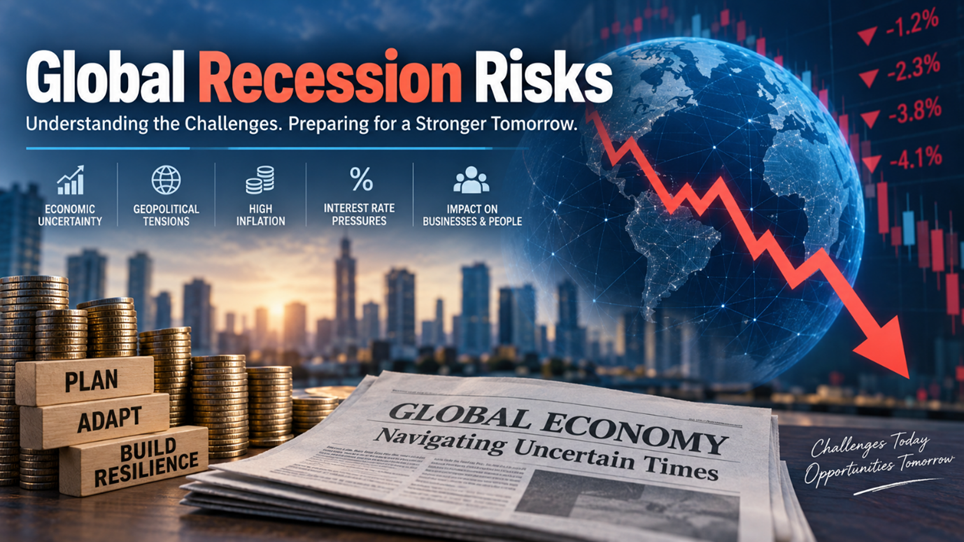
The global economy has entered 2026 with a mixture of resilience and uncertainty. Major international institutions do not currently describe a worldwide recession as the baseline outcome, but they do identify several interconnected risks that could weaken growth sharply.
The latest forecasts illustrate why the situation deserves close attention. The IMF projects global growth of 3.0% in 2026 and 3.4% in 2027, while the OECD March outlook projected 2.9% growth in 2026. The World Bank has a more cautious June forecast of 2.5% growth in 2026, reflecting the effects of higher energy prices and geopolitical disruption.
A global slowdown is not automatically a recession. A recession generally involves a substantial, widespread decline in economic activity, employment, income, production, and spending. The important question, therefore, is not simply “Is a recession coming?” but rather: Which risks could turn a manageable slowdown into a much broader economic contraction?
What Are Global Recession Risks?
Global recession risks are the economic, financial, geopolitical, and structural factors that could cause worldwide economic activity to deteriorate significantly.
Unlike a purely domestic recession, a global downturn can spread through interconnected channels:
- International trade
- Energy and commodity prices
- Financial markets
- Banking and credit
- Supply chains
- Consumer spending
- Business investment
- Exchange rates
- Government debt
This interconnections can create a feedback loop. For example, an energy shock can increase inflation, prompting tighter monetary policy. Higher interest rates can reduce borrowing and investment, which weakens employment and consumer spending. Lower demand then affects exporters in other countries.
That is why seemingly regional problems can become global economic risks.
The Current Global Economic Picture
The latest international forecasts provide an important distinction between slow growth and recession.
The IMF’s July 2026 World Economic Outlook expects global growth of 3.0% in 2026, followed by 3.4% in 2027. It says the global economy is being pulled in two directions: geopolitical and energy shocks are weighing on activity, while technology investment and AI-related demand are supporting growth.
The World Bank is more cautious, forecasting 2.5% global growth for 2026, down from 2.9% in 2025. It identifies escalating conflict, commodity disruptions, financial stress, and policy uncertainty as significant downside risks.
The OECD similarly emphasizes that higher energy prices could prolong inflation and reduce demand. Its March 2026 outlook projected 2.9% global growth in 2026 and 3.0% in 2027.
These differences are a useful reminder: economic forecasts are scenarios, not guarantees.
1. Geopolitical Conflicts and Energy Shocks
One of the most immediate global recession risks is a prolonged geopolitical crisis that disrupts energy supplies or international trade.
The current Middle East conflict has demonstrated this transmission mechanism. Disruptions affecting energy production and shipping can push up oil, gas, and fertilizer prices. Higher input costs then spread through transportation, manufacturing, agriculture, and household consumption.
How an energy shock can spread
Consider a manufacturing company that depends heavily on imported fuel and electricity.
- Energy prices rise.
- Production becomes more expensive.
- The company raises prices or reduces production.
- Consumers face higher prices.
- Central banks become concerned about inflation.
- Interest rates may remain higher for longer.
- Investment and consumption weaken.
If this process occurs across many economies simultaneously, global growth can deteriorate.
The OECD has warned that a prolonged disruption to energy supplies could produce significantly weaker growth and higher inflation than its baseline scenario.
2. Persistent Inflation and Higher Interest Rates
Inflation is another major recession risk because it creates a difficult policy dilemma.
When inflation remains high, central banks may be reluctant to reduce interest rates even when economic growth weakens.
This can create a situation sometimes described as a growth-inflation squeeze:
Inflation remains too high for aggressive monetary easing, while economic activity is too weak for comfortable policy tightening.
Higher interest rates affect the economy through several channels:
- Mortgages become more expensive.
- Corporate borrowing costs rise.
- Business investment may decline.
- Consumers reduce discretionary spending.
- Governments face higher debt-servicing costs.
- Asset valuations can come under pressure.
The IMF reported in July that global disinflation had stalled, with headline inflation projected at 4.7% for 2026.
This does not mean that high inflation inevitably causes recession. The risk becomes more serious when inflation remains persistent while growth, employment, or financial stability deteriorate.
3. Trade Fragmentation and Supply-Chain Disruptions
Globalization has created enormous economic efficiencies, but it also creates dependencies.
Modern products frequently cross multiple borders before reaching consumers. A smartphone, automobile, or piece of industrial equipment can depend on raw materials, components, software, and logistics networks spanning numerous countries.
Trade restrictions, tariffs, sanctions, or geopolitical tensions can therefore increase costs and reduce economic efficiency.
The IMF identifies trade fragmentation as a downside risk because greater barriers can hurt output while increasing prices.
Real-world example
Imagine an automobile manufacturer that imports components from five countries.
If tariffs or shipping disruptions increase the cost of those components, the manufacturer may:
- Raise vehicle prices.
- Delay production.
- Search for alternative suppliers.
- Reduce investment.
- Pass higher costs to consumers.
If many industries experience similar disruptions, the effect can extend beyond individual companies and affect national economic growth.
4. High Public and Private Debt
Debt is not necessarily a problem. Borrowing can finance productive investments that increase future economic output.
The risk emerges when debt becomes difficult to service.
Governments, companies, and households can all become vulnerable when interest rates rise or incomes fall.
The IMF noted in September 2026 that global public debt is approaching 100% of GDP, highlighting the limited fiscal room available to many governments if another major shock occurs.
Why debt matters during a recession
During a healthy economy, borrowers can often service debt using relatively stable income.
During a downturn:
Lower income → weaker cash flow → difficulty servicing debt → reduced spending and investment → weaker economic activity.
Highly indebted emerging economies can be particularly vulnerable to currency depreciation, capital outflows, and higher international borrowing costs.
5. Financial-Market Repricing
Financial markets can amplify economic problems.
Investors continuously reassess expectations about interest rates, corporate earnings, inflation and economic growth. If expectations change abruptly, asset prices can fall rapidly.
The danger is not simply that stock markets decline. The bigger concern is what happens if market stress affects:
- Bank lending
- Corporate financing
- Investment funds
- Credit markets
- Household wealth
- Business confidence
The IMF has identified potential financial-market repricing as an important downside risk, particularly if geopolitical conditions deteriorate or expectations surrounding technology investment change sharply.
6. A Sharp Correction in Technology Investment
Artificial intelligence is currently one of the important sources of global investment and productivity optimism.
The IMF says AI-driven demand is supporting economies integrated into the global technology value chain.
However, investment booms can also create vulnerabilities if expected returns fail to materialize.
For example, if businesses spend heavily on AI infrastructure but productivity gains are substantially weaker than expected, investors could reassess company valuations and future investment plans.
That would not automatically create a recession. But if a technology correction coincided with high debt, weak consumer demand, and tight financial conditions, its effects could become considerably larger.
The OECD has similarly highlighted lower-than-expected returns from AI investment as a potential downside risk.
7. Weak Consumer Demand
Consumers account for a substantial share of economic activity in many major economies.
A prolonged reduction in consumer spending can therefore become a significant recession signal.
Households may cut spending when:
- Real wages fall.
- Food and energy costs rise.
- Borrowing becomes expensive.
- Job security deteriorates.
- House prices decline.
- Consumer confidence weakens.
The problem can become self-reinforcing.
Lower spending → lower business revenue → reduced hiring → weaker household income → even lower spending.
For businesses, monitoring consumer demand is therefore often more useful than focusing exclusively on headline GDP forecasts.
8. Why Emerging Markets Could Face Greater Pressure
Global recession risks are not distributed evenly.
Countries that rely heavily on imported energy, foreign capital or commodity exports may have fewer tools available to absorb an external shock.
The World Bank expects emerging market and developing economies to experience their weakest per-capital income growth since the pandemic in 2026. It also highlights rising borrowing costs and fiscal constraints as important challenges.
However, there are also important differences between countries.
An energy-importing economy may suffer when oil prices rise, while an energy exporter could benefit from higher export revenues. Similarly, countries with strong foreign-exchange reserves and relatively low debt may be better positioned to withstand financial volatility.
How to Tell if Recession Risks Are Increasing
No single indicator can reliably predict a global recession. A better approach is to monitor several indicators together.
Key indicators to watch
1. Global GDP growth
Persistent downward revisions across major economies can indicate deteriorating conditions.
2. Employment
Rising unemployment and falling job creation can signal weakening demand.
3. Inflation
Persistent inflation can restrict central banks’ ability to support growth.
4. Interest rates
Higher borrowing costs can expose heavily indebted households and businesses.
5. Manufacturing activity
Manufacturing surveys can provide relatively early information about changes in business conditions.
6. Global trade volumes
A sustained decline can signal weakening demand and supply-chain problems.
7. Credit conditions
Tighter lending standards can indicate increasing financial stress.
8. Commodity prices
Sudden increases in energy or food prices can create inflationary pressure.
9. Business investment
Falling capital expenditure may indicate that companies expect weaker future demand.
10. Financial-market volatility
Sharp repricing across credit, equity and currency markets deserves particular attention.
What Governments and Businesses Can Do
Recession preparation is not about predicting the exact date of a downturn. It is about improving resilience before conditions deteriorate.
Governments
Policymakers can focus on:
- Maintaining sustainable public finances.
- Protecting vulnerable households with targeted support.
- Preserving financial-system stability.
- Improving energy security.
- Diversifying supply chains.
- Supporting productivity-enhancing investment.
- Avoiding policies that unnecessarily intensify inflation.
The OECD recommends targeted and temporary measures when governments cushion households and businesses from energy shocks, while preserving incentives to reduce energy consumption.
Businesses
Companies can strengthen resilience by:
- Maintaining adequate liquidity.
- Reviewing debt maturities.
- Diversifying critical suppliers.
- Stress-testing cash flow.
- Avoiding excessive dependence on one market.
- Controlling unnecessary costs.
- Investing selectively in productivity.
For example, a manufacturer might model what would happen if energy costs increased 30%, sales declined 15%, and financing costs rose simultaneously. Such scenario planning can reveal weaknesses before they become emergencies.
Households
Individuals can also reduce exposure by maintaining emergency savings, managing high-cost debt carefully, and avoiding excessive financial commitments based on optimistic income assumptions.
The goal is not to become fearful during every economic slowdown. It is to build enough financial flexibility to withstand uncertainty.
Is a Global Recession Inevitable?
No.
Current international forecasts show that the global economy is still expected to grow in 2026 and 2027, although the outlook varies considerably between institutions and countries.
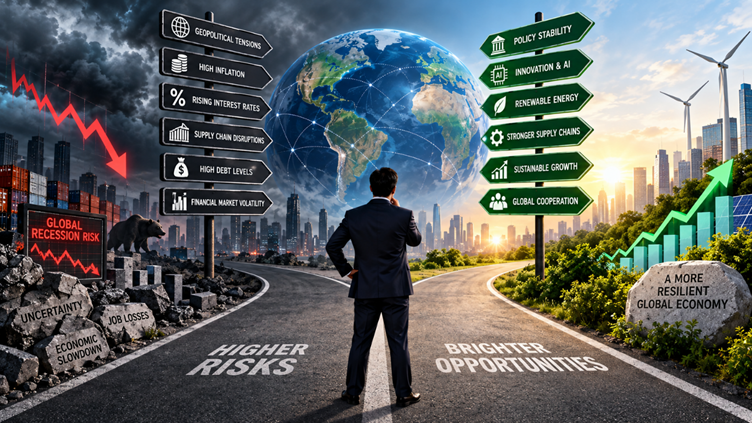
There are also forces supporting growth. Technology investment, productivity improvements, energy diversification, and resilient businesses can offset some of the negative effects of geopolitical and financial shocks.
The more appropriate conclusion is that global recession risks are elevated enough to justify careful monitoring, but a synchronized worldwide recession should not be treated as a certainty.
Conclusion: Resilience Matters More Than Predictions
Global recession risks rarely come from a single event. They usually emerge from the interaction of several vulnerabilities.
An energy shock can intensify inflation. Inflation can keep interest rates higher. Higher rates can expose excessive debt. Financial stress can reduce investment. Falling investment and consumer spending can then weaken employment and global trade.
That interconnected chain is what makes the current economic environment important to watch.
At the same time, the global economy has demonstrated considerable resilience. The IMF’s latest assessment expects continued global growth, while the World Bank and OECD emphasize that significant downside risks exist alongside potential sources of recovery.
For businesses, governments and households, the most useful response is therefore neither complacency nor panic. It is preparation: maintain financial flexibility, diversify risks, monitor economic indicators and invest in productivity and resilience.
A recession cannot always be prevented. But the economic damage from one can often be reduced when institutions and individuals enter the downturn prepared rather than surprised.
