

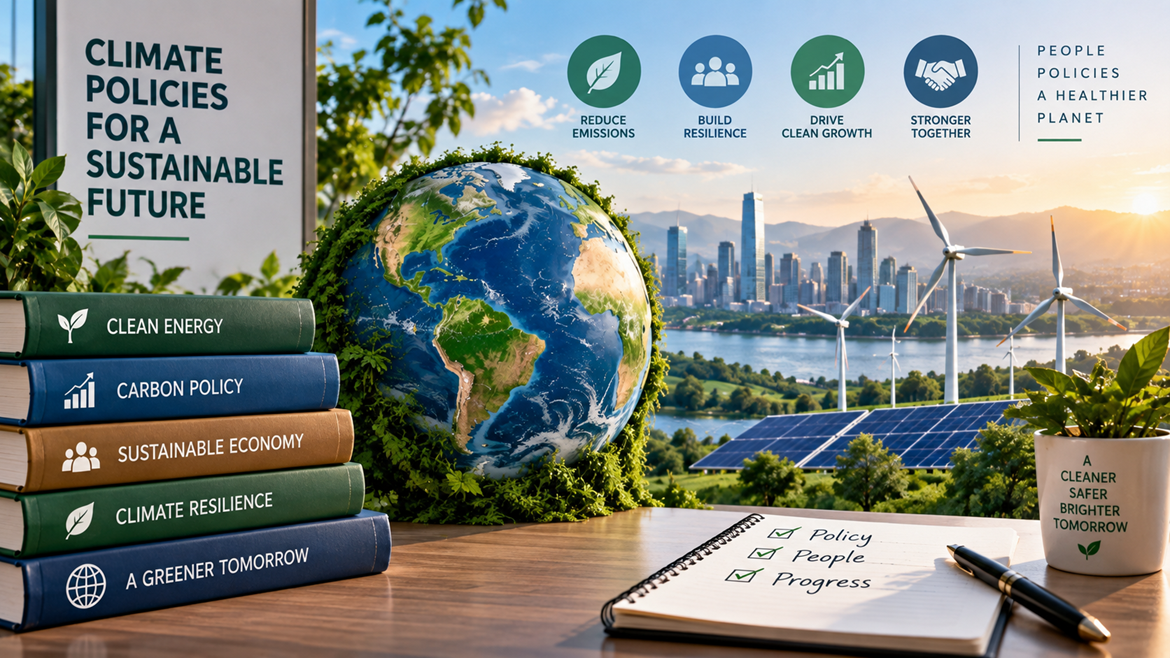
Climate change policies are the rules, investments, incentives, and international agreements governments use to reduce greenhouse gas emissions, prepare communities for climate impacts, and accelerate the transition toward cleaner economies.
These policies matter because climate change is not simply an environmental issue. It affects energy systems, agriculture, infrastructure, public health, trade, finance, employment, and long-term economic development. Effective policy therefore requires more than a single solution. Governments typically combine regulations, carbon pricing, public investment, clean-energy incentives, adaptation measures, and international cooperation.
The global policy framework is anchored by the Paris Agreement, a legally binding international treaty adopted in 2015. Its central goal is to hold the increase in global average temperature to well below 2°C above per-industrial levels while pursuing efforts to limit warming to 1.5°C.
What Are Climate Change Policies?
Climate change policies are government actions designed to address two broad challenges:
- Mitigation: Reducing greenhouse-gas emissions or increasing carbon removal.
- Adaptation: Preparing societies and economies for climate impacts that are already occurring or expected.
A comprehensive climate strategy normally combines both.
For example, replacing coal-fired electricity with renewable energy is a mitigation measure. Building flood-resistant infrastructure, improving early-warning systems, or developing drought-resistant crops are adaptation measures.
The strongest policy frameworks recognize that mitigation and adaptation are interconnected. Reducing emissions can limit future risks, while adaptation helps communities manage unavoidable impacts.
Major Types of Climate Change Policies
1. Carbon Pricing
Carbon pricing attempts to incorporate the environmental cost of greenhouse-gas emissions into economic decisions.
The two most common approaches are:
Carbon taxes: Governments establish a price per unit of emissions.
Emissions trading systems (EST): Governments establish an emissions limit and allow covered companies to trade emissions allowances.
The economic logic is relatively straightforward: when emitting carbon becomes more expensive, businesses and consumers have stronger incentives to improve efficiency, adopt cleaner technologies, and reduce fossil-fuel use.
The IMF’s climate-policy research identifies carbon pricing as an important component of climate strategy, while also emphasizing that it works best alongside complementary policies.
2. Renewable Energy Policies
Governments can accelerate clean-energy deployment through:
- Renewable-energy auctions
- Tax credits and investment incentives
- Feed-in tariffs
- Clean-energy standards
- Grid modernization
- Public investment in transmission
- Support for energy storage
These policies can reduce barriers that prevent new technologies from competing immediately with established fossil-fuel infrastructure.
For example, a government might use competitive auctions to encourage companies to build large-scale solar or wind projects at increasingly competitive prices.
3. Energy Efficiency Standards
Energy efficiency is often one of the most practical areas for climate policy.
Governments can establish efficiency standards for:
- Buildings
- Appliances
- Vehicles
- Industrial equipment
- Heating and cooling systems
Building codes are particularly important because buildings can remain in use for decades. Requiring better insulation, efficient cooling systems, and energy-conscious design can reduce energy consumption throughout a building’s lifetime.
4. Electric Transportation Policies
Transportation policies increasingly focus on reducing emissions from cars, buses, trucks, and other vehicles.
Common measures include:
- Electric-vehicle incentives
- Charging infrastructure investment
- Fuel-economy standards
- Zero-emission vehicle requirements
- Public-transit investment
- Walking and cycling infrastructure
A successful transportation strategy does not necessarily mean replacing every conventional vehicle with an electric one. Urban planning, public transportation, and reduced dependence on private vehicles can also play important roles.

Climate Adaptation Policies
Even with aggressive emissions reductions, some climate impacts cannot be avoided immediately. Adaptation policies help societies manage these risks.
Infrastructure Resilience
Governments can update infrastructure standards to account for changing climate risks.
Examples include:
- Flood-resistant roads
- Stronger drainage systems
- Heat-resistant railways
- Coastal defenses
- Water-storage systems
- More resilient electricity grids
The objective is not simply to repair infrastructure after disasters, but to reduce vulnerability before damage occurs.
Agriculture and Water Management
Farmers may face increased pressure from heat, drought, changing rainfall patterns, and water shortages.
Policy responses can include:
- Drought-resistant crops
- Efficient irrigation
- Soil conservation
- Weather forecasting
- Agricultural insurance
- Water-efficiency programs
These measures can improve resilience while supporting food security and rural livelihoods.
The Role of International Climate Agreements
Climate change is a global problem because greenhouse gases mix throughout the atmosphere. Emissions reductions in one country therefore benefit countries everywhere.
The Paris Agreement addresses this challenge through Nationally Determined Contributions (NDCs). Countries submit national climate plans and are expected to strengthen their efforts over time through a five-year cycle.
However, commitments on paper are not enough. Governments must translate targets into legislation, budgets, infrastructure projects, industrial policies, and measurable emissions reductions.
The UNEP Emissions Gap Report 2025 illustrates the challenge: even full implementation of available NDCs was projected to result in approximately 2.3–2.5°C of warming over this century, while current policies were associated with a higher projection of around 2.8°C.
Why Climate Policy Must Consider Economic Impacts
Climate policies can create economic benefits, but they also produce transition costs.
For example, a carbon price may encourage cleaner energy but increase costs for some carbon-intensive businesses and households. Workers and communities dependent on fossil-fuel industries may also face disruption.
That is why climate policy increasingly emphasizes a just transition.
Governments can use climate-policy revenues and public investment to support:
- Low-income households
- Worker retraining
- Regional economic diversification
- Clean-energy employment
- Small businesses
- Communities dependent on high-carbon industries
IMF analysis emphasizes that climate strategies need to balance environmental objectives with fiscal sustainability, economic efficiency, and protection for vulnerable households and workers.
Real-World Application: A Policy Package Rather Than One Solution
Consider a country seeking to reduce emissions from electricity generation.
Instead of relying exclusively on a carbon tax, policymakers could combine:
- A gradually increasing carbon price
- Competitive renewable-energy auctions
- Investment in electricity transmission
- Energy-efficiency standards
- Support for energy storage
- Assistance for affected workers
- Financial support for low-income households
- Clear emissions-monitoring requirements
This approach illustrates an important lesson: climate policy works best as a coordinated system rather than as a collection of isolated measures.
The IMF’s Climate Policy Assessment Tool, for example, evaluates combinations of measures including carbon pricing, fossil-fuel subsidy reform, energy-efficiency regulations, renewable subsidies, green public investment, and other instruments.
Challenges Facing Climate Change Policies
Political Feasibility
Climate policies can affect energy prices, employment, investment, and household budgets. Policies that ignore these effects may face strong public resistance.
Transparent communication and targeted financial support can improve acceptance.
Policy Stability
Businesses make investments based on expectations about future regulations. Frequent policy reversals can increase uncertainty and discourage investment.
Long-term targets therefore need credible implementation plans.
International Competitiveness
If one country imposes substantially higher costs on carbon-intensive production than its competitors, industries may face competitive pressure.
This has contributed to growing interest in international coordination, carbon-border measures, and common climate standards.
Financing
Developing economies often face particularly difficult financing challenges. They may need substantial investment in clean energy, resilient infrastructure, transportation, water systems, and adaptation while also addressing poverty and development needs.
International climate finance and private investment can therefore play important roles.
How Effective Climate Policies Should Be Evaluated
A climate policy should not be judged only by its stated objective. Policymakers should measure whether it actually produces results.
Important indicators include:
- Greenhouse-gas emissions
- Energy intensity
- Renewable-energy deployment
- Fossil-fuel consumption
- Air quality
- Household energy costs
- Employment
- Private investment
- Climate-resilience improvements
- Distributional impacts
Regular measurement makes it possible to strengthen policies that work and redesign policies that do not.
The Future of Climate Policy
Climate policy is moving toward a broader approach that combines environmental goals with economic and social priorities.
Future policy frameworks are likely to place increasing emphasis on clean industrial development, resilient infrastructure, low-carbon technologies, climate finance, electricity-grid modernization, and policies that help workers and communities manage economic transitions.
The key challenge is implementation. Setting ambitious targets is important, but achieving meaningful emissions reductions requires consistent investment, effective institutions, credible regulation, technological deployment, and public support.
Conclusion
Climate change policies are no longer limited to environmental regulations. They increasingly shape energy, transportation, industry, agriculture, infrastructure, finance, and economic development.
The most effective approach is rarely a single policy instrument. Carbon pricing can create incentives to reduce emissions, while regulations can establish minimum standards. Public investment can accelerate clean technologies, and adaptation programs can protect communities from climate risks. Social policies can ensure that the transition does not place disproportionate burdens on vulnerable households and workers.
Ultimately, successful climate policy depends on turning long-term climate objectives into practical, measurable action. The challenge is substantial, but carefully designed policies can simultaneously reduce emissions, strengthen resilience, encourage innovation, and support a more sustainable economic future.
