

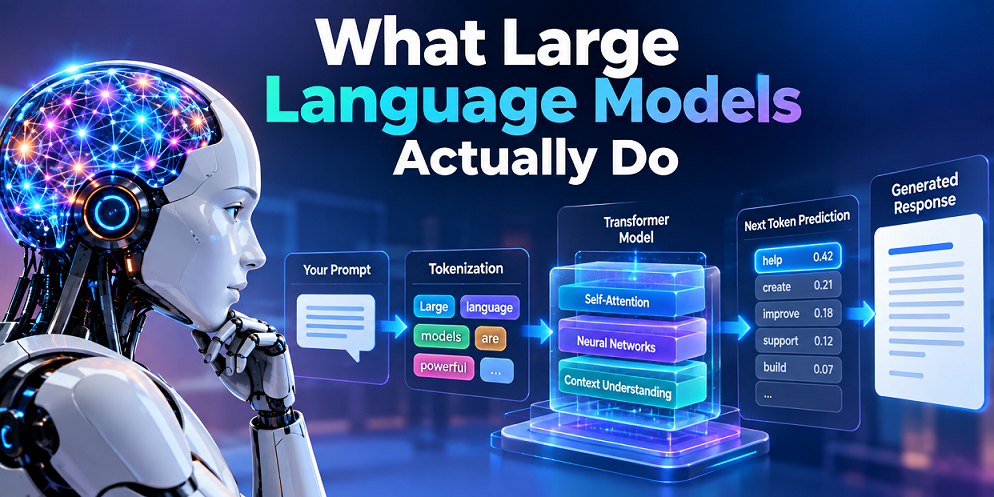
Large language models (LLMs) have become a central technology behind modern AI assistants, search tools, coding applications, and content-generation systems. They can write, summarize, translate, answer questions, analyze text, and generate computer code. But what is actually happening inside an LLM when it produces an answer?
At its core, an LLM is a neural network trained to recognize patterns in enormous amounts of data and generate sequences of tokens. Most modern LLMs are based on the Transformer architecture, introduced in the 2017 research paper Attention Is All You Need.
Understanding this basic mechanism makes it easier to appreciate both what LLMs can do and where their limitations come from.
What Is a Large Language Model?
An LLM is a deep-learning model trained on very large collections of text and, depending on the system, code or other data. During training, the model learns statistical relationships between tokens—the smaller units into which text is divided.
For example, the sentence:
“The sun rises in the ___.”
contains contextual information that makes “east” a likely continuation.
The model does not simply store a giant collection of completed sentences. Instead, training adjusts billions of numerical parameters so the network becomes better at predicting patterns in language.
How LLMs Process Your Prompt
1. Text Is Converted Into Tokens
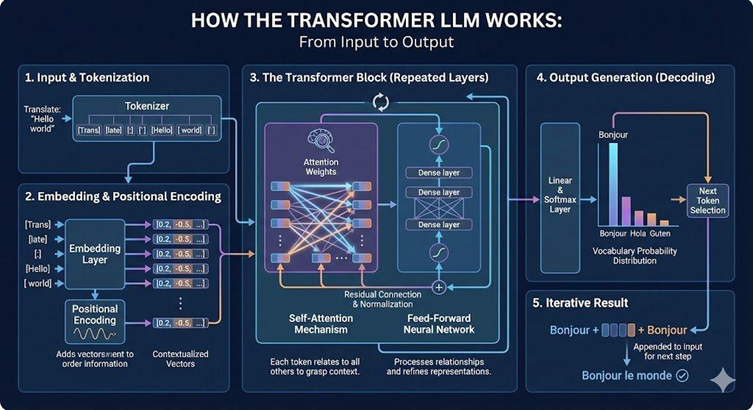
When you enter a prompt, the model first breaks it into tokens. A token can represent a complete word, part of a word, punctuation, or another small unit.
For example, a technical word may be divided into several tokens rather than being treated as one complete word.
These tokens are then converted into numerical representations that the neural network can process.
2. The Transformer Processes Context
The tokens pass through multiple Transformer layers.
One of the most important mechanisms is self-attention. It allows the model to consider relationships between different parts of the input when determining what information is relevant.
Consider:
“The company launched a new product because it wanted to increase sales.”
To interpret “it,” the model needs to consider the surrounding context. Attention mechanisms help the network represent these relationships.
Transformers were designed to process relationships between elements in a sequence efficiently, which helped enable the development of modern large-scale language models.
The Key Job: Predicting the Next Token
The simplest way to understand an auto regressive LLM is to think of it as repeatedly answering one question:
“Given everything so far, what token should come next?”
Suppose the prompt is:
“Artificial intelligence can help businesses”
The model calculates probabilities for possible next tokens, such as “automate,” “analyze,” “improve,” or other possibilities.
It selects a token according to its generation settings and then performs the process again using the expanded sequence.
This continues token by token until the response is complete.
This is why an LLM does not normally generate an entire paragraph simultaneously. The output is constructed sequentially.
Why Does It Appear to Understand?
This is one of the most interesting aspects of LLMs.
During training, models encounter enormous numbers of examples containing grammar, facts, concepts, relationships, writing styles, programming structures, and other patterns. Their parameters are adjusted to become better at predicting the next token.
As a result, the model can develop representations that allow it to perform tasks such as summarization, translation, question answering, classification, and code generation—even when it was not separately programmed with a specific rule for every task.
However, fluent language should not automatically be interpreted as proof that the model possesses human-like understanding or consciousness.
What LLMs Can Actually Do
LLMs are useful because the same underlying prediction mechanism can support many applications.
Content and Communication
They can help draft:
- Articles and reports
- Emails and business documents
- Product descriptions
- Summaries
- Marketing copy
- Brainstorming materials
Programming
LLMs can generate, explain, transform, and debug code. Developers can use them to understand unfamiliar co debases, create prototypes, generate documentation, or explore implementation approaches.
Information Processing
An LLM can summarize long text, extract information, classify documents, translate languages, and transform information into different formats.
Conversational Interfaces
Businesses can integrate LLMs into customer-support systems, knowledge assistants, internal search tools, and other conversational applications.
In many real-world systems, an LLM is combined with external tools, databases, search systems, or retrieval mechanisms rather than operating alone.
What LLMs Do Not Automatically Do
An LLM’s ability to produce convincing text does not guarantee that every statement is correct.
Models can generate hallucinations, meaning outputs that appear plausible but contain inaccurate or unsupported information. Grounding an LLM with reliable external information, such as through retrieval-augmented generation (RAG), can reduce this risk.
LLMs also do not automatically have current information unless their surrounding application provides access to updated sources or tools.
For important decisions, factual claims should therefore be checked against reliable primary or authoritative sources.
Why the Distinction Matters
Understanding how LLMs work changes how people should use them.
Instead of thinking of an LLM as an infallible database, it is more accurate to view it as a powerful language-processing and generation system that has learned complex patterns from training data.
The quality of the result depends on factors such as the model, prompt, available context, training, generation settings, and whether the system can access reliable external information.
Conclusion
Large language models are sophisticated pattern-learning systems built primarily around neural networks and Transformer architectures. Their fundamental operation is surprisingly straightforward to describe: process tokens, use contextual representations to estimate probabilities, and generate output one token at a time.
What makes LLMs powerful is the scale and complexity of the patterns they learn. That capability allows one model to support writing, programming, summarization, translation, question answering, and many other tasks.
At the same time, fluent output is not the same as guaranteed truth. Understanding both the capabilities and limitations of LLMs is essential for using AI responsibly, efficiently, and effectively.
