

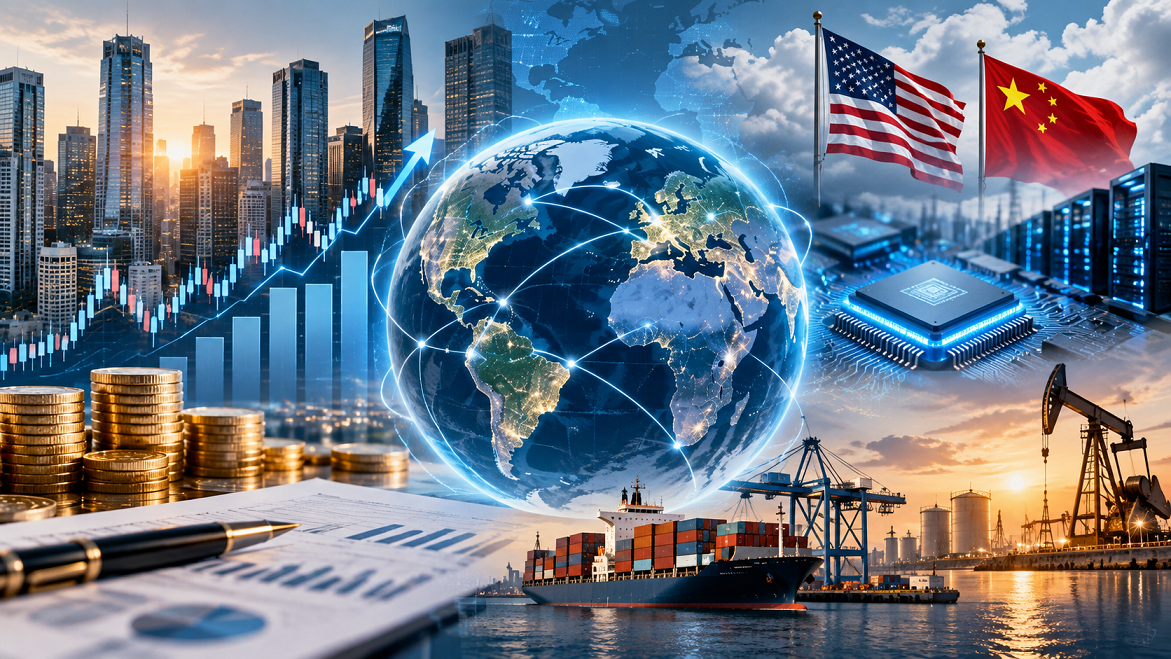
The global business landscape is being shaped by several forces at once: changing interest-rate expectations, renewed U.S.-China trade discussions, elevated government bond yields, continuing investment in artificial intelligence, and persistent energy-market uncertainty.
For companies, investors, entrepreneurs, and consumers, these stories are connected. Higher borrowing costs can affect business investment, energy prices can influence operating expenses, and trade policy can reshape supply chains. At the same time, enormous spending on AI infrastructure is creating opportunities for technology, energy, semiconductor, and data-center businesses.
Here are some of the most important business developments to understand this week, ending September 24, 2026.
1. U.S.-China Trade Takes Center Stage
One of the biggest business stories this week is the meeting between U.S. President Donald Trump and Chinese President Xi Jinping in Washington.
The two countries have extended their trade truce while officials continue discussions about a broader agreement. Reuters reported that U.S. and Chinese officials agreed to extend the current trade arrangement by two months, giving negotiators additional time to work toward a larger deal.
The discussions matter far beyond Washington and Beijing.
Why businesses are watching
The United States and China remain deeply connected through manufacturing, technology, agriculture, consumer goods, energy, and logistics. Changes in tariffs or export restrictions can therefore affect companies well outside either country.
Businesses importing products from China, for example, may need to reconsider:
- Supplier locations
- Inventory levels
- Shipping routes
- Product pricing
- Manufacturing costs
- Long-term sourcing strategies
Technology companies are paying particular attention to restrictions involving advanced semiconductors and artificial intelligence.
The summit also comes as the two governments discuss AI safety and other technology-related issues.
For multinational companies, the broader lesson is clear: geopolitical developments are increasingly becoming business-planning variables.
2. Borrowing Costs Are Becoming a Bigger Business Concern
Interest rates and government bond yields remain another major focus for financial markets.
The Federal Reserve raised its benchmark interest-rate target by 25 basis points in September, taking the target range to 3.75%–4.00%. Reuters reported that policymakers also signaled concerns about persistent inflation and the possibility of additional tightening.
At the same time, the U.S. 10-year Treasury yield has moved around the 5% level, a development that matters because Treasury yields influence borrowing costs throughout the financial system.
Reuters reported this week that investors are increasingly discussing whether 6% could eventually become a new psychological threshold for the 10-year Treasury yield.
What this means for companies
Higher long-term borrowing costs can make it more expensive for companies to:
- Finance acquisitions
- Build factories
- Expand offices
- Purchase equipment
- Fund real-estate projects
- Refinance existing debt
Smaller businesses can feel the impact particularly quickly because they often rely more heavily on bank loans and variable-rate financing.
For example, a company planning to borrow $10 million for expansion may discover that a relatively small change in financing costs can materially affect the project’s expected return.
This is why businesses are increasingly paying attention not just to central-bank decisions, but also to the broader bond market.
3. AI Investment Remains One of the Biggest Business Themes
Artificial intelligence continues to dominate corporate investment and technology strategy.
The AI boom is creating enormous demand for computing infrastructure, including advanced chips, data centers, networking equipment and electricity.
At the same time, investors are becoming more attentive to the enormous capital requirements involved.
Reuters reported that AI-related stocks experienced volatility after prominent AI industry leaders raised concerns about the pace and risks of AI development.
That does not mean AI investment has stopped. Instead, businesses are increasingly asking a more practical question:
How quickly can AI investment translate into sustainable revenue and productivity?
The infrastructure opportunity
AI is no longer just a software story.
It is increasingly an infrastructure story involving:
- Semiconductor manufacturing
- Cloud computing
- Data centers
- Electricity generation
- Cooling systems
- Networking
- Cybersecurity
- Construction
- Fiber-optic infrastructure
One example is AI cloud company Nscale, which reported a substantial increase in revenue in its 2026 IPO filing while also reporting significant losses as it invests heavily in infrastructure.
That illustrates a broader characteristic of the current AI economy: rapid growth can require enormous upfront capital.
4. Energy Prices Continue to Influence the Global Economy
Energy remains another critical factor for businesses around the world.
Geopolitical disruptions in the Middle East have contributed to higher oil prices and increased uncertainty surrounding global energy supplies. Reuters recently highlighted the combination of rising energy prices and higher borrowing costs as a growing concern for global economies.
Energy-intensive industries are particularly exposed.
These include:
- Airlines
- Transportation
- Manufacturing
- Chemicals
- Shipping
- Agriculture
- Logistics
- Data centers
For consumers, higher energy costs can eventually feed into transportation and product prices.
For businesses, the effects can appear in several places simultaneously: production costs rise, logistics become more expensive, and customers may reduce discretionary spending.
The AI-energy connection
There is also an increasingly important connection between AI and energy.
Large data centers require substantial amounts of electricity. As companies expand AI computing capacity, demand for power infrastructure is becoming an important part of technology investment.
The IMF has noted that AI-related investment, including spending on power projects required to support AI infrastructure, is contributing to growth in the United States and other economies connected to the technology supply chain.
5. Global Growth Remains Resilient—but Uneven
Despite multiple economic challenges, the global economy has continued to expand.
The IMF’s July 2026 World Economic Outlook projected global growth of 3.0% in 2026 and 3.4% in 2027, while warning that the outlook remains uneven and vulnerable to renewed conflict and financial-market repricing.
The IMF has also emphasized the importance of fiscal and monetary policies that can withstand future shocks.
India is an important part of this global picture. During a September visit, IMF Deputy Managing Director Nigel Clarke described India as a key driver of global growth and highlighted its strong economic fundamentals.
For businesses, the important point is that the global economy isn’t moving in a single direction.
Some economies and industries are benefiting from technology investment, while others are dealing with expensive energy, higher financing costs or weaker consumer demand.
6. Global Financial Markets Are Adjusting to a New Rate Environment
Equity markets have remained closely tied to developments in interest rates, energy prices and technology spending.
The combination of higher bond yields and uncertainty over inflation creates a complicated environment for investors and businesses.
When relatively safe government bonds offer higher yields, investors may demand greater potential returns from riskier assets. Higher interest rates can also reduce the present value of future corporate earnings, particularly for companies whose valuations depend heavily on expected growth far into the future.
This is particularly relevant to technology companies.
The result is not necessarily a universal decline in technology investment. Instead, markets may become more selective about which companies can demonstrate strong revenue, sustainable margins and credible long-term business models.

7. Supply Chains Are Becoming a Strategic Priority
Another important trend emerging from this week’s business news is the continuing transformation of global supply chains.
Companies once optimized supply chains primarily around cost and efficiency. Increasingly, they are also considering:
- Geopolitical risk
- Tariffs
- Energy availability
- Shipping disruptions
- Semiconductor access
- Currency movements
- Regulatory requirements
The U.S.-China trade relationship is an obvious example.
A manufacturer dependent on a single country for critical components may face significant disruption if tariffs or export restrictions suddenly change.
As a result, companies are exploring approaches such as supplier diversification, regional manufacturing and strategic inventory management.
This doesn’t necessarily mean abandoning globalization. Instead, businesses are increasingly trying to make global supply chains more resilient.
8. What These Stories Mean for Small Businesses
Large corporations dominate financial headlines, but these developments also affect smaller companies.
A small business may never trade directly with China or issue corporate bonds, yet it can still feel the consequences.
Consider a hypothetical online retailer.
If shipping costs increase, the retailer’s delivery expenses rise. If its supplier increases prices because of higher manufacturing costs, margins shrink. If interest rates remain elevated, financing inventory becomes more expensive. And if consumers face higher household expenses, they may reduce discretionary purchases.
The business therefore needs to monitor the broader economy even though it is not a multinational corporation.
Practical steps for business owners
Businesses can respond by:
- Reviewing cash flow regularly
- Avoiding unnecessary debt
- Diversifying important suppliers
- Negotiating longer-term supplier agreements where appropriate
- Monitoring energy and transportation expenses
- Testing different pricing scenarios
- Investing carefully in technology with measurable returns
The objective isn’t to predict every economic event. It is to build a business capable of adapting when conditions change.
What Businesses Should Watch Next
Several issues deserve close attention over the coming weeks.
U.S.-China negotiations
Businesses will be watching whether the extended trade truce develops into a broader agreement or whether disagreements over tariffs, technology and strategic industries return to the forefront.
Interest rates and inflation
Future inflation data and central-bank communications will remain important for borrowing costs, currencies, investment and consumer spending.
AI spending
Investors and corporate executives will increasingly focus on whether massive AI infrastructure investments generate measurable productivity improvements and revenue.
Energy markets
Any further disruption to global energy supplies could affect inflation, transportation and industrial costs.
Government debt and bond yields
Higher government borrowing costs can influence everything from corporate financing to mortgage rates and investment decisions.
The Bigger Picture
Taken together, this week’s stories reveal an increasingly interconnected business environment.
Trade policy affects supply chains. Energy affects inflation. Inflation affects interest rates. Interest rates affect borrowing costs and valuations. Meanwhile, AI investment is creating a new source of economic growth while simultaneously increasing demand for chips, electricity, data centers and capital.
For business leaders, this means traditional planning based solely on industry trends is no longer enough.
Companies need to understand the broader economic environment and build enough flexibility into their strategies to respond to rapid changes.
Conclusion
The biggest business stories this week are not isolated events. They are pieces of a larger transformation taking place across the global economy.
U.S.-China trade negotiations are influencing corporate supply-chain decisions. Higher interest rates and bond yields are changing the economics of borrowing. AI investment is creating enormous opportunities while raising questions about capital requirements and long-term returns. Energy-market uncertainty continues to influence inflation and operating costs.
For companies of every size, the practical lesson is straightforward: stay informed, protect financial flexibility, diversify where appropriate and make investment decisions based on measurable business value.
The businesses best positioned for an uncertain environment will not necessarily be those that predict every headline correctly. They will be those capable of adapting quickly when the economic landscape changes.
Editorial note: This article reflects publicly reported developments available through September 24, 2026. Economic and market conditions can change rapidly, so individual financial or business decisions should be based on current information and appropriate professional advice.
