
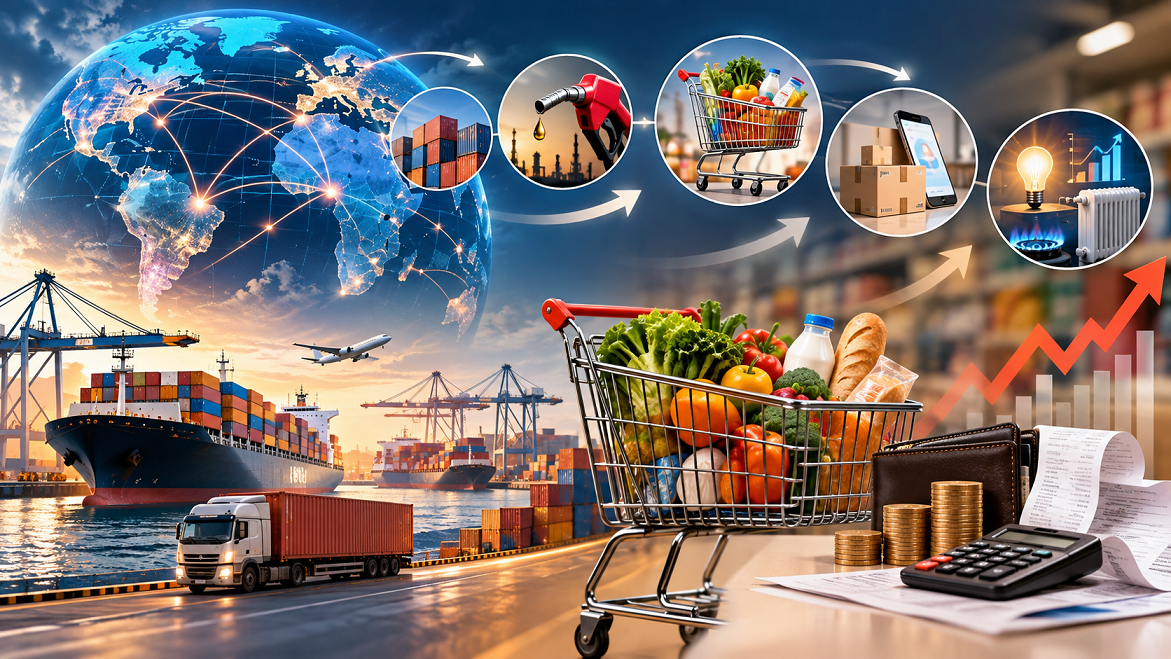
A major global event can feel distant when it happens thousands of miles away, but its economic effects can eventually appear in ordinary places: the grocery store, fuel station, online checkout, utility bill, or travel booking page.
Wars, pandemics, natural disasters, trade disruptions, major shipping interruptions, and other international shocks can affect the movement and cost of energy, food, raw materials, manufactured goods, and services. The impact is rarely identical for every country or household, however. It depends on the event, the products involved, how dependent a country is on imports, currency movements, government policies, and how quickly businesses can adjust.
Understanding these connections helps consumers make more informed financial decisions without reacting to every headline.
How Does a Global Event Reach Your Wallet?
The journey from a global event to a household budget often follows several stages:
Global event → supply disruption → higher business costs → price changes → consumer impact
For example, suppose an international disruption affects an important shipping route. A company importing components may face longer delivery times and higher transportation and insurance costs. If alternative suppliers are more expensive or difficult to find, the company may eventually pass some of those costs to customers.
Research published by the International Monetary Fund has documented a connection between shipping delays and consumer prices. Its 2026 analysis found that the effects of shipping disruptions can build over several months rather than appearing immediately.
This is why the effects of a global event may continue even after the original headline has disappeared from the news.
1. Grocery Prices Can Change
Food is one of the most visible ways global disruptions can affect households.
Food production depends on an international network involving:
- Fertilizer
- Fuel
- Agricultural machinery
- Packaging
- Transportation
- Refrigeration
- International trade
- Weather conditions
If a disruption increases the cost of fertilizer, fuel, shipping, or imported agricultural inputs, producers and distributors may face higher operating expenses.
The World Bank has reported that higher costs and supply-chain disruptions can put pressure on food prices, while fertilizer markets can also be affected by global disruptions.
A simple example
Imagine a supermarket selling imported coffee.
A major disruption increases shipping costs and delays deliveries. The retailer may initially absorb some of the additional expense. If higher costs continue, however, the wholesale price may rise, eventually affecting the price consumers see on the shelf.
The same principle can apply to packaged foods, cooking ingredients, fresh produce, and other internationally traded products.
2. Fuel and Transportation Costs May Rise
Energy markets are particularly interconnected.
Oil and gas are used not only to power vehicles but also throughout the production and transportation system. Trucks, ships, aircraft, factories, warehouses, and agricultural operations all depend to varying degrees on energy.
When a major event disrupts energy supplies or transportation routes, fuel prices can become more volatile.
That can affect consumers through:
- Petrol and diesel prices
- Airline tickets
- Delivery charges
- Public transportation costs
- Logistics expenses
- Prices of products transported long distances
The IMF has described higher commodity prices as a potential supply shock that can raise costs for energy-intensive goods and services and reduce household purchasing power.
For consumers, this means that an increase at the fuel pump can sometimes have a wider economic effect than the price of fuel itself.
3. Electronics and Other Imported Products Can Become More Expensive
Modern products often depend on complicated international supply chains.
A smartphone, laptop, automobile, appliance, or other manufactured product may involve raw materials and components sourced from several countries before final assembly.
A disruption affecting one important supplier can therefore create problems elsewhere.
For instance, if a manufacturer cannot obtain a particular component on schedule, it might:
- Delay production.
- Search for an alternative supplier.
- Pay more for components.
- Reduce product availability.
- Adjust the final retail price.
Not every disruption results in higher consumer prices. Businesses may instead absorb costs, change suppliers, redesign products, reduce margins, or delay expansion.
The final outcome depends on the duration and severity of the disruption and the availability of alternatives.
4. Online Shopping and Delivery Times Can Be Affected
Consumers increasingly expect fast delivery, but international logistics is a complex process.
An online order may involve:
Manufacturer → export warehouse → port → international shipping → import processing → distribution center → local delivery
A problem at any stage can create delays.
Shipping disruptions can also cause companies to reroute vessels, use alternative transportation, hold additional inventory, or pay higher freight rates.
The IMF notes that disruptions to shipping and air transportation can increase costs throughout supply chains and affect consumers through higher prices for food and essential goods.
For shoppers, the first visible effect may therefore be a delivery estimate changing from “2–3 days” to “2–3 weeks.”
5. Travel Can Become More Expensive
Global events can influence tourism and travel through several channels.
Airlines may face higher fuel expenses, route restrictions, operational disruptions, or reduced capacity. Hotels and tourism businesses can also experience changes in demand.
Consumers may consequently encounter:
- Higher airfare
- Fewer flight options
- Longer routes
- Higher hotel prices in some destinations
- Increased travel insurance costs
- Changes in cancellation policies
However, travel prices do not automatically rise after every global event. Reduced demand can sometimes produce the opposite effect, particularly when consumers postpone trips.
The relationship between global events and travel prices therefore depends on both supply and demand.
6. Interest Rates and Borrowing Costs May Change
The effects of a major event can extend beyond physical products.
If a global shock contributes to persistent inflation, central banks may face difficult decisions about monetary policy. Depending on the circumstances, interest rates may remain higher for longer or change in response to economic conditions.
This matters to consumers with:
- Home loans
- Personal loans
- Credit-card balances
- Business loans
- Variable-rate debt
A household may therefore experience the economic effects of an international event without purchasing any imported product.
For example, a family might notice higher monthly borrowing costs even though the original disruption occurred in another region.
7. Currency Movements Can Change What Consumers Pay
Exchange rates are another important transmission mechanism.
Suppose a country’s currency weakens against the currency used by major trading partners. Imported goods can become more expensive in local currency, assuming other factors remain unchanged.
This can affect imported:
- Electronics
- Vehicles
- Clothing
- Fuel
- Food
- Industrial products
On the other hand, a stronger currency can reduce the local-currency cost of some imports.
Currency movements can therefore amplify or partially offset the effects of a global disruption.
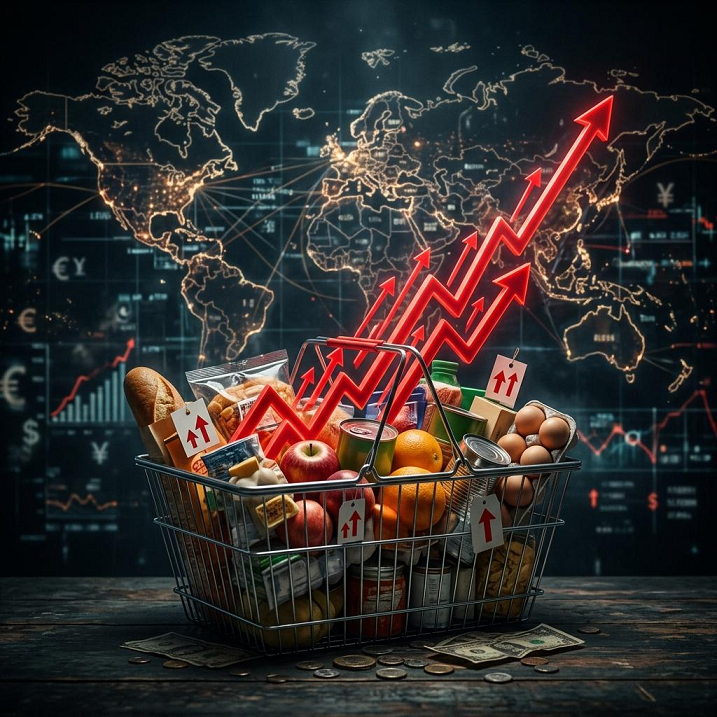
8. Employment and Household Income Can Also Be Affected
The consumer impact is not limited to prices.
A major global event can change business activity. Industries dependent on international tourism, manufacturing, energy, shipping, agriculture, or exports may experience significant changes in demand or operating costs.
Some businesses may expand because demand increases for their products. Others may reduce hiring or investment.
This creates an important distinction:
A household can be affected by a global event through both sides of its budget—income and expenses.
For example, a household might face higher transportation costs at the same time that a local employer is experiencing weaker demand.
Why the Impact Is Different for Different Households
There is no universal “global event effect.”
Two families living in the same city can experience the same event differently.
A household that spends a large percentage of its budget on transportation and food may notice changes quickly. Another household with lower transportation expenses and more discretionary spending may have more flexibility.
Income also matters. Households with limited financial buffers generally have less room to absorb sudden increases in essential expenses.
The IMF has similarly noted that global shocks can affect countries and communities unevenly, with energy-importing and economically vulnerable populations often facing greater exposure to certain disruptions.
Practical Ways Consumers Can Respond
Consumers cannot control global events, but they can improve their financial resilience.
1. Avoid panic buying
A major headline does not necessarily mean a product will become unavailable.
Buying excessive quantities can create unnecessary financial pressure and, in some circumstances, contribute to temporary shortages.
Focus on genuine household needs rather than predictions based on social media or sensational headlines.
2. Compare prices regularly
When prices become volatile, comparing retailers can reveal meaningful differences.
Consider:
- Unit price rather than package price
- Local alternatives
- Different brands
- Subscription discounts
- Delivery fees
- Seasonal promotions
3. Build an emergency fund
An emergency fund can provide protection against unexpected expenses, including higher transportation, food, utility, or borrowing costs.
Even a modest reserve can provide more flexibility than relying entirely on credit.
4. Reduce unnecessary debt
High-interest debt can become especially difficult to manage when household expenses rise.
Where practical, consumers can prioritize expensive revolving debt and avoid taking on unnecessary new obligations.
5. Check multiple reliable sources
Economic headlines can move faster than the underlying data.
Consumers should distinguish between:
- Confirmed events
- Expert analysis
- Forecasts
- Social-media claims
- Speculation
For economic and supply-chain information, institutions such as the IMF and World Bank can provide useful background and data.
What Businesses Can Do—and Why Consumers Should Care
Businesses are also adapting to a world in which supply chains can face unexpected disruptions.
Companies may diversify suppliers, hold additional inventory, change transportation routes, redesign products, or source materials closer to their customers.
These strategies can make supply chains more resilient, but they may also involve additional costs.
For consumers, the result can be a trade-off between low-cost efficiency and greater resilience.
A Useful Consumer Framework: Follow the Chain
When a major global event occurs, instead of immediately assuming prices will rise, consumers can ask five questions:
1. What has actually been disrupted?
Energy, shipping, manufacturing, agriculture, tourism, finance, or something else?
2. Is my country dependent on the affected supply?
A disruption may have little effect where alternative suppliers are readily available.
3. Is the disruption temporary or prolonged?
Short interruptions can sometimes be absorbed through existing inventories.
4. Can businesses substitute another supplier or product?
Greater flexibility can reduce the eventual consumer impact.
5. Is the price change supported by reliable evidence?
Look for official statistics and credible economic research rather than relying solely on online commentary.
This approach helps separate genuine economic effects from speculation.
Conclusion
A major global event can influence everyday consumers through a surprisingly long chain of economic connections. A disruption thousands of miles away can eventually affect the price of groceries, fuel, electronics, travel, deliveries, utilities, and even borrowing costs.
But the impact is rarely simple or automatic. Supply chains can adjust, businesses can find alternatives, consumers can change their spending habits, and governments or central banks can respond. Some prices may rise while others remain stable or fall.
The most useful response for consumers is therefore not panic but awareness and preparation. Understanding how global events move through supply chains, energy markets, currencies, businesses, and household budgets makes it easier to distinguish temporary disruption from longer-term economic change—and to make practical financial decisions based on evidence rather than headlines.
