

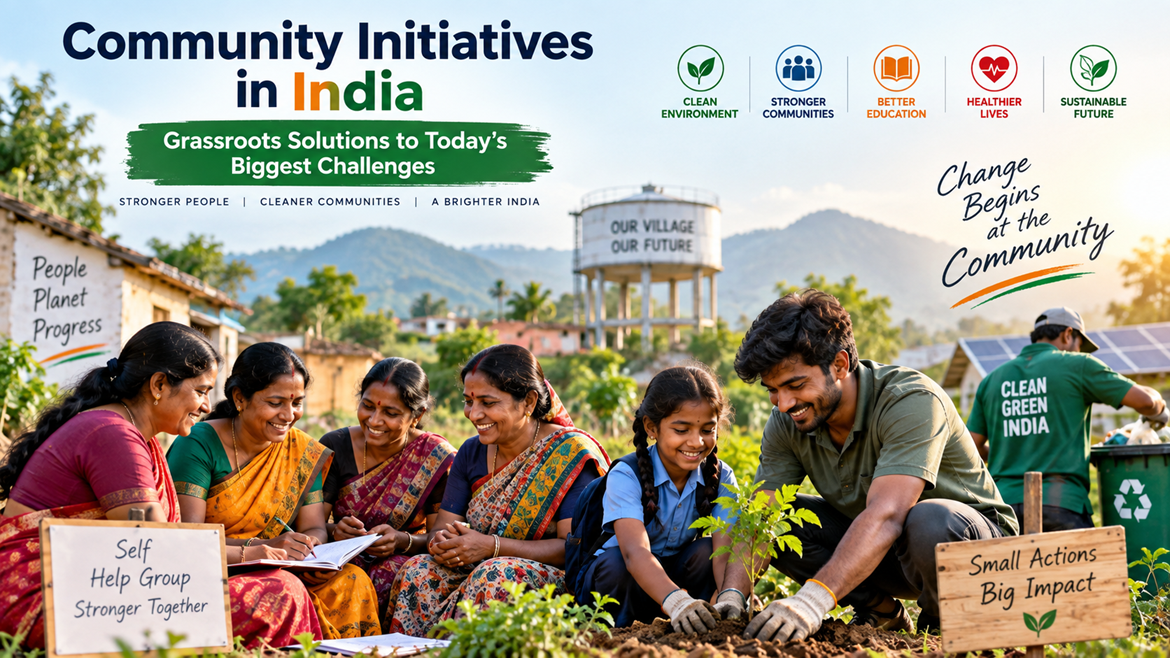
India’s development story is not shaped only by government policies, large corporations, or major infrastructure projects. Across villages, towns, neighborhoods, and local institutions, ordinary citizens are increasingly becoming part of the solution to some of the country’s most persistent challenges.
From women’s self-help groups and community-led water management to waste collection, youth networks, local climate action, and grassroots health campaigns, community initiatives in India are demonstrating how locally informed solutions can complement formal government programmed.
A defining strength of these initiatives is their proximity to the problems they seek to solve. Local residents understand seasonal water shortages, livelihood constraints, sanitation challenges, social barriers, and environmental risks in ways that outside institutions may not. When communities are given meaningful participation, resources, skills, and institutional support, they can turn local knowledge into practical action.
The scale is significant. As of August 2026, India’s Dependably Antyodaya Yojana–National Rural Livelihoods Mission (DAY-NRLM) had mobilized about 10.08 core women into 92.30 lakh Self-Help Groups (SHGs) across 28 states and six Union Territories.
What Are Community Initiatives?
Community initiatives are organized efforts in which residents, community groups, civil-society organizations, local governments, or other partners work together to address shared problems.
They can involve:
- Women’s Self-Help Groups (SHGs)
- Farmer and producer organizations
- Youth clubs and volunteer networks
- Village Water and Sanitation Committees
- Community-based environmental groups
- Local waste-management cooperatives
- Community health and education programmed
- Digital and social-innovation initiatives
The common principle is participation from the people affected by the problem.
The World Bank describes community-driven development as an approach that gives communities greater influence over planning decisions and investment resources. It has been applied to areas including sanitation, health, education, nutrition, roads, and livelihoods.
Why Grassroots Solutions Matter in India
India’s geographical, economic, and social diversity makes one-size-fits-all solutions difficult.
A water-management strategy suitable for Rajasthan may not work in Kerala. A livelihood programmer designed for an agricultural district may have limited relevance in a coastal fishing community. Local participation therefore helps adapt broader policies to local circumstances.
Local knowledge improves problem-solving
Residents often know which households need assistance, which water sources are reliable, what prevents children from attending school, and which livelihood opportunities are realistic.
This knowledge can make programmed more targeted and practical.
Collective action increases community ownership
When residents participate in planning and implementation, they are more likely to view an initiative as something they help manage rather than something delivered from outside.
That sense of ownership can be particularly important for maintaining community assets such as water systems, sanitation facilities, common land, or local enterprises.
Community networks can reach undeserved groups
Local organizations can help connect vulnerable households with government schemes, financial services, health services, education opportunities, and social protection.
UNICEF India’s work on community engagement, for example, highlights the role of local leaders, volunteers, women’s groups, farmer cooperatives, and youth networks in reaching undeserved communities.
1. Women’s Self-Help Groups: Turning Collective Action into Opportunity
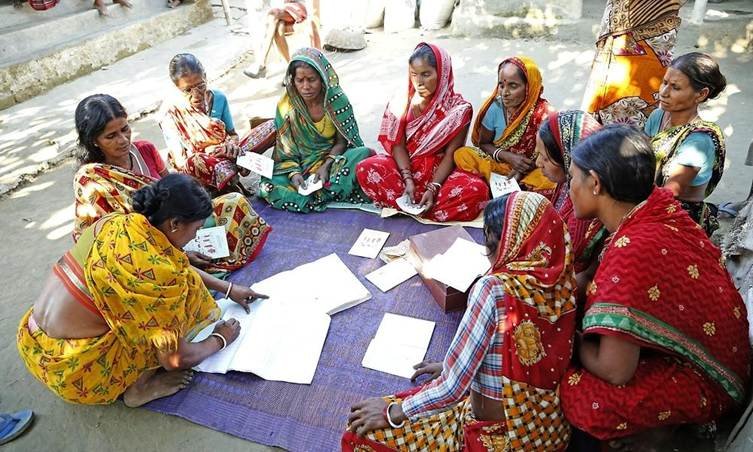
One of India’s most significant examples of grassroots mobilization is the Self-Help Group movement.
SHGs typically bring women together to save money, access financial services, build livelihoods, and collectively address social and community issues.
Under DAY-NRLM, the government focuses on social mobilization, financial inclusion, sustainable livelihoods, and social inclusion. SHGs are also connected with larger village and cluster-level institutions.
Beyond savings and credit
The role of SHGs has expanded considerably. Depending on the local programmer, women may become involved in:
- Agriculture and livestock activities
- Food processing
- Handicrafts
- Small businesses
- Financial inclusion
- Nutrition awareness
- Sanitation campaigns
- Local governance
- Community disaster response
The World Bank’s research on Indian women’s groups shows that collective participation can strengthen savings, civic inclusion, and social capital, although income and employment effects are not automatically guaranteed.
That distinction is important: community mobilization is a tool, not a guarantee of economic success. Training, market access, finance, infrastructure, and institutional support still matter.
JEEViKA in Bihar
Bihar’s JEEViKA programmer provides a useful example of how women’s collectives can be integrated into rural development. According to the World Bank, the programmer worked with more than 12 million rural women between 2008 and 2020, organizing them into more than one million SHGs while connecting communities with finance, markets, health, and nutrition interventions.
2. Community-Led Water Management
Water security is another area where grassroots participation can make a major difference.
India faces very different water challenges across regions: groundwater depletion, drought, floods, unreliable rainfall, contamination, and inadequate infrastructure.
Community-led water initiatives can combine infrastructure with local responsibility.
Rajasthan’s community water governance
UNICEF documented the transformation of Kotri, a tribal village in Rajasthan, where community participation became central to improving water security. A Village Water and Sanitation Committee played an important role in local water governance following the expansion of household tap connections.
The broader lesson is straightforward: building infrastructure is only part of solving a water problem. Communities also need mechanisms to monitor, maintain, and govern those resources.
Practical applications
Community water initiatives can include:
- Mapping local water sources
- Monitoring water quality
- Maintaining village water infrastructure
- Promoting responsible groundwater use
- Creating local water budgets
- Involving women and vulnerable households in decision-making
3. Grassroots Climate Action and Environmental Protection
Climate change is increasingly affecting agriculture, water resources, coastlines, forests, and livelihoods. Community initiatives can help translate broad climate policies into local action.
Examples include:
- Mangrove restoration
- Watershed management
- Community forestry
- Sustainable agriculture
- Water conservation
- Plastic-waste reduction
- Climate-resilient livelihoods
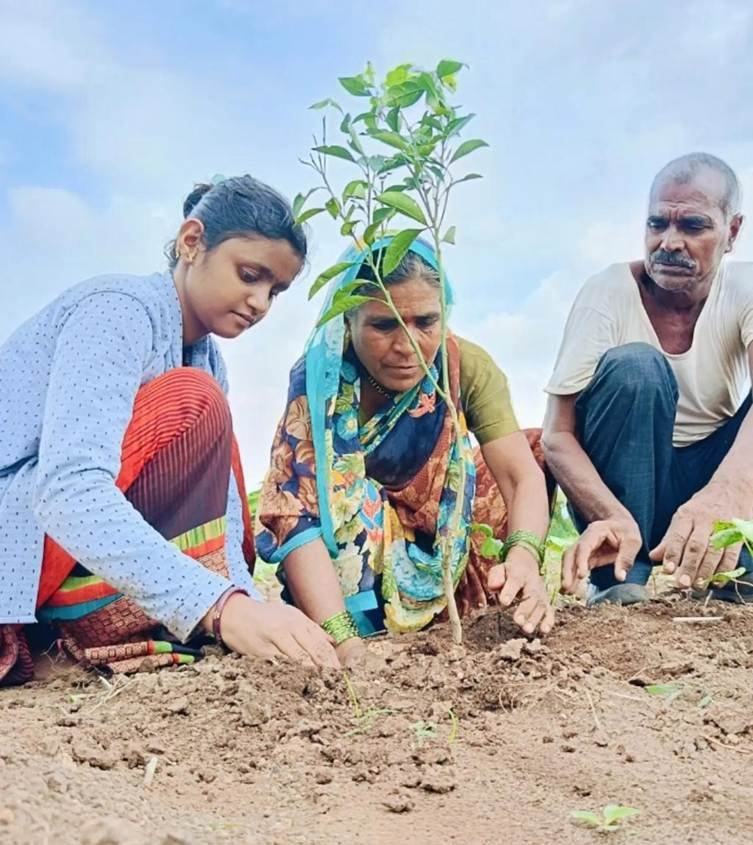
UNDP India reports that community-led projects have contributed to degraded-land restoration and climate-resilient livelihoods, while women and local community institutions are increasingly involved in climate action.
Why local climate action works differently
A farmer deciding which crops to plant, a coastal community restoring mangroves, or villagers protecting a shared water source are making decisions based on immediate environmental realities.
This local knowledge can complement scientific information and government programmed.
However, grassroots climate action should not be viewed as a substitute for national climate policy. Communities need access to finance, technology, markets, scientific expertise, and effective public institutions.
4. Community-Based Waste Management
India’s growing urbanization has made waste management an increasingly important community issue.
Local waste-management models can combine:
- Door-to-door collection
- Waste segregation
- Recycling
- Composting
- Worker cooperatives
- Public awareness
- Local entrepreneurship
Pune’s SWaCH cooperative is a notable example of organizing waste pickers into a worker-owned collection system. Such models demonstrate how environmental services can also become a pathway for livelihood creation and greater social recognition.
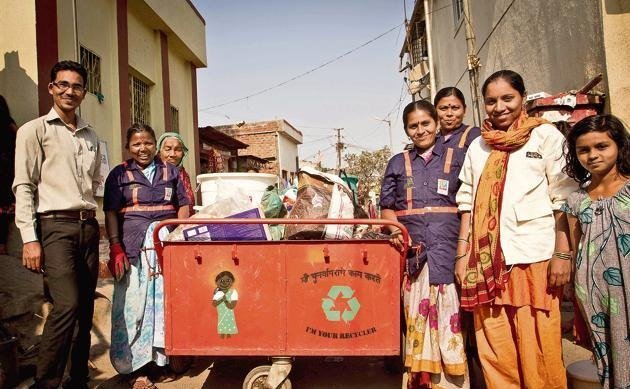
The larger lesson is that successful waste management requires more than collection vehicles and processing facilities. Household behavior, worker participation, segregation at source, and local accountability are equally important.
5. Youth-Led Community Initiatives
India’s young population represents a major potential resource for grassroots development.
Youth can contribute through:
- Digital literacy campaigns
- Environmental projects
- Community journalism
- Sports and education programmed
- Disaster preparedness
- Social entrepreneurship
- Volunteering
- Awareness campaigns
UNICEF India has documented a Community Youth Reporter Programmer in West Bengal in which young people use storytelling and local reporting to highlight issues such as child marriage, environmental degradation, and educational opportunities.
The approach illustrates an important principle: young people should not only be treated as beneficiaries; they can also be community problem-solvers and communicators.
6. Community Health and Social Awareness
Health interventions are often more effective when communities understand, trust, and participate in them.
Community networks can support:
- Vaccination awareness
- Maternal and child health
- Nutrition education
- Sanitation
- Disease prevention
- Mental-health awareness
- Access to government health programmed
UNICEF’s community-engagement work in India shows how local leaders, health workers, volunteers, and community organizations can help build trust around immunization and reach children who might otherwise remain undeserved.
This is particularly valuable in areas where distance, misinformation, social barriers, or limited awareness prevent people from accessing services.
What Makes a Community Initiative Successful?
Not every grassroots project automatically succeeds. Sustainable community initiatives generally require several complementary elements.
1. Genuine participation
People need meaningful opportunities to influence decisions, not simply participate in activities designed elsewhere.
2. Local leadership
Strong local leaders can coordinate residents, build trust, and maintain momentum.
3. Institutional support
Community groups work best when supported by responsive governments, NGOs, financial institutions, technical experts, and other partners.
Research on community-driven development emphasizes that community initiatives should complement—not replace—a capable state and effective public systems.
4. Measurable outcomes
Successful projects should track meaningful indicators such as:
- Household income
- School attendance
- Water availability
- Waste diverted from landfills
- Participation rates
- Health-service access
- Environmental restoration
- Women’s decision-making
5. Inclusion
Community initiatives should deliberately include women, low-income households, persons with disabilities, marginalized communities, and other groups that may otherwise be excluded.
Challenges Facing Grassroots Initiatives
Community action also has limitations.
Limited funding
Many local organizations struggle to secure long-term financing.
Unequal participation
Existing social hierarchies can influence who gets heard and who benefits.
Volunteer fatigue
Initiatives that rely heavily on unpaid work may struggle to maintain participation over time.
Weak monitoring
Without reliable data, it can be difficult to determine whether an intervention is actually producing lasting benefits.
Difficulty scaling
A solution that works well in one village may require substantial adaptation before being replicated elsewhere.
The answer is not to eliminate local variation but to identify principles that can be adapted to different contexts.
How India Can Strengthen Community-Led Solutions
The next stage of grassroots development should focus on connecting community knowledge with technology, finance, scientific expertise, and public institutions.
Several priorities stand out:
- Give local organizations predictable funding.
- Strengthen Gram Panchayats and community institutions.
- Expand digital and financial literacy.
- Improve access to local data.
- Build stronger partnerships between government, NGOs, universities, and businesses.
- Create better systems for measuring social impact.
- Replicate successful models while allowing local adaptation.
- Give women and young people meaningful leadership roles.
UNDP and NITI Aayog’s compilation of 75 social-sector best practices provides another useful example of documenting local solutions that can generate lessons for replication across different contexts.
The Bigger Picture: From Local Action to National Impact
Community initiatives should not be viewed as isolated charity projects. At their strongest, they form part of a broader development ecosystem.
A women’s SHG can become an economic institution. A village water committee can become a local governance mechanism. A waste cooperative can become a livelihood enterprise. A youth group can become a platform for civic participation. A community climate project can protect both ecosystems and livelihoods.
The challenge is creating the conditions in which these efforts can grow without losing their local relevance.
Conclusion
India’s biggest development challenges are too complex to be solved by governments, businesses, or communities working alone. Community initiatives provide an essential bridge between policy and everyday life.
The strongest grassroots programmed begin with local knowledge, involve the people affected, measure results honestly, and connect community action with wider institutions.
From women’s collectives and water governance to climate resilience, waste management, youth leadership, and health awareness, India’s experience shows that meaningful change can begin at the neighborhood and village level.
The future of community development is therefore not simply about doing more locally. It is about building stronger connections between citizens, local institutions, government, technology, finance, and evidence—so that solutions created close to the ground can contribute to a more inclusive, resilient, and sustainable India.
