

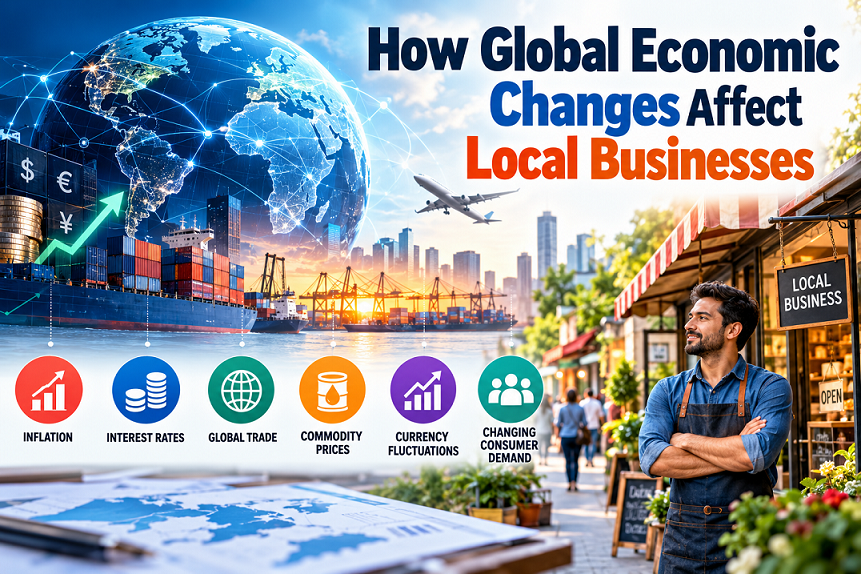
A local business may operate in one neighborhood, town, or city, but its financial environment is increasingly shaped by events happening around the world. Changes in inflation, interest rates, currency values, energy prices, international trade, supply chains, and consumer confidence can eventually influence what a local business pays, charges, sells, and earns.
Global economic changes do not affect every business in the same way. A small retailer that imports products may face higher costs when currencies fluctuate, while a local service provider may be more affected by changes in consumer spending. Understanding these connections can help business owners make better decisions about pricing, purchasing, cash flow, hiring, and growth.
The World Bank, IMF, and WTO regularly track these developments because changes in global growth, trade, inflation, and financial conditions can have effects across economies and businesses.
What Are Global Economic Changes?
Global economic changes are shifts in economic conditions that influence multiple countries or international markets. They can include:
- Changes in global economic growth
- Inflation and changes in consumer prices
- Interest-rate movements
- Currency fluctuations
- International trade policies and tariffs
- Energy and commodity prices
- Supply-chain disruptions
- Geopolitical developments
- Changes in consumer confidence
- Technological investment and productivity
These factors can move through the economy from international markets to national businesses and eventually to local shops, manufacturers, restaurants, service providers, and online businesses.
1. Inflation Can Increase Business Costs
Inflation occurs when the general level of prices rises over time. For businesses, inflation can increase the cost of inventory, transportation, rent, utilities, packaging, wages, and other operating expenses.
Consider a small restaurant that purchases cooking oil, imported ingredients, packaging, and fuel. If international commodity or energy prices increase, the restaurant may eventually face higher operating costs.
The owner then has several choices: absorb the additional cost, reduce expenses, change suppliers, adjust portion sizes, or increase prices.
Why Pricing Becomes Difficult
Businesses need to balance profitability with customer expectations.
If prices increase too quickly, customers may reduce purchases or switch to alternatives. If prices remain unchanged while costs rise, profit margins can become smaller.
This is why business owners should regularly monitor:
- Cost per product or service
- Gross profit margins
- Supplier pricing
- Transportation expenses
- Labor costs
- Customer demand
The IMF reported in 2026 that global disinflation had stalled amid renewed economic pressures, demonstrating why inflation remains an important consideration for businesses.
2. Interest Rates Affect Borrowing and Investment
Interest rates influence how expensive it is to borrow money.
A local business may need financing to purchase equipment, open another location, renovate a store, build inventory, or expand its workforce. When borrowing costs rise, these investments can become more expensive.
For example, suppose a small manufacturer plans to purchase new machinery using a business loan. A higher interest rate could increase monthly repayments and change whether the investment makes financial sense.
Higher interest rates can also affect customers. Consumers who face higher borrowing costs may have less disposable income for non-essential purchases.
Practical Business Response
Businesses can prepare by:
- Maintaining a realistic cash-flow forecast.
- Comparing financing options before borrowing.
- Avoiding unnecessary debt.
- Building an emergency cash reserve.
- Calculating the expected return on major investments.
Understanding the cost of capital is especially important for small businesses because they often have fewer financial resources than large corporations.
3. Currency Changes Can Affect Local Prices
Exchange rates determine how much one currency is worth relative to another.
A business that imports clothing, electronics, machinery, food ingredients, software, or other products may be directly exposed to currency movements.
For example, an Indian retailer importing products priced in U.S. dollars may see its purchasing costs change when the rupee moves against the dollar.
Currency movements can also affect exporters. A favorable exchange-rate movement may make exported products more competitive in foreign markets, while an unfavorable movement can reduce margins.
Managing Currency Risk
Businesses that regularly purchase internationally can consider:
- Negotiating longer-term supplier agreements
- Diversifying suppliers across countries
- Reviewing payment terms
- Monitoring exchange rates
- Pricing products with currency risk in mind
Small businesses do not necessarily need sophisticated financial instruments to manage every currency risk, but they should understand where their exposure exists.
4. Global Trade Changes Can Reach Local Shops
International trade connects businesses across countries through imports, exports, logistics, manufacturing, and services.
Trade policies can therefore affect local businesses even when those businesses never directly import or export anything.
For example, a local furniture retailer may purchase products from a domestic wholesaler. If the wholesaler depends on imported timber, hardware, machinery, or transportation services, international trade changes can eventually influence the retailer’s costs.
The WTO reported that global merchandise trade remained resilient in early 2026 but also highlighted continuing uncertainty related to trade policy, energy prices, and geopolitical disruptions.
5. Supply-Chain Disruptions Can Create Local Problems
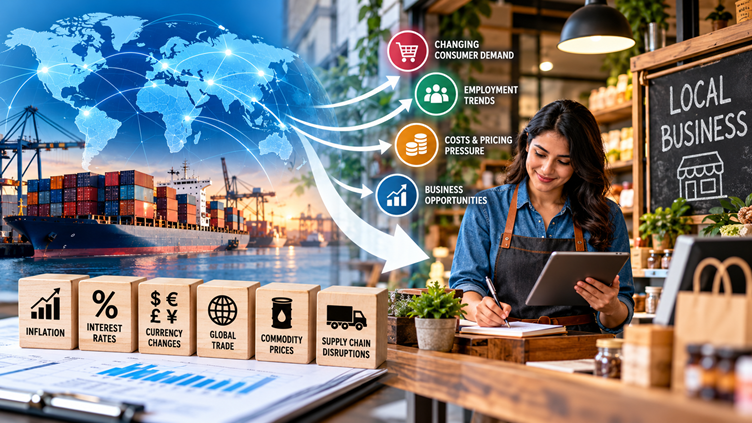
Modern supply chains often involve several countries. A product sold by a local business may contain materials manufactured in one country, assembled in another, transported through multiple ports, and finally delivered by a domestic distributor.
A disruption at any stage can create delays or increase costs.
Example: A Local Electronics Retailer
Imagine an electronics store that sells laptops and accessories. If international shipping delays affect component availability, the store may experience:
- Longer delivery times
- Reduced product availability
- Higher wholesale prices
- Difficulty meeting customer orders
- Greater inventory uncertainty
A practical response is to avoid depending too heavily on a single supplier or product source.
Businesses can also maintain appropriate safety stock for products that are critical to revenue.
6. Energy and Commodity Prices Affect Many Industries
Oil, natural gas, metals, agricultural products, and other commodities are important inputs for businesses.
Changes in energy prices can influence transportation, manufacturing, electricity, packaging, food production, and logistics.
For example, a delivery company may experience higher fuel expenses. A bakery may face higher costs for electricity, transportation, and ingredients. A manufacturer may face increased energy and raw-material expenses.
The World Bank has highlighted how energy-price movements can contribute to inflationary pressure and affect economic activity.
7. Consumer Spending Can Change Quickly
Global economic uncertainty can influence consumer confidence and spending behavior.
When households feel financially secure, they may spend more on travel, entertainment, restaurants, clothing, electronics, and other discretionary products.
During periods of economic pressure, customers may become more price-conscious.
This does not necessarily mean demand disappears. Instead, customers may change what they purchase.
For example, consumers might:
- Choose value brands
- Wait for discounts
- Buy fewer premium products
- Compare prices more carefully
- Prioritize essential goods
- Repair products instead of replacing them
Local businesses can respond by offering different price points rather than relying entirely on premium or discount positioning.
8. Technology Can Create New Opportunities
Global economic changes are not always negative for local businesses.
Technological investment can create opportunities for smaller companies to improve productivity and reach customers beyond their immediate geographic market.
Cloud software, artificial intelligence, digital payments, e-commerce, automation, and online marketing can allow small businesses to perform tasks that previously required larger teams or substantial infrastructure.
The IMF has identified technology investment and adaptability as important factors supporting global economic activity.
A local business could use technology to:
- Automate repetitive administrative tasks
- Improve inventory management
- Analyze customer behavior
- Sell products online
- Reach international customers
- Reduce marketing costs
- Improve customer support
9. Global Economic Changes Can Affect Employment
Economic conditions can influence hiring decisions.
When demand is strong and businesses are expanding, companies may hire additional employees. When sales slow, or costs rise significantly, businesses may become more cautious about adding staff.
For small businesses, workforce decisions should be connected to measurable indicators such as revenue, customer demand, productivity, and cash flow rather than short-term economic headlines alone.
Businesses can also invest in employee training so workers can handle multiple responsibilities and adapt to changing operational needs.
How Local Businesses Can Prepare
No business can control global economic conditions, but owners can improve their ability to respond.
Diversify Suppliers
Avoid unnecessary dependence on one supplier, country, or transportation route where practical.
Monitor Cash Flow
Revenue does not automatically mean healthy finances. Businesses should understand when money comes in, when bills must be paid, and how much cash is available.
Review Prices Regularly
Pricing should reflect changes in costs, customer demand, competitors, and desired margins.
Build Financial Resilience
Maintaining an appropriate cash reserve can provide flexibility during unexpected cost increases or temporary declines in sales.
Track Relevant Economic Indicators
Business owners do not need to follow every economic statistic. Instead, monitor indicators that directly affect the business, such as:
- Inflation
- Interest rates
- Exchange rates
- Fuel prices
- Supplier costs
- Consumer demand
- Industry-specific trends
Create Multiple Scenarios
Instead of preparing for only one future, businesses can create simple scenarios:
Scenario A: Costs remain stable, and demand grows.
Scenario B: Costs increase while demand remains stable.
Scenario C: Costs increase while customer demand falls.
Planning for different conditions can make decision-making faster when circumstances change.
A Simple Example of Local Economic Adaptation
Consider a small clothing retailer.
The business imports some products, purchases domestic products from wholesalers, and sells through both a physical store and an online marketplace.
A combination of currency changes, higher shipping costs, and weaker consumer spending could increase costs while reducing demand.
The owner could respond by:
- Increasing the proportion of products sourced domestically.
- Introducing several affordable product options.
- Reducing slow-moving inventory.
- Expanding online sales.
- Negotiating better supplier terms.
- Tracking profit margins by product category.
- Maintaining sufficient cash reserves.
None of these actions eliminates economic risk, but together they can improve the business’s ability to adapt.
Why Global Awareness Matters for Small Businesses
A local business does not need to become an economist to understand the global economy.
The key is recognizing which international developments have a direct connection to the company’s costs, customers, suppliers, financing, or revenue.
For a restaurant, commodity prices may matter most. For an importer, exchange rates and shipping costs may be critical. For a technology company, global technology investment and demand may matter more. For a service business, consumer spending and local employment conditions may have a greater influence.
The important question is not simply, “What is happening in the global economy?”
It is:
“Which global economic changes can affect my business, and how quickly could they reach me?”
Conclusion
Global economic changes can influence local businesses through multiple channels, including inflation, interest rates, currency movements, trade policies, supply chains, energy prices, consumer spending, and technology.
The effects are not identical for every company. A business’s industry, location, customers, suppliers, financing structure, and international exposure all determine how strongly it may be affected.
The most practical approach is to focus on controllable factors: maintain healthy cash flow, understand costs, diversify suppliers where appropriate, review pricing, monitor relevant economic indicators, and use technology to improve efficiency.
Global economic conditions will continue to change. Businesses that understand their exposure and prepare for different scenarios can make more informed operational and financial decisions, even when the wider economic environment remains uncertain.
