

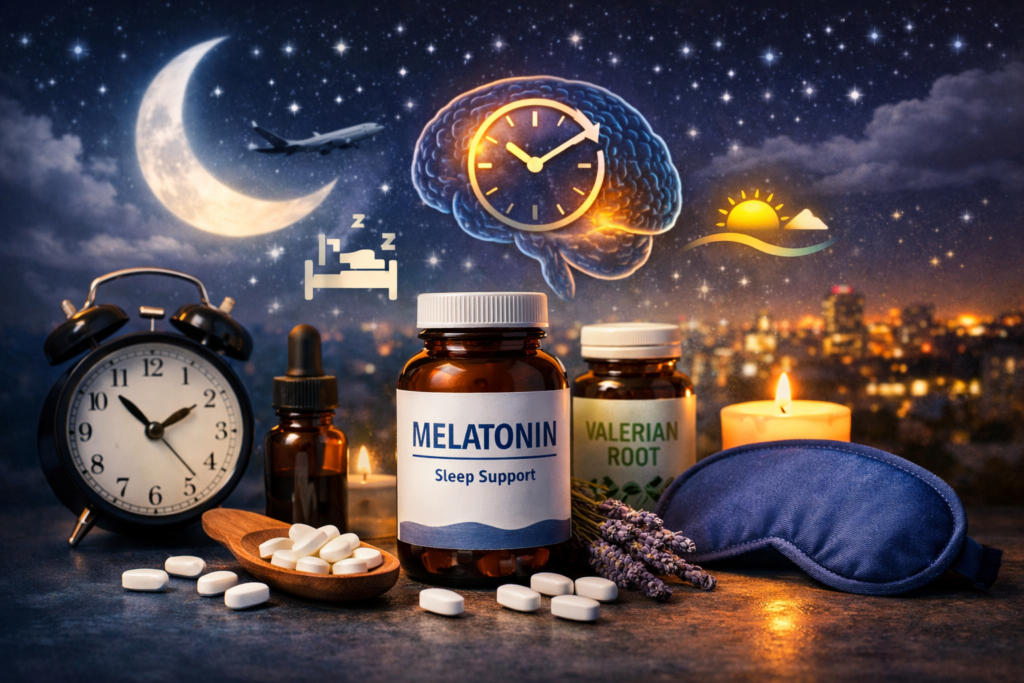
Sleep support supplements — especially melatonin — have become household names for restless nights and jet lag. But what is science actually saying about how they work, who they help, and what risks they carry? Let’s break this down with clear, evidence-based insight and practical takeaways.
What Is Melatonin?
A Natural Hormone That Signals Sleep
Melatonin is a hormone your body produces in response to darkness. It helps regulate the circadian rhythm — your internal clock that influences when you feel awake or tired. Higher levels at night promote sleepiness, and lower levels during the day help keep you alert.
Supplements Are “Exogenous” Melatonin
Melatonin used in sleep supplements is synthesized in a lab. Unlike prescription drugs, melatonin supplements aren’t regulated by global authorities like the FDA for consistency or purity, which means actual content can vary from what’s on the label.
👉 For a detailed scientific view, see the National Institutes of Health (NIH) summary on melatonin.
🔗 NIH: Melatonin – What You Need To Know – https://ods.od.nih.gov/News/Melatonin.aspx
How Melatonin and Sleep Supplements Work
Regulating Your Internal Clock
Melatonin doesn’t force you to sleep like a sedative. Instead, it nudges your internal clock to signal that it’s time to wind down. This is why timing matters: taking melatonin too late or too early can confuse your body clock instead of helping it.
Who Benefits Most?
- Delayed sleep phase syndrome (late sleep/wake times): Melatonin can shift your sleep schedule earlier.
- Occasional insomnia or travel-related jet lag: Some evidence suggests shorter sleep onset times.
- Shift workers or irregular schedules: Preliminary data show possible short-term sleep improvements.
- Blind individuals with non-24-hour sleep-wake rhythm: Stronger support exists here due to circadian rhythm regulation.
For more scientific depth, the NIH also highlights the uses and limitations of melatonin supplements.
🔗 Melatonin – Office of Dietary Supplements (NIH) – https://ods.od.nih.gov/News/Melatonin.aspx
What the Research Really Says
Modest Benefits, Not a Cure-All
Clinical studies and meta-analyses show melatonin can modestly reduce the time it takes to fall asleep and sometimes improve overall sleep quality compared to a placebo. However, effects are generally smaller than those of many prescription sleep medications.
Its effectiveness is most clear for specific conditions (jet lag, shift sleep issues, circadian disorders), but less consistent for general insomnia in adults.
Safety and Side Effects
Short-term use of melatonin appears relatively safe for most adults, with mild side effects like headache, dizziness, or daytime drowsiness. Long-term safety is not well-established, and evidence remains limited. Because supplements vary in actual dosage, products might deliver much more or less than stated — potentially increasing side effect risk.
Sleep Supplements Beyond Melatonin
Melatonin is only one piece of a broad sleep-support landscape:
- Magnesium, valerian root, and other botanicals: Evidence is mixed and often weaker than for melatonin.
- Lifestyle methods: Consistent bedtime routines, light management, and reducing nighttime screen exposure often have a greater real-world impact.
- Cognitive Behavioral Therapy for Insomnia (CBT-I): Long-term strategy with strong evidence.
Practical Tips for Using Melatonin Wisely
Start with a minimal dose
Lower doses (often 0.3–3 mg) taken 30–60 minutes before your desired sleep time usually work better than high doses — more isn’t always better.
Know When It Might Help
- Resetting disrupted sleep due to schedule changes
- Occasional sleepless nights
- Specific circadian rhythm disorders
When to Be Cautious
- Regular nightly use for chronic insomnia without physician advice
- Use in children, pregnant people, or those with complex health conditions
- Combining with sedatives or alcohol
Consult a healthcare provider for personalized dosing and guidance.
Conclusion
Melatonin and sleep supplements can be useful tools — especially for short-term issues or circadian rhythm challenges — but they’re not miracle sleep solutions. Current science shows modest benefits, variability in product quality, and ongoing questions about long-term safety. Integrating sleep hygiene and addressing lifestyle factors often plays a larger role in improving sleep than supplements alone.
Sleep better, but with informed choices.
