

Practical Advice to Improve Connections Personally and Professionally
Effective communication is one of the most important life skills. It forms the foundation of healthy relationships, productive workplaces, and strong communities. Whether you’re talking with a partner, family member, colleague, or a stranger, how you express and receive messages deeply influences outcomes. Below, we unpack evidence-based communication strategies that help people connect more effectively, reduce friction, and foster mutual understanding.
Why Healthy Communication Matters
Clear, compassionate communication strengthens bonds, prevents misunderstandings, and supports emotional well-being. Research consistently links positive communication patterns with stronger relationship satisfaction and fewer conflicts over time. Healthy communication also plays a vital role in professional settings, increasing collaboration and trust.
Core Principles of Healthy Communication
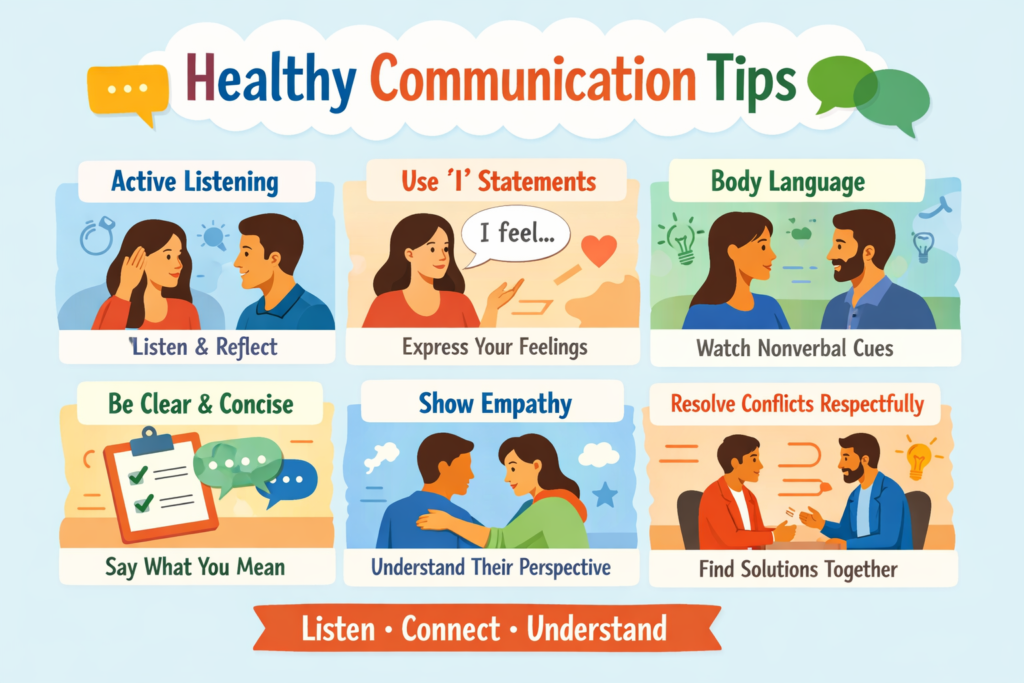
Active Listening: The Heart of Understanding
Active listening means tuning in fully to another person’s message—verbal and nonverbal—without interrupting.
- Focus completely on the speaker.
- Avoid formulating your response while they talk.
- Reflect what you heard in your own words.
Example: If someone says, “I’ve been overwhelmed with work lately,” you might reply, “It sounds like the past week has felt really stressful for you.” This shows you’re paying attention and validating their experience.
Active listening builds trust and reduces defensive responses by showing that the other person’s perspective matters.
Speak Clearly and Concisely
Clarity reduces misinterpretations. When speaking:
- Choose simple language.
- Stay focused on the main point.
- Avoid jargon or unnecessary details.
Example: Instead of a rambling explanation in a team meeting, distill your message to one or two key points to improve comprehension and retention.
Being clear and concise not only makes your message easier to receive but also shows respect for others’ time and cognitive load.
Use “I” Statements to Reduce Defensiveness
“I” statements allow you to express feelings without placing blame.
- Structure: “I feel ___ when ___ because ___.”
- Focus: your experience and needs, not the other person’s faults.
Example: “I feel worried when plans change at the last minute because I like to be prepared.”
This strategy encourages collaboration and openness rather than triggering defensiveness or conflict.
Be Mindful of Nonverbal Cues
Communication is more than words—body language, tone, and facial expressions all matter.
- Maintain appropriate eye contact.
- Use open body language.
- Match your tone to your message.
For instance, saying “I’m listening” while looking at your phone sends mixed signals. Awareness of nonverbal cues enhances trust and clarity in interactions.
Practice Empathy and Emotional Intelligence
Empathy means understanding others’ emotions and perspectives without judgment.
- Imagine yourself in the other person’s shoes.
- Validate emotions before offering solutions.
Example: “It makes sense you’d feel frustrated after that situation.”
Empathetic communication deepens connections and fosters psychological safety.
Tips for Constructive Conflict Resolution
Approach Conflict Respectfully
Disagreements are normal. What matters is how they’re handled.
- Stay calm and avoid accusatory language.
- Listen more than you defend.
- Collaborate on solutions instead of winning arguments.
Example: In a work setting, instead of saying “You’re wrong,” try “Let’s explore this different view together.”
Collaborative conflict resolution maintains respect and focuses on problem-solving, not personalities.
Check Assumptions Before Reacting
Misunderstandings often arise from assumptions. Before responding, ask clarifying questions:
- “Can you explain what you meant by that?”
- “Am I understanding this correctly?”
This reduces the chances of reacting to misunderstandings rather than real concerns.
Regular Check-Ins Build Communication Habits
In long-term relationships—whether professional or personal—regular communication check-ins reinforce connection.
Examples of check-in prompts:
- “What’s one thing we did well this week?”
- “Is there anything we can improve in how we work together?”
Scheduling this kind of dialogue prevents small issues from becoming larger problems.
Applying These Tips in Daily Life
Healthy communication isn’t only for serious conversations. It applies everywhere:
- Workplace: Clear emails, active listening, and respectful feedback improve collaboration.
- Friendships: Empathy and honest self-expression strengthen trust.
- Family: Non-judgmental dialogue creates a supportive home environment.
- Romantic partnerships: Regular check-ins and emotional validation sustain long-term satisfaction.
No matter the context, the skills above can be practiced and refined with intention and patience.
Conclusion
Healthy communication is not innate for most people — it’s a set of skills that can be learned, practiced, and strengthened over time. By listening actively, speaking clearly, expressing feelings thoughtfully, and paying attention to nonverbal signals, individuals can improve understanding, reduce conflict, and build deeper, more satisfying connections. Whether in the workplace, at home, or in social settings, these strategies help create interactions that are respectful, meaningful, and effective.
