


Customer experience (CX) has become one of the most important factors shaping how people choose, evaluate, and remain loyal to businesses. Customers no longer judge a company only by the quality or price of its products. They also consider how easy it is to find information, make a purchase, get support, resolve problems, communicate with a brand, and interact across digital and physical channels.
In fact, Salesforce reports that 80% of customers consider the experience a company provides to be as important as its products and services.
At the same time, customer expectations are changing rapidly. Digital platforms, mobile technology, artificial intelligence, social media, and increasingly personalized services have raised the standard for convenience and responsiveness.
For businesses, this means customer experience is no longer simply a customer-service responsibility. It is a company-wide strategy that can influence satisfaction, retention, reputation, and long-term relationships.
What Is Customer Experience?
Customer experience refers to the overall perception a customer develops through interactions with a company throughout the customer journey.
It can include:
- Discovering a brand through search or social media
- Visiting a website
- Reading product information
- Speaking with a salesperson
- Completing a purchase
- Receiving an order
- Contacting customer support
- Using a product or service
- Receiving follow-up communication
- Leaving feedback or a review
Customer service is therefore only one component of the broader customer experience. Salesforce describes CX as extending across interactions from initial contact through ongoing support.
A company can have an excellent product but still create a poor experience if its website is confusing, checkout is difficult, communication is slow, or customers have to repeatedly explain their problems.
Why Customer Experience Matters More Than Ever
1. Customer Expectations Are Increasing
Customers have become accustomed to convenient digital experiences. They can compare products, read reviews, communicate with companies, and switch providers with relatively little effort.
This creates a higher standard for businesses.
PwC’s 2025 Customer Experience Survey found that 70% of executives surveyed said customer expectations were evolving faster than their companies could adapt. The same research found that 29% of consumers surveyed had stopped using or buying from a brand because of poor customer experience online or in person.
For businesses, the lesson is straightforward: understanding customer expectations must be an ongoing process rather than a one-time project.
2. Experience Can Influence Customer Retention
A customer’s relationship with a company does not end after the sale. Post-purchase support, product usability, communication, billing, returns, and problem resolution can all affect whether that customer comes back.
Salesforce reports that 88% of customers surveyed said good customer service makes them more likely to purchase from a company again.
For example, imagine two online stores selling similar products at similar prices.
Store A provides clear delivery information, sends useful order updates, offers an easy return process, and quickly resolves problems.
Store B has unclear shipping information, slow responses, and a complicated returns process.
Even if both sell comparable products, the overall experience can influence which company a customer chooses for a future purchase.
3. Great CX Builds Trust
Trust develops through consistent experiences.
Customers want businesses to:
- Provide accurate information
- Keep promises
- Protect their information
- Communicate clearly
- Resolve problems fairly
- Deliver products or services as described
Small interactions can therefore have a significant cumulative effect.
A customer who repeatedly receives accurate answers and reliable service has more reasons to trust the company. Conversely, inconsistent communication can create uncertainty even when the underlying product is good.
4. Digital Experiences Are Now Part of the Brand
A company’s website, mobile experience, email communication, online checkout, social media presence, and digital support channels can all shape brand perception.
A slow website can create frustration. A confusing checkout process can discourage purchases. A poorly designed support system can make customers feel ignored.
This is particularly important because customers often experience a company through multiple channels.
For example, someone may:
- Discover a company through Google.
- Visit its website.
- Check its social media profile.
- Purchase through a mobile device.
- Receive an email confirmation.
- Contact support through live chat.
- Leave a review after receiving the product.
Each interaction contributes to the customer’s overall perception.
Personalization Is Becoming More Important
Personalization means using relevant customer information to make interactions more useful and appropriate.
Effective personalization might include:
- Relevant product recommendations
- Personalized email communication
- Remembering previous purchases
- Providing support based on customer history
- Showing appropriate content based on customer needs
However, personalization should provide genuine value rather than simply collecting data.
Customers generally benefit when a company uses information to reduce repetition or make an interaction easier. For example, a support representative who can see a customer’s previous case may be able to solve the issue without asking the customer to explain everything again.
Salesforce’s research indicates that customers increasingly expect businesses to adapt to changing needs, while many customers still report having to repeat information between departments.
The Role of Technology and AI
Technology can help businesses improve customer experience, but technology itself is not the objective.
Artificial intelligence can assist with tasks such as:
- Answering common questions
- Routing support requests
- Summarizing customer conversations
- Identifying recurring issues
- Providing product recommendations
- Helping service representatives find information
- Automating routine processes
However, automation should be designed around customer needs.
For complicated, sensitive, or unusual problems, customers may still need access to knowledgeable human employees. Salesforce’s 2025 State of Service research shows that service organizations are increasing their use of AI while maintaining customer experience as a central priority.
The best approach is often to use technology to remove unnecessary friction while allowing employees to handle situations where human judgment and empathy are valuable.
Customer Feedback Creates a Valuable Improvement Loop
One of the most practical ways to improve CX is to listen systematically to customers.
Useful sources of feedback include:
- Customer satisfaction surveys
- Product reviews
- Support tickets
- Online reviews
- Social media comments
- Sales conversations
- Refund and cancellation reasons
- Customer interviews
- Website analytics
The important step is not simply collecting feedback. Businesses need to identify recurring patterns and act on them.
For example, if customers repeatedly ask the same question before purchasing, the company could improve its product page or FAQ section.
If customers frequently complain about delivery uncertainty, clearer shipping information may solve part of the problem.
This creates a feedback loop:
Customer feedback → Identify friction → Make improvements → Measure results → Gather more feedback
Salesforce also highlights customer-service interactions as a source of information for identifying recurring problems and improving products and services.
How Businesses Can Improve Customer Experience
1. Map the Customer Journey
Start by documenting the major stages customers go through.
Consider what happens before, during, and after purchase.
At each stage, ask:
- What does the customer need?
- What information do they require?
- Where could confusion occur?
- How quickly can they receive help?
- What could make the process easier?
This exercise often reveals problems that individual departments cannot see from their own perspective.
2. Reduce Unnecessary Friction
Friction refers to anything that makes an interaction unnecessarily difficult.
Examples include:
- Too many checkout steps
- Complicated forms
- Slow websites
- Unclear pricing
- Difficult cancellation procedures
- Repeated identity verification
- Poor navigation
- Long support queues
Removing even a few unnecessary steps can make an experience considerably easier.
3. Make Support Fast and Useful
Speed matters, but speed without accuracy is not enough.
Customers generally want their problems resolved efficiently and correctly.
Businesses should therefore invest in:
- Knowledge bases
- Self-service resources
- Well-trained support teams
- Clear escalation processes
- Appropriate automation
- Consistent customer records
The goal should be resolution, not simply reducing response time.
4. Create Consistency Across Channels
A customer should not receive completely different information depending on whether they contact a company through email, phone, live chat, or social media.
Consistent policies, accurate information, and connected systems can create a smoother experience.
5. Measure What Matters
Businesses can use several metrics to understand CX performance.
Customer Satisfaction Score (CSAT): Measures satisfaction with a particular interaction.
Net Promoter Score (NPS): Measures how likely customers are to recommend a company.
Customer Effort Score (CESSPIT): Measures how easy customers found it to complete an action or resolve an issue.
Customer Retention Rate: Measures the proportion of customers a business retains over a specific period.
Churn Rate: Measures the percentage of customers who stop using a product or service.
No single metric tells the entire story. Combining quantitative measurements with qualitative feedback can provide a more complete picture.
A Practical Example of Better Customer Experience
Consider a small online clothing business.
Initially, customers frequently contact support asking about sizing, delivery times, and returns.
Instead of simply hiring more support staff, the company analyzes the questions and discovers three recurring problems.
It then:
- Adds a detailed size guide.
- Displays estimated delivery dates clearly.
- Simplifies the returns instructions.
- Creates an FAQ section.
- Trains support staff to handle unusual cases.
The result is not merely faster customer service. The company has improved the overall customer journey by addressing the underlying sources of confusion.
This illustrates an important CX principle: the best customer-service problem is often the one that can be prevented in the first place.
The Future of Customer Experience
Customer experience will continue to evolve as businesses adopt new technologies and customer behavior changes.
AI, automation, personalization, mobile commerce, self-service platforms, and omnichannel communication are likely to remain important areas of investment.
However, technology should support—not replace—the fundamentals of good CX.
Customers still want businesses to be reliable, transparent, responsive, convenient, and respectful.
The companies that treat customer experience as an organization-wide responsibility can better understand where customers encounter problems and identify practical ways to improve those interactions.
Conclusion
Customer experience matters more than ever because customers have more choices, more information, and more ways to interact with businesses than in the past.
A strong product remains important, but the experience surrounding that product can influence whether customers trust a company, return to it, recommend it, or move elsewhere.
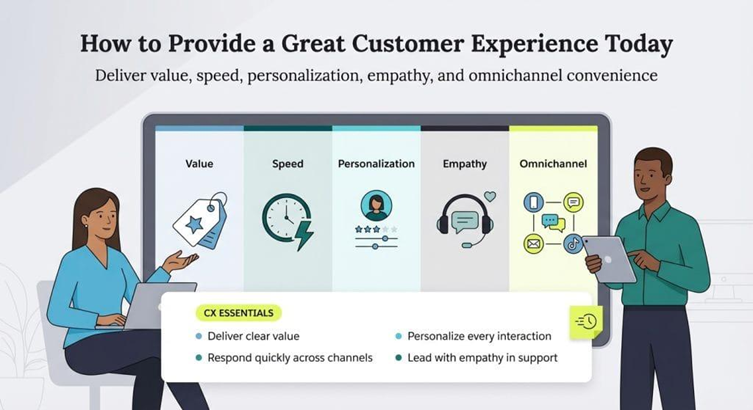
The most effective CX strategies are not necessarily about creating extravagant experiences. They are often about getting the fundamentals right: clear communication, convenient processes, reliable products, responsive support, useful personalization, and consistent interactions.
Businesses that continuously listen to customers, measure meaningful outcomes, remove friction, and improve the customer journey can build stronger relationships over time.
Customer experience is ultimately not a single department’s responsibility. It is the combined result of every interaction a customer has with a business.
