


Starting a business often begins with an exciting idea. But an idea alone does not prove that customers want the product, will pay for it, or that the business can operate profitably. Before spending significant money on inventory, software development, office space, advertising, or employees, entrepreneurs can reduce uncertainty by systematically testing the idea.
Business validation is the process of gathering evidence to determine whether a proposed product or service solves a genuine problem for a sufficiently large group of customers at a price that can support the business. The U.S. Small Business Administration recommends market research and competitive analysis as important parts of evaluating a business opportunity.
The goal is not to prove that an idea is perfect. Instead, effective validation helps you discover what needs to change—and whether the opportunity deserves further investment.
What Does Business Idea Validation Mean?
Business idea validation means testing your assumptions before committing substantial resources.
For example, suppose you want to launch a subscription service that delivers healthy snacks to office workers. You might assume:
- Office workers want healthier snacks.
- They are willing to pay for delivery.
- Companies will allow the service in their workplaces.
- Customers will order repeatedly.
- Your pricing can cover product, delivery, marketing, and operating costs.
Each assumption can be tested separately.
The SBA notes that market research can help entrepreneurs understand demand, market size, customer characteristics, competition, and pricing.
1. Clearly Define the Problem You Want to Solve
Before researching your product, define the problem.
Ask:
- What specific problem does my business solve?
- Who experiences this problem?
- How frequently does it occur?
- How are people solving it today?
- What is frustrating about existing solutions?
- Is the problem important enough for someone to pay for a better solution?
A common mistake is starting with a product rather than a customer problem.
For example, instead of saying, “I want to create a productivity app,” define the underlying problem:
“Freelancers struggle to keep track of tasks, deadlines, and client communication across multiple projects.”
This makes your validation process much more specific.
2. Identify Your Target Customer
A business idea rarely serves everyone equally well. Define your initial customer segment as precisely as possible.
Consider:
- Age or business stage
- Location
- Occupation
- Income or purchasing power
- Interests
- Existing purchasing behavior
- Main frustrations
- Where they search for solutions
For example, “small businesses” is broad. “Independent marketing agencies with 2–10 employees that manage multiple SEO clients” is much more specific.
A clearly defined audience makes customer interviews, advertising tests, competitor research, and pricing experiments more meaningful.
3. Conduct Market Research
Market research gives you evidence about the environment in which your business would operate.
Look at:
Market demand
Search for evidence that people are actively looking for solutions to the problem.
Useful sources include:
- Search engines
- Industry reports
- Customer reviews
- Online communities
- Marketplaces
- Government statistics
- Industry associations
- Google Trends
Google Trends can help you compare search interest and investigate how interest varies by location. However, remember that search interest is not the same thing as purchasing demand.
Existing competitors
Competitors can actually provide valuable validation. If businesses are already selling similar products, it demonstrates that customers are purchasing solutions in that category.
Study:
- Products and services
- Pricing
- Customer reviews
- Features
- Positioning
- Marketing channels
- Customer complaints
- Strengths and weaknesses
The SBA recommends examining direct and indirect competitors, market conditions, barriers to entry, and competitors’ strengths and weaknesses.
4. Talk to Potential Customers
One of the most valuable validation methods is speaking directly with prospective customers.
Conduct interviews with people who match your target customer profile.
Avoid asking only:
“Would you buy this product?”
People can express positive intentions without actually purchasing.
Instead, ask questions about their existing behavior:
- How do you currently solve this problem?
- What is the most frustrating part?
- How often does this happen?
- What have you already tried?
- How much does the problem currently cost you?
- Have you paid for a solution before?
- What would make you change your current solution?
The SBA identifies interviews, questionnaires, surveys, and focus groups as useful forms of direct market research.
Y Combinator similarly emphasizes launching something, talking to users, learning from their feedback, and iterating.
5. Create a Simple Value Proposition
Once you understand the customer problem, explain your proposed solution in one clear sentence.
A useful structure is:
For [target customer], our product helps [solve specific problem] by [unique approach].
For example:
“For independent consultants, our platform simplifies client reporting by automatically turning project data into branded monthly reports.”
Your value proposition should communicate the customer benefit rather than simply listing product features.
6. Test the Idea With a Minimum Viable Product
You do not necessarily need to build the complete business to test demand.
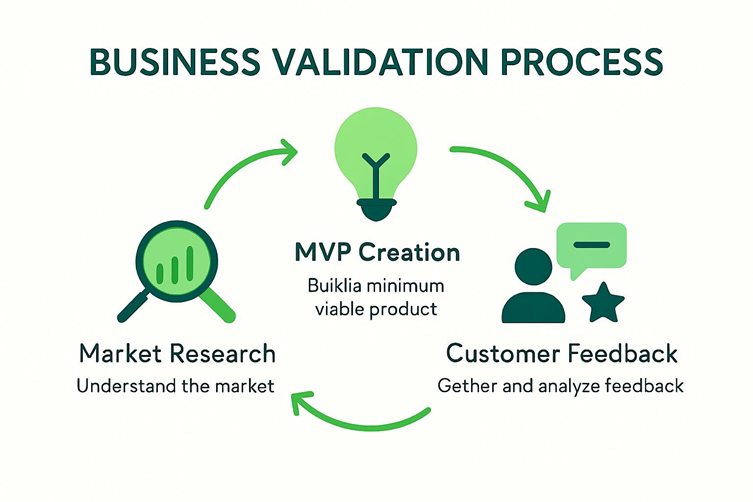
A Minimum Viable Product (MVP) is a simplified version of an offering designed to test important assumptions with real users.
Examples include:
- A landing page before building a full software product
- A manual service before developing automation
- A small product batch before ordering large inventory
- A prototype before manufacturing at scale
- A pilot consulting program before hiring a team
The SBA has specifically highlighted prototypes and smaller versions of business concepts as ways to test customer response before committing fully.
The objective is learning—not creating a polished final product.
7. Test Whether Customers Will Actually Pay
Interest is useful, but payment behavior provides stronger evidence.
Depending on your business model, you could test:
- Pre-orders
- Paid pilot programs
- Deposits
- Trial subscriptions
- Small initial purchases
- Letters of intent for appropriate B2B situations
- Paid consultations
For example, suppose 50 people say they like your proposed online course. That demonstrates interest.
If 10 of those people purchase an early-access version, you have stronger evidence of commercial demand.
However, even early sales do not guarantee long-term profitability. You still need to examine acquisition costs, delivery expenses, refunds, retention, and other financial factors.
8. Test Your Pricing
Pricing should be validated rather than chosen entirely by intuition.
Research:
- Competitor prices
- Customer budgets
- Existing alternatives
- Your cost structure
- Perceived value
- Different pricing models
You can test several price points through legitimate customer experiments.
For example:
- Basic plan: $19/month
- Professional plan: $39/month
- Premium plan: $79/month
Instead of asking customers which price they “like,” observe actual purchasing or sign-up behavior where possible.
Remember that a low price is not automatically a competitive advantage. If the price cannot cover costs, increasing sales may increase losses rather than profits.
9. Calculate the Basic Business Economics
Before investing heavily, create a simple financial model.
Estimate:
Revenue = Number of customers × Average revenue per customer
Then estimate:
Gross profit = Revenue − Direct costs
You should also investigate:
- Customer acquisition cost
- Gross margin
- Fixed operating expenses
- Break-even point
- Cash requirements
- Expected repeat purchases
- Refunds and cancellations
- Working capital requirements
For example, imagine a product sells for $50 and has $25 in direct costs. Your gross profit before other expenses is $25 per sale.
If acquiring each customer costs $30, the model needs additional analysis before scaling.
The SBA recommends calculating startup costs and considering financial requirements as part of business planning.
10. Run a Small Marketing Experiment
You can test whether your target audience responds to your positioning without launching a large marketing campaign.
Possible experiments include:
- A simple landing page
- Small paid advertising campaigns
- Organic social posts
- Email outreach
- Search-focused content
- Marketplace listings
- Local promotional tests
Track measurable actions such as:
- Landing-page visits
- Sign-ups
- Demo requests
- Email responses
- Trial registrations
- Purchases
- Cost per lead
- Conversion rate
Do not judge the entire business based on one small experiment. Instead, use the results to identify which assumptions require further testing.
11. Look for Negative Evidence
Good validation is not about collecting only positive feedback.
Pay attention when customers:
- Do not understand the offer
- Prefer an existing alternative
- Consider the price too high
- Do not experience the problem frequently
- Refuse to switch from their current solution
- Express interest but take no action
- Require expensive customization
Negative evidence can save substantial money.
If your research shows that customers do not value the proposed solution, you can change the target market, modify the product, adjust the business model, or abandon the idea before making a larger investment.
12. Use a Validation Checklist
Before committing substantial capital, review your evidence.
Customer
- Have I clearly identified the target customer?
- Have I spoken with real potential customers?
- Is the problem significant?
- Do customers currently spend money or time solving it?
Market
- Is there measurable demand?
- Who are the competitors?
- What alternatives already exist?
- What makes the proposed solution meaningfully different?
Product
- Can I test the core solution without building everything?
- Have real users tried it?
- What feedback have they provided?
Financial
- Will customers pay the proposed price?
- What are my direct costs?
- What will customer acquisition cost?
- How much capital is required before the business can sustain itself?
Evidence
- Which assumptions have been tested?
- Which assumptions remain uncertain?
- What evidence would cause me to change direction?
A Practical Example
Imagine an entrepreneur wants to launch a local meal-preparation service.
Instead of immediately renting a commercial kitchen, hiring employees, and purchasing equipment, they could:
- Interview 20–30 potential customers.
- Identify the most requested meal categories.
- Research competing services and prices.
- Create a simple menu.
- Offer a limited paid pilot.
- Measure orders and repeat purchases.
- Calculate ingredient, packaging, delivery, and marketing costs.
- Collect customer feedback.
- Adjust the menu and pricing.
- Only then consider larger investment.
This approach does not eliminate business risk, but it can replace some assumptions with evidence.
Common Business Validation Mistakes
Building too much too early
Spending months developing a sophisticated product before confirming demand can create unnecessary costs.
Asking leading questions
Questions such as “Wouldn’t this save you a lot of time?” can encourage polite agreement. Neutral questions produce more useful information.
Confusing compliments with demand
“That’s a great idea” is not equivalent to a purchase.
Ignoring competitors
Competition can reveal existing demand, customer expectations, pricing standards, and gaps in the market.
Testing only with friends
Friends and family may provide useful feedback, but they may not represent your actual customer base.
Scaling before unit economics work
More customers do not automatically create a healthier business. Understand the economics of each sale before aggressively increasing marketing expenditure.
Final Thoughts
Validating a business idea before investing money is essentially a disciplined learning process. Start by identifying a genuine customer problem, define the target audience, research the market, study competitors, interview potential customers, create a small test version, and measure real behavior.
The strongest validation usually comes from a combination of evidence rather than a single survey or conversation. Market research can establish context, customer interviews can reveal problems, MVP experiments can test usability, and actual purchasing behavior can provide evidence of commercial interest.
Most importantly, treat validation as an ongoing process. Customer needs, competitors, costs, and market conditions can change. A business idea should continue to be tested and refined as new evidence becomes available.
