

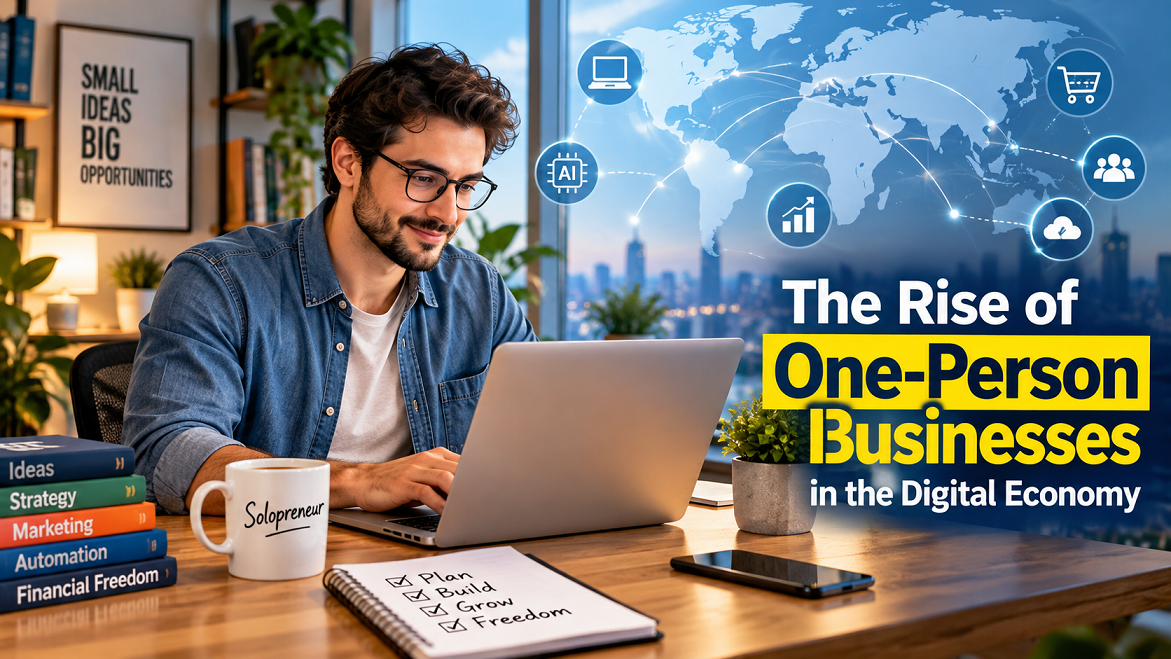
The traditional image of a successful business often includes employees, offices, departments, and significant startup capital. The digital economy is changing that model. Today, an individual with a laptop, internet connection, specialized expertise, and access to digital tools can build a business that serves customers across cities, countries, and continents.
These businesses are often described as one-person businesses, solo businesses, or solopreneur ventures. They can include freelancers, consultants, creators, online educators, software developers, e commerce operators, designers, marketers, coaches, and specialized service providers.
The scale of this segment is significant. The U.S. Census Bureau reported 29.8 million non employer businesses generating approximately $1.7 trillion in receipts in 2022. Non employer businesses have no paid employees, although the category can include partnerships and therefore should not be treated as identical to one-person businesses.
At the same time, cloud computing, online marketplaces, automation, artificial intelligence, digital payments, and social platforms have reduced many of the barriers traditionally associated with starting a business.
The result is a business environment in which expertise, distribution, technology, and personal reputation can sometimes matter more than organizational size.
What Is a One-Person Business?
A one-person business is generally a venture operated primarily by one individual rather than a conventional organization with a large employee base.
The owner may handle strategy, sales, customer relationships, product development, marketing, and administration personally. However, “one-person” does not necessarily mean doing every task manually.
A solo business owner may use:
- AI tools for research and content assistance
- Accounting software for bookkeeping
- Freelancers for specialized projects
- Cloud-based software for operations
- E commerce platforms for selling products
- Email automation for customer communication
- Online advertising for customer acquisition
- Virtual assistants for administrative work
- Payment platforms for international transactions
This distinction is important. A modern one-person business can have a small operational footprint without being technologically small.
Why One-Person Businesses Are Growing
1. Digital tools have lowered startup barriers
Starting a business once often required office space, expensive equipment, employees, and substantial administrative infrastructure.
Today, many businesses can begin with a domain name, laptop, internet connection, software subscriptions, and a relatively focused service or product.
The OECD notes that digitalisation can help smaller businesses improve processes, innovate, reach customers, and compete more effectively with larger firms. At the same time, it highlights continuing barriers such as skills gaps, limited resources, and financing constraints.
This means technology has not eliminated the challenges of entrepreneurship, but it has changed the economics of getting started.
2. Global markets are accessible to individuals
A specialist no longer needs to operate exclusively within their local market.
For example, a freelance SEO consultant in India can work with a company in the United States. A graphic designer in Europe can sell templates globally. A software developer can build a subscription product for customers in multiple countries.
Digital distribution makes this possible through websites, search engines, social media, marketplaces, online communities, and payment infrastructure.
The OECD has specifically identified digitalisation as a mechanism that can help smaller companies reach global markets and participate in international business activity.
3. Artificial intelligence is expanding individual capacity
AI is becoming another important component of the one-person business model.
A business owner can use AI-assisted tools for tasks such as:
- Brainstorming and research
- Drafting and editing
- Customer-support workflows
- Data analysis
- Software development assistance
- Marketing personalization
- Meeting summaries
- Document processing
- Workflow automation
Recent Forbes coverage has examined how AI and automation are enabling entrepreneurs to operate businesses with fewer employees and less conventional infrastructure.
However, AI should be viewed as a productivity tool rather than a replacement for business judgment. Human oversight remains important for accuracy, strategy, ethics, customer relationships, and quality control.
The Business Models Behind the Trend
One-person businesses can operate using many different models.
Freelance and professional services
Freelancing remains one of the most straightforward ways to build a solo business.
Examples include:
- SEO consulting
- Web development
- Graphic design
- Copy writing
- Accounting
- Digital marketing
- Video editing
- Business consulting
The advantage is that the entrepreneur can monetize existing expertise without developing a physical product.
Digital products
Digital products can include e books, templates, online courses, software, research reports, design assets, and downloadable resources.
Once created, some digital products can be distributed repeatedly without manufacturing another physical item for every customer.
That can create operational efficiencies, although successful distribution, customer acquisition, updates, support, and competition still require substantial work.
E commerce
Online commerce allows individual entrepreneurs to sell physical products through their own websites or third-party marketplaces.
Modern fulfillment providers can also handle parts of warehousing, shipping, and returns, allowing the owner to focus more heavily on product selection, branding, marketing, and customer relationships.
Content and audience-based businesses
Creators can build businesses around newsletters, educational content, podcasts, video channels, memberships, sponsorship’s, or communities.
In these models, audience trust becomes an important business asset.
A creator who consistently demonstrates expertise within a specific niche may eventually monetize that audience through products, services, subscriptions, or partnerships.

The Economics of Staying Small
One of the most interesting characteristics of the one-person business model is that growth does not always require a large workforce.
Traditional companies often measure expansion through employees, offices, physical assets, or geographic locations.
A digital business may instead grow through:
Better systems → more customers → higher automation → stronger margins → additional products or services
This does not mean every solo business becomes highly profitable. In fact, many remain small or part-time.
Forbes reported in 2025 that the number of U.S. non employer businesses generating at least $1 million in annual revenue had reached 116,803 in 2022, compared with 57,222 in 2021, based on Census Bureau data. These businesses are an exceptional subset of non employer businesses, not representative of the typical solo operator.
That distinction is important when evaluating headlines about “million-dollar solopreneurs.”
Practical Example: A Solo Digital Marketing Consultant
Consider a hypothetical digital marketing consultant who specializes in technical SEO.
Instead of establishing a traditional agency immediately, the consultant could:
- Build a professional website.
- Publish useful educational content.
- Develop a clear service package.
- Use LinkedIn and search engines to attract prospects.
- Schedule consultations through an online booking system.
- Use CRM software to organize leads.
- Automate invoices and payment reminders.
- Use AI-assisted research tools while reviewing the output manually.
- Outsource occasional design or development work.
- Develop digital products based on recurring customer problems.
The entrepreneur remains the central decision-maker while technology and contractors provide additional capacity.
This model can be particularly useful when customers are purchasing expertise rather than physical infrastructure.
Advantages of One-Person Businesses
Greater operational flexibility
A solo operator can often make decisions faster because fewer organizational layers are involved.
Lower fixed overhead
Without a large payroll or office infrastructure, some businesses can operate with relatively limited fixed costs.
Direct customer relationships
The person selling the service may also be the person delivering it. This can make communication and feedback more direct.
Ability to specialize
A small business can target a narrow customer segment rather than attempting to serve an entire market.
For example, “marketing services” is broad, while “SEO for independent accounting firms” is much more specific.
Faster experimentation
An individual can test a new offer, landing page, pricing structure, or marketing channel without coordinating a large team.
The Challenges of Going Solo
The one-person model also has limitations.
Capacity constraints
There are only so many hours in a day. Increasing customers without improving systems can quickly create operational pressure.
Revenue concentration
If most income comes from a handful of customers, losing one major client can significantly affect the business.
Skill limitations
A talented entrepreneur may still need expertise in accounting, legal compliance, cybersecurity, marketing, sales, or technology.
Burnout risk
When the owner is responsible for virtually every important decision, it can become difficult to separate work from personal life.
Forbes coverage of micro businesses has highlighted work-life balance as a significant challenge for entrepreneurs, including solopreneurs.
Security and compliance
Digital businesses are not automatically low-risk businesses. Entrepreneurs handling customer information, payments, or confidential business data need appropriate cybersecurity, privacy, backup, and compliance practices.
How to Build a Sustainable One-Person Business
Start with a specific problem
Instead of asking, “What business should I start?” consider:
Which valuable problem can I solve better or more conveniently for a specific customer group?
Specific positioning makes marketing easier and helps potential customers understand the value being offered.
Create repeatable processes
Document recurring activities such as:
- Lead generation
- Client on boarding
- Project delivery
- Invoicing
- Customer support
- Content publishing
Processes make it easier to automate or outsource repetitive work later.
Use technology selectively
More software does not automatically create a better business.
Choose tools that solve genuine operational problems. A simple technology stack that the owner understands is often more useful than dozens of disconnected applications.
Build owned distribution
Social media can help build visibility, but entrepreneurs should also consider assets they control, such as a website, email list, customer database, or community.
This can reduce dependence on a single platform.
Track business fundamentals
Revenue alone does not tell the complete story.
A solo entrepreneur should monitor:
- Revenue
- Profit
- Customer acquisition cost
- Customer retention
- Average transaction value
- Cash flow
- Time spent per customer
- Revenue concentration
These metrics help reveal whether the business is actually becoming more sustainable.
The Future of One-Person Entrepreneurship
The digital economy is making it increasingly practical for individuals to combine specialized knowledge, digital distribution, automation, and external services.
Forbes has described this development as the rise of the “industry of one,” pointing to cloud infrastructure, automation, and AI as technologies that can allow individuals to perform work that previously required larger organizations.
However, the future is unlikely to be simply “everyone works alone.” Many successful solo businesses will continue to rely on contractors, agencies, freelancers, software providers, professional advisers, and strategic partners.
The more realistic development is a shift toward small, flexible business ecosystems in which one person remains the core operator while technology and external specialists provide additional capabilities.
Conclusion
The rise of one-person businesses reflects a broader transformation in how businesses can be created and operated. Digital platforms have expanded access to customers, cloud services have reduced infrastructure requirements, and automation and AI can increase the amount of work one person can manage.
But technology does not eliminate the fundamentals of entrepreneurship. A sustainable business still needs a genuine customer problem, valuable products or services, effective marketing, sound financial management, reliable operations, and trust.
The biggest change is that business scale and organizational size no longer have to move together. A focused individual can build a specialized business, serve customers internationally, and use technology to extend their capabilities without immediately creating a large organization.
For aspiring entrepreneurs, that creates a different starting point: instead of asking how many employees a business needs, they can first ask what valuable problem they can solve, who needs the solution, and which digital systems can help them deliver it efficiently.
